Why Understanding Onsite IT Support Matters for Your Business
What does onsite services mean in the IT world? It’s technical support from a qualified technician who travels to your physical location—your office, data center, or worksite—to resolve technology issues in person. Unlike remote support, which connects to systems over the internet, onsite service involves direct, hands-on interaction with your hardware and infrastructure.
Quick Definition:
- Onsite services = IT support provided at your business location by a technician who is physically present
- Core purpose = Resolve issues that require direct access to hardware, networks, or equipment
- Key difference = Remote support handles software and connectivity issues from afar; onsite support tackles physical infrastructure, complex deployments, and hardware failures
When your server crashes or your network fails, a remote session often isn’t enough. Onsite IT services are critical to minimize disruption and restore operations quickly by providing the hands-on expertise certain situations demand.
Many businesses find their IT provider is slow or unavailable when a physical problem strikes. For firms handling sensitive data, like Houston-area tax and accounting practices, onsite support is a strategic necessity. Whether setting up an office in Katy, responding to a network outage in Sugarland, or ensuring data security compliance in Conroe, reliable onsite support prevents minor hiccups from becoming critical failures.
I’m Orrin Klopper, CEO of Netsurit. For 30 years, I’ve built IT service teams that help businesses with everything from emergency hardware failures to planned infrastructure deployments. This guide explains when you need onsite support, how it compares to remote alternatives, and how to choose the right provider for your firm.
What Does Onsite Services Mean in an IT Context?
P
In IT, what does onsite services mean is simple: a qualified technician travels to your location to resolve technology problems in person. By definition, on-site means located at the place of use. This isn’t about convenience; it’s about hands-on support that requires a physical presence. When a server won’t power on or you need to trace a network cable, you need a technician in the room who can physically inspect and repair the equipment.
The value of onsite service is direct interaction with your IT environment. A technician can spot issues invisible on a screen—like an overheating server room or an unplugged cable—and provide immediate hardware access for repairs, upgrades, and installations that can’t be done remotely.
What does onsite services mean for physical hardware and networks?
The clearest need for onsite support is when something physical breaks or needs to be built. Key tasks include:
- Hardware Failure: Replacing failed hard drives, power supplies, or other components in servers and workstations.
- Network Installation: Mounting switches, configuring routers, and running cabling for new offices or infrastructure expansions.
- Server Maintenance: Physically replacing RAM, swapping drives, or racking new equipment.
- Workstation Setup: Configuring new employee desks with docking stations, multiple monitors, and peripherals.
- Cabling Issues: Tracing and repairing loose or damaged cables and ports that can disrupt network segments.
Example: A tax firm in Katy, TX, must install a new, physically isolated server to meet data security standards. An onsite technician handles the entire physical installation—racking the server, running dedicated network cables, and integrating it into a separate network segment—ensuring the infrastructure’s integrity and security.
Onsite vs. Remote Support: A Clear Distinction
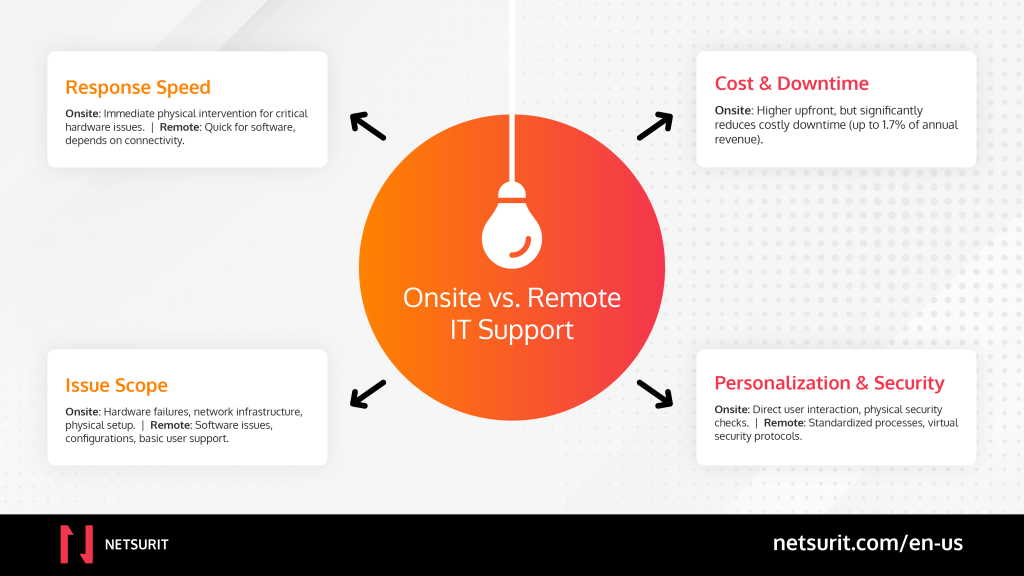
Knowing when to use onsite versus remote support saves time and money. They solve different types of problems.
Table
| Feature | Onsite IT Support | Remote IT Support |
|---|---|---|
| Definition | Technician physically present at your location. | Technician accesses your systems remotely over the internet. |
| Problem Type | Hardware failures, network installations, physical cabling, complex infrastructure. | Software issues, system updates, network configuration changes, user support. |
| Response Time | Slower initial response due to travel; immediate resolution once on-site. | Faster connection (often within minutes); any available technician can respond. |
| Cost Structure | Higher due to travel time, labor, and overhead. | Lower; optimizes technician time and eliminates travel costs. |
| Security | Direct physical access in a controlled environment; requires vetted technicians. | Relies on secure remote access tools; potential risk if platforms aren’t hardened. |
| Best Use Cases | Critical infrastructure failures, new office setup, hardware repairs and upgrades. | Software troubleshooting, routine maintenance, user training, quick fixes. |
| Personal Touch | High; direct interaction, hands-on training, environmental observation. | Lower; interaction via screen share, chat, or voice only. |
| Observation | Technician can spot physical issues—unplugged cables, overheating equipment, environmental hazards. | Limited to what’s visible on screen; cannot assess physical conditions. |
Onsite support is direct and personal, ideal for critical infrastructure and urgent physical repairs. Remote support excels at speed and flexibility for software issues and routine tasks. At Netsurit, we often use remote IT support for initial triage before dispatching an onsite technician when physical access is required.
Pinpoint When Your Firm Needs Hands-On IT Support
Knowing when to call for onsite support is critical. For tax and accounting firms, where downtime equals lost billable hours, recognizing these moments prevents minor issues from becoming business-critical failures. A slow computer might be a software glitch, but it could also be a failing hard drive that requires immediate physical replacement.
Critical Scenarios Demanding Onsite Intervention
Certain situations demand a technician on-site, as remote diagnostics are ineffective for:
- Complete Network Failures: When the entire office is offline, a technician must physically inspect switches, routers, and cabling to find the failure point.
- Server or Storage Crashes: If a server won’t boot or a storage array shows critical errors, hands-on diagnosis is required to replace components or restore data from local backups.
- New Office IT Setup: Building infrastructure from the ground up—racking servers, running cables, and configuring workstations—is a physical job.
- Physical Security Investigations: If you suspect tampering or find physical damage to equipment, an onsite team must secure the area, document evidence, and implement safeguards.
- Hardware Upgrades: Deploying new desktops, replacing firewalls, or upgrading RAM across multiple machines is more efficient with an onsite technician.
Example: An accounting firm in Sugarland, TX, has a network outage on the last day of a tax quarter. An onsite technician arrives, traces the fault to a failed switch, and replaces it. Operations are restored before the filing deadline, preventing financial penalties and reputational damage.
How Onsite Support Boosts Firm Productivity
Beyond emergencies, onsite support boosts firm productivity by:
- Minimizing Downtime: Technicians can troubleshoot multiple physical and software issues simultaneously, resolving complex problems faster than remote back-and-forth.
- Reducing Billable Hour Loss: Quick resolution gets your accountants back to client work faster, protecting revenue during critical periods like tax season.
- Providing Hands-on Staff Training: An onsite technician can offer personalized training on new tools, answering questions and troubleshooting issues on the spot to speed up adoption.
- Enabling Proactive Maintenance: During visits, technicians can visually inspect server rooms and spot physical risks like overheating or fraying cables before they cause failures.
- Improving Employee Morale: Knowing expert help can be physically present reduces stress and lets your team work with more confidence.
Example: An onsite technician at a Conroe accounting practice provides in-person training for a new software rollout. This personalized approach accelerates user adoption and reduces help desk tickets by 40% in the first month.
Trade-offs to consider:
- Works best when: You manage critical on-premises infrastructure, handle sensitive data, or need to resolve hardware failures impacting multiple users.
- Avoid when: The issue is purely software-related, affects only remote employees, or can be solved with simple phone guidance.
- Risks: Higher per-hour cost; technician availability can be a bottleneck without a service agreement.
- Mitigations: Use a hybrid model that triages with remote IT support and escalates to onsite presence only when necessary. This approach optimizes both cost and response time. The best IT support services ensure you’re covered for both.

The Financial Equation: Cost vs. Value
Onsite support costs more per hour than remote help due to travel and overhead. But you’re buying immediate resolution for problems that can’t be fixed from afar. Providers typically offer three pricing structures:
- Managed Services Plans: Bundle onsite visits with remote support for a predictable monthly cost. This is our recommended approach as it focuses on prevention.
- Per-Incident Pricing: The “break-fix” model charges for each visit. It seems affordable until a crisis hits and you pay premium rates.
- Project Fees: Best for defined work like a new office setup or server migration.
Now, consider the cost of downtime. For an accounting firm, a server outage costs more than just the technician’s time; it includes missed deadlines, penalty fees, and reputational damage. An hour of downtime can cost professional services firms thousands in lost billable hours alone.
This is where onsite services deliver their real ROI. A $500 visit that prevents tens of thousands in losses by quickly replacing a failed hard drive is a bargain. Remote teams can’t replace a power supply or trace a faulty cable. For firms managing sensitive financial data, onsite support is a core business expense, like insurance.
The Trade-Offs: Choosing Your Support Model
Your support model depends on your infrastructure, risk tolerance, and need for control.
- Onsite-heavy models are essential for firms with complex, centralized hardware and strict physical data security requirements, like a tax firm in Katy.
- Avoid onsite support for purely software-related issues or for remote employees, where remote support is faster and cheaper.
- The risk of an onsite-only approach is high cost and potential technician bottlenecks during emergencies.
- The smart mitigation is a hybrid model. Partner with a provider like Netsurit that uses Remote IT Support for initial triage and dispatches an onsite technician only when necessary. This balances cost with rapid response for physical issues. For a deeper look at integrated approaches, explore our Managed IT Services offerings.
Select the Right Onsite Service Provider for Your Firm
Choosing an onsite IT provider is a critical decision. For Houston firms handling sensitive financial data, this partner gains physical access to your most critical assets. The right provider acts as an extension of your team, understanding your infrastructure and anticipating problems.
What does onsite services mean when choosing a provider?
When evaluating providers, look beyond hourly rates. Key criteria include:
- Guaranteed Response Times: Your Service Level Agreement (SLA) must specify how quickly a technician will arrive for critical issues (e.g., “onsite within four hours”). For a tax firm on April 14th, this is non-negotiable.
- Relevant Experience and Certifications: Look for industry certifications (Microsoft, Cisco) and, more importantly, experience with businesses like yours. A provider who has secured networks for other accounting firms understands your compliance needs.
- Client Testimonials: Reviews and references should confirm the provider resolves complex problems, communicates clearly, and meets promises. Look for feedback from similar firms in the Houston area.
- Scalability: Can the provider support your growth, like a second office in Conroe or a major infrastructure upgrade? A good partner scales with you.
- Local Presence: A provider with technicians based in the Houston area can get to your Katy office quickly. They understand local challenges and have relationships with regional vendors. Our Onsite IT Support Services are built on this principle.
Understanding Service Level Agreements (SLAs)
An SLA is your written promise for service. For firms where downtime is expensive, a strong SLA is essential. Key components to scrutinize include:
- Response vs. Resolution Time: Response time is how quickly help is dispatched; resolution time is how long until the problem is fixed. A Houston tax firm might need a four-hour response guarantee with an eight-hour resolution target for critical failures.
- Guaranteed Uptime: A 99.9% uptime SLA still allows over eight hours of downtime per year. Clarify what systems this covers and what happens if the provider misses the target.
- Penalties for Failure: A strong SLA includes financial credits or service adjustments if the provider fails to meet its commitments. Without penalties, an SLA is just a wish list.
- Business Hours: Clarify if support is 24/7 or restricted to specific hours, especially during critical periods like tax season. A Conroe firm working on a weekend needs to know if help is available.
The best providers, like Netsurit, build SLAs around your business reality, not just industry averages. To see how we support Houston’s professional services landscape, visit our IT Support Houston page.
Frequently Asked Questions about Onsite IT Services
Is onsite support more expensive than remote support?
Yes, the hourly rate for onsite support is higher to cover travel and hands-on skills. However, the total value often outweighs the cost. For a Katy accounting firm, a $500 onsite visit that prevents $5,000 in lost revenue from downtime is a smart investment. The most cost-effective approach is a hybrid model, often included in Managed IT Services plans, which uses remote support for routine issues and reserves onsite visits for critical physical problems.
What types of issues can only be fixed with onsite support?
Remote support can’t physically touch your equipment. Onsite intervention is required for:
- Hardware Replacement: Swapping out failed server components, dead power supplies, or faulty workstation parts.
- Network Cabling Issues: Repairing a severed cable, a loose connector, or a misconfigured patch panel.
- Physical Device Setup: Installing and configuring new workstations, printers, or specialized equipment during an office move or expansion.
- ISP Coordination: Having your IT expert on-site when your internet provider’s technician visits ensures proper testing and prevents vendor finger-pointing.
Do I need a dedicated onsite team or can I use it on-demand?
The answer depends on your firm’s size and risk tolerance.
- A dedicated onsite team is usually only cost-effective for very large organizations.
- An on-demand (break-fix) model seems cheap but can lead to slow response times and high costs during a crisis.
- A managed services provider with a hybrid approach is the practical middle ground. You get proactive remote support and an onsite technician who already knows your environment when needed. Our IT Help Desk Support serves as your first line of defense, escalating to onsite resources efficiently.
Conclusion
When your server crashes on the last day of tax season, what does onsite services mean becomes clear: it’s the difference between meeting a deadline and losing a client. Onsite IT support—a technician physically present at your location—solves critical problems that remote support can’t, from hardware failures to network installations.
For professional services firms in Houston, Sugarland, and Katy, the value of preventing costly downtime far outweighs the per-visit cost of an onsite technician. The smartest strategy is a hybrid one: use efficient remote support for software glitches and deploy onsite experts for physical infrastructure work. When choosing a partner, prioritize guaranteed response times in your SLA and a strong local presence. A provider who understands the compliance needs of Texas accounting firms and can be at your office quickly is an invaluable asset.
Your IT should enable growth, not constrain it. To build a resilient strategy that blends remote efficiency with essential onsite response, explore a comprehensive Onsite IT Support Services plan. The right partner gives you the confidence to focus on your clients, not your technology.