



Businesses rely heavily on their IT infrastructure to stay competitive. A poorly managed IT environment can lead to disruptions, security issues, and even a loss of productivity. 94% of businesses report that a single hour of downtime can cost them over $100,000. This statistic highlights the importance of having the proper IT support.
| Orrin Klopper, CEO of Netsurit, says, “Choosing the right IT support and help desk services can make or break the efficiency of your business operations.” |
This blog will explore the differences between help desk and IT support, explain how they work together, and help you decide which is best for your business.
Get Reliable IT Support for Your Business
Keep your systems secure, operational, and efficient with customized support solutions Learn More
What is IT Support and What Does It Do?
IT support is a strategic, all-encompassing service designed to keep your entire technology ecosystem running efficiently, from physical hardware to software applications.
Unlike the help desk, which handles immediate user concerns, IT support takes a proactive role in managing and maintaining your organization’s whole IT infrastructure.
Key responsibilities of IT support include:
- Network Management – Safeguards and maintains your business network to ensure stable and secure connectivity.
- Cybersecurity Measures – Implements protective tools and practices to defend your systems against malware, data breaches, and other cyber threats.
- System Performance Tuning – Enhances the efficiency of both hardware and software to maintain optimal operations at peak performance.
- Advanced Troubleshooting – Diagnoses and resolves complex technical problems that go beyond everyday user issues.
By focusing on prevention rather than reaction, IT support plays a crucial role in maintaining uptime, safeguarding business data, and ensuring long-term operational stability. A well-structured IT support framework is essential for minimizing risk and ensuring uninterrupted productivity.
What is a Help Desk, and What Does It Do?
On the other hand, a help desk is the primary point of contact when employees or customers encounter problems.
Helpdesk agents have a 45.1% utilization rate, spending nearly half their workday actively supporting users. It’s typically the go-to service for quick troubleshooting, fixing common issues, and providing assistance with everyday tech challenges.
A help desk serves as the frontline of technical support, providing immediate assistance for routine IT issues that employees or customers may encounter. Its primary goal is to resolve problems quickly and keep day-to-day operations running smoothly.
Core functions of a help desk include:
- Basic Troubleshooting – Addresses common issues, including password resets, printer malfunctions, and software errors.
- Ticket Management – Utilizes a structured ticketing system to log, prioritize, and track support requests from start to resolution.
- Remote Assistance – Delivers prompt support through remote access tools, eliminating the need for onsite visits.
- User Training and Guidance – Helps employees become more confident and efficient with software tools and systems.
While help desk teams excel at resolving immediate, user-level issues, they typically do not handle more technical or system-wide challenges.
Those cases are escalated to the IT support team. Nevertheless, a well-organized help desk significantly enhances employee productivity and satisfaction by reducing downtime and ensuring quick resolutions.
| More articles you might like: |
Help Desk vs IT Support: Key Differences
Now that we’ve covered what each service does, let’s explore the key differences between help desk and IT support. This comparison will help you understand where each service fits into your business.
Scope of Services: Help Desk vs. IT Support
One of the most notable distinctions between IT support and the help desk lies in the breadth of their responsibilities.
IT support provides a wide-ranging, proactive approach to managing an organization’s entire IT infrastructure. This includes essential services such as network administration, cybersecurity implementation, system monitoring, and hardware maintenance.
On the other hand, the help desk is more focused on reactive, day-to-day support, assisting users with immediate technical problems such as login issues, software bugs, or device glitches.
Examples:
- IT Support may resolve a server crash, implement regular backups, or install security patches to prevent threats.
- Help Desk may assist a staff member with a software installation error or guide them through a password reset.
While both functions are vital to a well-rounded IT strategy, IT support ensures long-term stability and risk mitigation. In contrast, the help desk ensures smooth daily operations by resolving issues rapidly.
Engagement with Users
Another significant difference between help desks and IT support lies in how they interact with users. The help desk serves as the primary point of contact, directly assisting employees and customers with their immediate technical concerns. Whether it’s answering questions, resolving issues, or offering step-by-step guidance, help desk agents are prominent and accessible.
In contrast, IT support works more behind the scenes, maintaining the core systems and infrastructure that power the organization’s technology. Their role is less about direct user engagement and more about maintaining networks, servers, and security protocols in the background to ensure smooth operation.
Think of the help desk as your frontline responders, quickly addressing day-to-day issues. At the same time, IT support acts as the engineering team, ensuring everything behind the curtain is stable, secure, and optimized to prevent future disruptions.
Being Proactive vs Reactive
A key distinction between a help desk and IT support lies in how they address technical challenges. IT support takes a proactive approach, continuously monitoring systems to detect and resolve issues before they escalate. This includes tasks like performing routine updates, applying security patches, and conducting network performance checks—all designed to prevent downtime and maintain system integrity.
On the other hand, the help desk operates reactively, intervening only after a problem has been reported. Whether it’s assisting a user with a software crash or troubleshooting a malfunctioning device, the help desk is focused on resolving existing issues as quickly as possible.
While the help desk is essential for real-time support, IT support ensures your infrastructure stays resilient and optimized over the long term, making both roles critical for comprehensive IT management.
The Benefits of Both IT Support and Help Desk Services
Both IT support and help desk are essential for a healthy IT environment. While their roles differ, they collaborate to provide a seamless experience for employees and customers.
Why Businesses Need IT Support
Investing in IT support is essential for maintaining a secure, efficient, and reliable technology environment. IT support professionals play a crucial role in safeguarding your operations and minimizing disruptions, enabling your team to stay focused on achieving your business goals. Here’s how IT support benefits your organization:
- Cybersecurity Protection – On average, there is a hacker attack every 39 seconds. Defends your systems against cyberattacks, malware, and data breaches, helping to prevent costly security incidents.
- Proactive Network Monitoring – Continuously tracks network activity to detect and address potential issues before they impact operations.
- System Maintenance and Upgrades – Keeps hardware and software up to date, ensuring peak performance and long-term reliability.
With the proper IT support in place, your business can stay ahead of threats, reduce downtime, and maintain a competitive edge.
Why You Need a Help Desk
While IT support handles the broader infrastructure, a help desk is vital for maintaining daily productivity. Without it, employees are left to troubleshoot issues on their own, leading to wasted time, frustration, and decreased efficiency. A reliable help desk ensures your team gets the quick assistance they need to stay focused and effective.
Key benefits of having a help desk include:
- Fast Issue Resolution – Provides immediate support for common technical problems, reducing downtime.
- Everyday Tech Support – Assists with routine issues like software glitches, login problems, and device errors.
- Improved Customer Service – Ensures both internal and external users receive timely and helpful responses to their technical concerns.
By combining help desk responsiveness with IT support’s long-term strategy, businesses can operate more smoothly, minimize disruptions, and focus on scaling with confidence.
Help Desk vs Service Desk: What’s the Difference?
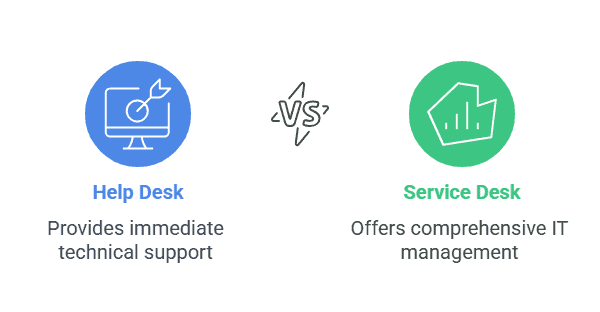
There’s also the service desk to consider. Though it may sound similar to a help desk, a service desk tends to be more formal and structured. It integrates into the broader IT service management framework and often covers everything from incident management to service requests.
While a help desk focuses primarily on immediate technical support, the service desk may handle software provisioning, IT asset management, and change requests.
A service desk may be more suitable for businesses with complex IT environments. However, for most small and medium-sized companies, the help desk and IT support roles are sufficient.
How Help Desk and IT Support Work Together
While IT support and help desk have different roles, they work together to create a comprehensive IT solution. When issues arise, the help desk can escalate more complex problems to the IT support team for resolution.
For example, if an employee experiences a network outage, the help desk will first troubleshoot fundamental issues. If the problem persists, they’ll escalate the case to IT support, who will investigate the network issues further to find a solution.
This collaboration ensures that your business always has the support it needs, whether for immediate help or long-term IT management.
How Help Desk and IT Support Contribute to Your Business Growth
While we’ve covered the differences between IT support and help desk, another critical aspect is how each service impacts your business growth. Beyond handling issues, both help desk and IT support contribute significantly to your business’s productivity, efficiency, and overall success.
Let’s see how these services support business growth:
| Category | Help Desk | IT Support |
| Primary Function | First point of contact for technical issues | Comprehensive management of IT infrastructure |
| Scope of Services | Day-to-day troubleshooting and user assistance | Network, cybersecurity, systems, and infrastructure management |
| Approach | Reactive – addresses issues as they occur | Proactive – prevents issues before they arise |
| User Interaction | High – directly supports users and resolves basic queries | Low – works behind the scenes to keep systems running |
| Examples of Tasks | Password resets, software glitches, printer issues | Server maintenance, network monitoring, data backup, system optimization |
| Resolution Speed | Quick fixes for common problems | Longer-term solutions for complex or systemic issues |
| Escalation Role | Escalates more complex issues to IT support | Handles escalated and advanced technical problems |
| Tools Used | Ticketing systems, remote support software | Monitoring tools, cybersecurity solutions, backup and recovery systems |
| Impact on Productivity | Keeps employees productive by resolving minor issues quickly | Minimizes downtime and maximizes performance of IT systems |
| Business Value | Enhances user experience and daily efficiency | Strengthens IT resilience and supports long-term business growth |

Choose Netsurit for Reliable IT Support and Help Desk Services
The decision between IT support and help desk comes down to your business’s needs. While IT support handles your overall IT infrastructure, keeping everything secure and running smoothly, the help desk is there for immediate, user-level support.
With over 27 years of experience and a team of more than 450 dedicated professionals, Netsurit delivers reliable IT support and help desk services tailored to meet your unique technology needs. Our comprehensive approach ensures your business stays secure, efficient, and future-ready—so you can focus on growth while we handle the tech.
|
Reliable Managed IT Services Near You |
Don’t let technology issues slow you down. Contact us today to schedule a consultation and see how we can help you.
