Why AI Automation Is No Longer Optional for Accounting Firms
The accounting field is in crisis: 85% of companies can’t find finance managers, 300,000 accountants left between 2020 and 2022, and client demands are rising. Your firm faces an impossible equation—more work, fewer people, and no time for the strategic advisory that builds revenue. The solution is AI-driven automation.
Quick Answer: Best AI Automation Strategies for Accounting Firms
- Automate high-impact tasks: Start with transaction categorization, invoice processing, and reconciliation to save 15+ hours weekly.
- Deploy agentic AI: Use systems that handle exceptions, make contextual decisions, and learn your firm’s methods.
- Implement in phases: Begin with quick wins (data entry), add predictive analytics, then build custom workflows.
- Prioritize security: Choose tools with SOC 2 compliance and data encryption, addressing the top concern for 31% of professionals.
- Focus on advisory: Reclaim 20-40 hours weekly with AI, shifting your team from prep work to strategic consulting.
Firms using AI automation support 55% more clients and cut monthly close times by 7.5 days. Some report 200% revenue growth in two years without adding staff. But generic automation breaks on exceptions. You need agentic AI—systems that adapt, learn your processes, and handle multi-step complexity. Think of an AI that reviews an invoice, cross-references a purchase order, flags a discrepancy, contacts the vendor, and learns from the interaction. That’s a business analyst working 24/7.
I’m Orrin Klopper, CEO of Netsurit. For nearly 30 years, we’ve helped businesses modernize their IT and security. I’ve guided hundreds of firms through digital change, including implementing AI automation securely. This playbook shows how firms can scale without hiring and shift accountants to strategic advisory roles.

Target Foundational Tasks for Immediate AI Automation Wins
The best way to start with AI is to automate the grunt work drowning your team. Focus on bookkeeping automation, data entry, reconciliation, accounts payable, accounts receivable, and payroll processing. These are the areas where 62% of accounting professionals report making the most mistakes and where 46% of finance teams cite data entry as their biggest pain point. Tackling these bottlenecks first can save 15-20 hours per week and build your team’s confidence in AI. These quick wins clear the decks for strategic advisory work.
For a broader look at automation opportunities, see our guide on
Quick Win Automations for Your SMBs.
Streamline Accounts Payable and Receivable
Your AP and AR workflows are likely leaking hours. IFOL Research on AP automation shows 56% of finance professionals spend over ten hours weekly processing invoices. Top frustrations include excessive data entry and handling exceptions. AI changes this by automating invoice processing—pulling data, categorizing expenses, and routing approvals. This drops processing costs from $12 per transaction to under $2.00 and cuts processing time by 80%. Automated payment reminders and duplicate entry flagging improve collections and prevent costly errors. The result is real-time cash flow management that lets your team advise on strategy instead of chasing paper.
Works best for: High invoice volumes and standardized formats where AI can learn quickly.
Avoid for: Highly unique or non-standard invoices that require extensive custom training.
Risks: Initial setup effort, potential for misreads on unusual data, and the need for human validation during the learning phase.
Mitigations: Use tools with strong OCR and learning algorithms. Run parallel manual and automated processes initially and train staff on exception handling.
Automate Bookkeeping, Data Entry, and Reconciliation
Bookkeeping and reconciliation are repetitive, making them perfect for AI. Modern tools achieve 99.8% accuracy for text extraction and over 93% auto-booking rates. Transaction categorization happens automatically as AI learns your historical data and assigns general ledger codes. Bank statement reconciliation matches transactions and flags discrepancies, cutting reconciliation time by an average of 38% and saving some firms 27 hours per month. By eliminating manual data entry, you reduce errors and accelerate monthly closes by 20%. Your team stops dreading month-end and gains the bandwidth to analyze what the numbers mean. This shift is the foundation of digital finance, enabling speed and accuracy that manual processes cannot match. For more on this journey, explore our article on
Digital Finance Transformation.
The Best Way to Automate Accounting Firm Workflows with AI: Adopt Agentic Workflows
Most firms mistake automation for simple speed. The best approach isn’t just a faster calculator; it’s deploying agentic AI that thinks, adapts, and handles the messy reality of accounting. Basic automation follows rigid “IF/THEN” rules and breaks on exceptions. Agentic AI makes contextual decisions across multi-step processes. For example, it can review an invoice, notice a price discrepancy against the purchase order, contact the vendor, and learn from the interaction to handle similar cases better next time. This is augmentation, not just automation. This approach is critical for firms in competitive markets like Houston, Sugarland, Conroe, and Katy, where client expectations are high and qualified staff is scarce. Agentic AI multiplies your team’s expertise, providing 24/7 capability.
Basic Automation vs. Agentic AI in Accounting
| Logic | Rule-based, IF/THEN statements | Adaptive, learns, makes contextual decisions |
| Complexity Handled | Simple, repetitive, single-step tasks | Complex, multi-step workflows, human-like judgment |
| Exception Handling | Fails or flags for human intervention | Adapts, resolves, learns from exceptions |
| Learning Capability | None, static rules | Continuously learns and improves performance |
| Example Task | Categorize “Starbucks” as “Meals” | Review invoice, cross-reference PO, flag discrepancy, contact vendor, update system |
Implement an Agentic Workflow for Document Processing
Document processing is a chain of manual handoffs that introduces delays and errors. An agentic workflow collapses this process. The AI receives a document, identifies it (invoice, receipt, W-9), and uses automated document sorting to route it to the correct workflow. Modern Optical Character Recognition (OCR) then extracts data with 99.8% text accuracy, understanding context to pull relevant figures. The agentic step is error detection and cross-referencing. The system doesn’t just extract an invoice amount; it checks it against the purchase order, flags discrepancies, and routes the issue to the right person with all documents attached. This workflow can reduce processing time by up to 90%, freeing your team to focus on judgment calls.
Works best for: High volumes of standardized documents (invoices, receipts) where accuracy is critical.
Avoid for: Highly unique documents with non-standard formats or dominant handwritten notes.
Risks: Initial misclassification, missing context-dependent information, and staff skill atrophy if over-reliant.
Mitigations: Run parallel processes for 30-60 days, maintain human review for high-value transactions, and train staff on AI capabilities and limitations.
Transform Client Onboarding and Communication
Slow client onboarding is usually due to scattered communication and missing documents. Agentic AI compresses this timeline. Digital Know-Your-Customer (KYC) workflows automate identity verification and document collection, sending checklists and reminders automatically. Modern AI chatbots handle up to 80% of routine client inquiries—status updates, deadline reminders, process questions—without human intervention. This provides clients with 24/7 support and frees your staff from playing phone tag. AI-drafted emails with tone adjustment handle remaining communications, ensuring a consistent, professional voice even during busy season. Stanford research shows these efficiencies allow AI-enabled firms to support 55% more clients. You let intelligent systems handle the administrative burden while you focus on strategic relationships.
Works best for: High volumes of routine inquiries and standardized onboarding processes.
Avoid for: Client interactions requiring deep empathy or complex, nuanced judgment.
Risks: Impersonal communication, AI “hallucinations” (incorrect information), and client discomfort with AI.
Mitigations: Train AI on your firm’s knowledge base, set clear escalation rules to humans, maintain human oversight on critical communications, and be transparent with clients about AI use.
Use AI to Lift Your Firm to a Strategic Advisor
AI automation does more than speed up compliance; it frees 20-40 hours weekly per employee. This time allows your team to become strategic advisors who spot opportunities, prevent disasters, and guide growth. This shift from data entry to analysis is where AI delivers its greatest value, enabling premium advisory services that build lasting client relationships.
Improve Financial Forecasting and Fraud Detection
Clients need to know what’s coming. AI delivers this with predictive analytics, analyzing historical data to generate reliable forecasts. Scenario modeling turns “what if” questions into concrete answers, simulating the financial impact of decisions like opening a new location. This capability alone can justify your advisory fees. Fraud detection is equally critical. With 744 data compromises in the financial industry in 2023, AI-powered anomaly detection is essential. It flags unusual transactions in real-time, like a payment that is 40% above average or patterns indicating embezzlement. One of our Sugarland clients caught a $47,000 scheme because their AI flagged suspicious small transfers. Real-time transaction monitoring acts as a 24/7 watchdog, alerting your team immediately, not next month. This level of protection requires a secure foundation, which starts with a comprehensive
Cyber Risk Assessment.
Works best for: Clients with complex operations, multiple revenue streams, or in fraud-prone industries (retail, construction).
Avoid for: Businesses with highly volatile models where historical data is not predictive.
Risks: Models can miss black-swan events, and false positives from fraud detection can cause alert fatigue.
Mitigations: Present forecasts with clear assumptions, tune fraud detection thresholds, and train clients to use AI insights as decision support, not crystal balls.
Automate Marketing and Client Support
AI can handle marketing and support without a dedicated team. Content idea generation tools analyze trending topics and client questions to suggest relevant blog posts and newsletters. A firm in Katy uses AI to draft monthly tax planning tips, saving six hours of writing time. Blog post drafting and social media scheduling streamline content creation, allowing your team to refine AI-generated first drafts and maintain a consistent online presence. The biggest leverage comes from 24/7 client Q&A portals powered by AI chatbots. These systems handle most routine inquiries (“Where’s my tax return?”), freeing your team for complex issues. Personalized communication tailors emails and updates to specific client segments, increasing engagement. The result is less time on administrative communication and more time building the client relationships that drive growth.
Create Your Strategic Roadmap for AI Implementation
Implementing AI is a strategic journey, not a single event. The most effective approach follows a clear roadmap: audit your current workflows, implement in phases, train your team, and measure results. Firms that do this save 20-40 hours weekly, cut operational costs by 30-50%, and grow revenue by 25-40%. But you can’t automate everything at once. Start with a workflow audit to identify the most time-consuming and error-prone manual tasks. These pain points are your priority list. Proper training is also critical; firms that prioritize AI literacy see 22% additional time savings. Your team must understand what the tools do, why they work, and when to intervene.
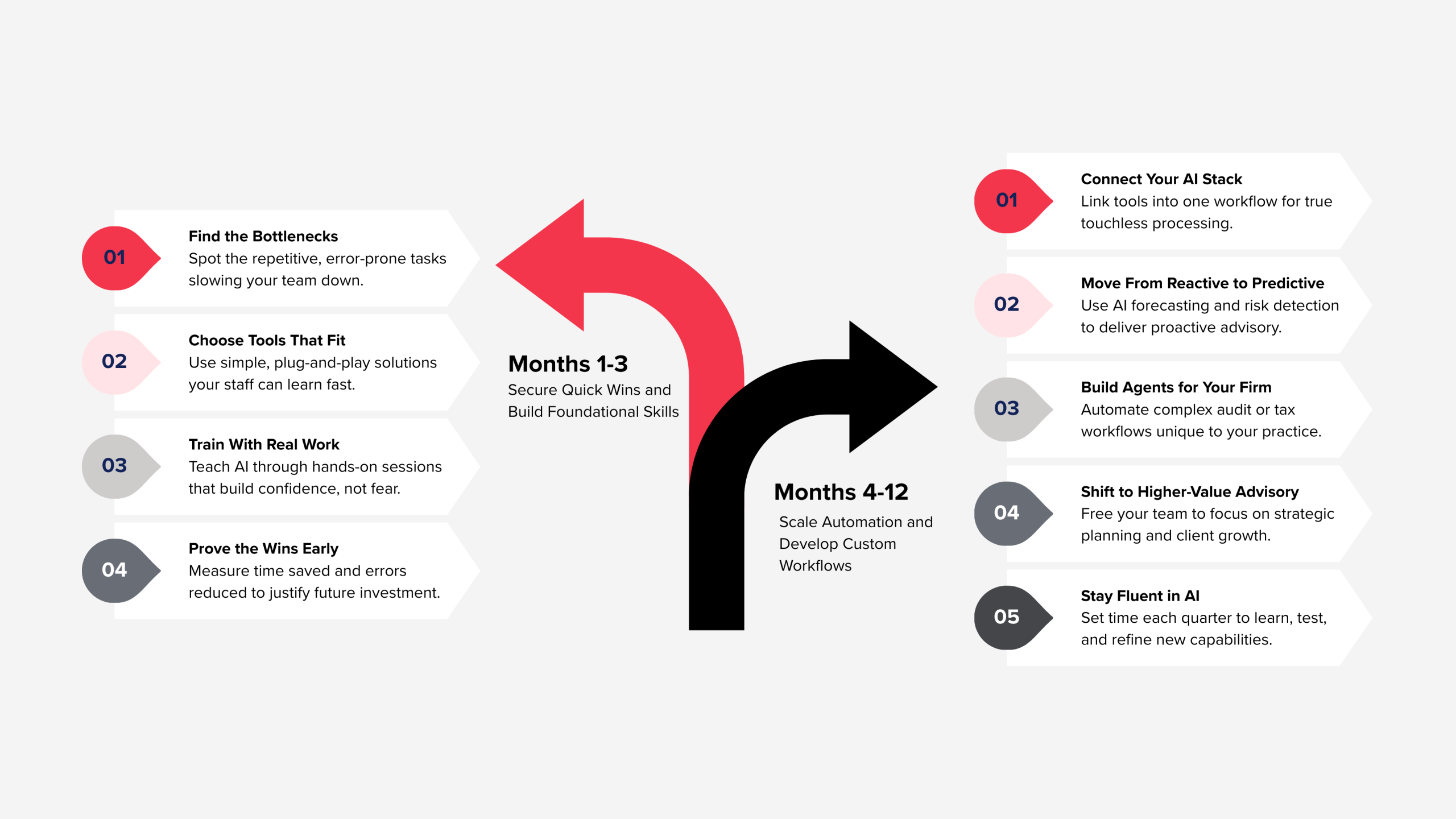
Months 1-3: Secure Quick Wins and Build Foundational Skills
Your first quarter is about proving value and building confidence.
- Identify high-impact manual tasks: Focus on repetitive, error-prone work like data entry, basic reconciliation, and invoice processing.
- Implement user-friendly tools: Choose solutions that integrate smoothly with existing systems and have a short learning curve.
- Train staff on core AI concepts: Run hands-on workshops using real client work. Address fears about job replacement by framing AI as a tool for higher-value work.
- Measure initial time savings: Rigorously track before-and-after metrics on task time, error rates, and cost. This data justifies future investment.
Our IT Strategy Services can help define this initial phase to ensure your AI roadmap aligns with your firm’s technology goals.
Months 4-12: Scale Automation and Develop Custom Workflows
With foundational skills in place, you can expand into more sophisticated applications.
- Integrate multiple AI tools: Create end-to-end workflows, such as connecting document processing to your AP system for touchless invoice-to-payment cycles.
- Develop predictive analytics: Shift to proactive advisory with AI-powered forecasting, risk assessment, and anomaly detection.
- Build custom agentic workflows: Automate complex processes unique to your practice. Custom AI agents for specific audit or tax planning scenarios can yield dramatic results, with some firms serving 300% more clients.
- Focus on advanced advisory services: With routine tasks automated, your team can shift to strategic tax planning, business consulting, and risk management, driving significant revenue growth.
- Invest in ongoing AI literacy: The landscape evolves quickly. Dedicate time quarterly for your team to explore new tools and refine workflows to stay ahead.
Conclusion: Transform Your Firm from Preparer to Partner
The accounting talent shortage and rising client demands are straining manual processes to their breaking point. You can either continue pushing your team until it breaks or strategically automate your firm’s workflows with AI. This isn’t about replacing expertise; it’s about multiplying it. By automating routine tasks, you free your team to become the strategic advisors clients need, shifting from preparer to partner. Firms we work with in Houston, Sugarland, Conroe, and Katy have already proven this model, deepening client relationships and driving growth. This change requires a secure, intelligent IT foundation that supports AI tools while protecting sensitive financial data. Netsurit specializes in building that foundation for accounting firms, enabling you to adopt AI without compromising security or disrupting operations. The profession is changing. Lead the change instead of struggling to catch up.
Start your AI innovation journey with Netsurit today.