Digital change accounting is the process of integrating technology—cloud platforms, AI, automation, and analytics—into every aspect of your accounting operations to improve efficiency, accuracy, and decision-making. It replaces manual data entry and disconnected systems with automated workflows and real-time insights.
What Digital Change Accounting Delivers:
- Automated data entry that updates records in real time without manual effort
- Cloud-based systems that centralize financial data and enable remote access
- AI and machine learning for anomaly detection, forecasting, and compliance
- Integrated analytics that turn raw data into actionable business intelligence
- Stronger governance through digital audit trails and improved security controls
Most accounting firms today face a familiar problem: staff spend hours entering data, systems don’t talk to each other, and reports lag behind the pace of business. Manual processes drain time, introduce errors, and prevent your team from delivering the strategic advice clients expect. Growth stalls because you can’t scale without adding headcount, and clients move to competitors who respond faster.
The research is clear. Automation, AI, and cloud computing are becoming standard tools in finance teams at lightning speed. Firms that automate data entry free their professionals to focus on higher-value work that drives growth and strengthens client relationships. The fastest-growing firms use data to identify where relationships are deepening and opportunities are expanding. Meanwhile, businesses unprepared for digital change risk their competitiveness and survival.
I’m Orrin Klopper, CEO and co-founder of Netsurit. Since 1995, I’ve helped organizations modernize their IT infrastructure, and over the past decade I’ve worked with accounting firms navigating digital change accounting—moving from paper-based workflows to integrated, cloud-enabled systems that support both compliance and growth. The path forward requires clear planning, the right technology, and a team ready to adapt.
Digital Change in Accounting: A Necessary Shift, Not a Choice
Accounting firms face a stark reality: clients expect real-time data, regulators demand transparency, and efficiency is no longer optional. Digital change accounting has moved from “nice to have” to survival requirement. This isn’t about buying new software and calling it done—it’s a fundamental restructuring of how your firm operates, competes, and grows.
The shift is already underway. Cloud platforms, AI tools, and automation have matured to the point where they’re accessible to firms of all sizes. Manual, spreadsheet-driven workflows are giving way to automated systems that update in real time. The firms that move now will pull ahead; those that wait risk becoming irrelevant.

What Changes in the Digital Accounting Model
Digital change accounting reshapes your firm across four dimensions: process, business model, domain, and culture. Paper-based workflows disappear, replaced by systems that automate data entry, reconciliation, and routine compliance tasks. Instead of digging through file cabinets for audit documentation, your team accesses digital files instantly, with built-in security and complete audit trails. Some firms now audit 100% of transactions instead of samples—something impossible with manual methods.
Your business model evolves as well. Traditional services get faster and more accurate, but new offerings emerge: data analytics that spot trends before clients do, strategic advisory that helps businesses grow, real-time dashboards that replace quarterly reports. Within specific domains like financial reporting or internal auditing, continuous accounting becomes possible—monthly close cycles shrink from weeks to days.
The cultural shift is often the hardest. Your team needs to accept new ways of working, communicate differently, and stay curious about emerging tools. We’ve seen this transition firsthand—helping firms move from resistance to momentum once they see the time savings and client impact. Our Accounting Firm IT Services build the foundation for this shift, ensuring your infrastructure supports rather than blocks progress.
The Cost of Standing Still
Firms that delay digital change pay a steep price. Manual data entry drains professional hours that could go toward advisory work. Errors multiply. Client trust erodes when competitors deliver insights faster. You can’t build a complete client view when data sits in disconnected systems, and you can’t scale without adding headcount at an unsustainable rate.
The numbers tell the story: more than half of accounting firms from a decade ago no longer exist, replaced by leaner, tech-enabled competitors. Businesses unprepared for digital change don’t just lose market share—they risk their survival. The gap between firms that modernize and those that don’t widens every quarter.
Standing still isn’t neutral. It’s a decision to fall behind.
Core Technologies Reshaping Accounting Workflows
Four technologies are driving the shift from manual accounting to digital change accounting: artificial intelligence, robotic process automation, cloud computing, and data analytics. These aren’t experimental tools anymore—they’re becoming standard infrastructure in finance teams, and they’re changing how firms capture data, generate insights, and serve clients.

AI helps firms spot patterns and anomalies that humans would miss in massive data sets. RPA handles repetitive tasks—invoice processing, bank reconciliations, compliance checks—without getting tired or making transcription errors. Cloud platforms centralize your data and make it accessible from anywhere, which matters when your team is split between the office, client sites, and home. And analytics layers turn all that raw financial information into dashboards that actually answer business questions. Together, these technologies create a system that updates itself, flags exceptions, and surfaces the insights that matter. Our Cloud Consulting team works with firms to design these integrated systems from the ground up.
Automating Data Entry: Where Most Firms Start
Manual data entry is the single biggest drain on accounting productivity. It’s slow, error-prone, and it keeps your most skilled people stuck in spreadsheets instead of talking to clients. Automation breaks that cycle. When systems can read invoices, categorize transactions, and update ledgers without human intervention, your monthly close shrinks from days to hours. Your team shifts from data entry to exception handling and analysis—work that actually builds client relationships and grows revenue.
AI-powered invoice systems learn your accounting codes and routing rules. Expense management tools read receipts, match them to policy, and flag outliers for review. Bank feeds reconcile themselves. The result? One firm we worked with cut 60 hours per month from their close process after automating AP and bank reconciliation. That’s time they redirected to advisory services that clients actually pay premium rates for.
Trade-offs:
Works best when your data is structured, your chart of accounts is stable, and your processes are documented. Avoid when you’re dealing with highly inconsistent data sources or transactions that require judgment calls and context. Risks include over-reliance—automation can mask bad data or misconfigured rules, creating errors at scale. Mitigations include regular audits of automated workflows, strong exception-handling protocols, and keeping humans in the loop for complex or unusual transactions.
To find where automation will deliver the biggest return in your firm, start with a Productivity Assessment. It maps your current workflows, flags bottlenecks, and quantifies the time you’re losing to manual tasks.
Cloud and AI: Opening up Real-Time Insights
Cloud computing gives you a single source of truth for all your financial data. No more version-control nightmares, no more emailing spreadsheets, no more wondering if the file you’re looking at is current. Your data lives in one place, accessible from anywhere, with permissions and audit trails baked in. That’s essential for remote teams and multi-location firms, but the real value comes when you layer AI on top.
AI-driven analytics turn cloud-stored data into insights you can act on. Dashboards update in real time, showing cash position, client profitability, and trend lines without waiting for month-end reports. AI spots anomalies—unusual transactions, emerging patterns, compliance risks—faster than any human reviewer. It can forecast cash flow, predict client churn, and identify which accounts are growing or stalling.
A mid-sized firm in Houston used cloud dashboards integrated with AI analytics to cut their quarterly reporting cycle from six days to three. They reduced reporting time by 40% in Q1 2024 and started spotting market trends early enough to adjust strategy before their competitors. That’s the advantage of a system that maintains itself through passive data capture and automated enrichment.
Our AI Productivity solutions and Cloud Migration services help firms build these capabilities step by step, starting with the data you already have.
From Compliance to Growth: Strategic Outcomes of Digital Accounting
Digital change accounting doesn’t just make your existing processes faster—it changes what your firm can do. When you automate the routine work, you free your team to focus on strategy, advisory, and growth. The goal isn’t merely to close the books quicker; it’s to turn your accounting function into a competitive advantage. We help firms develop an IT Strategy Services plan that aligns technology investments with these strategic outcomes.
Real-Time Reporting and Financial Clarity
Transparency builds trust. When clients and regulators can see clear, real-time financial data backed by digital audit trails, confidence grows. Automated dashboards eliminate the lag between events and reporting, so stakeholders always have current information. A study on the impact of accounting digital change on financial transparency found that organizational, technical, and human dimensions all improve transparency—especially when strong governance practices are in place. The organizational dimension, particularly around information clarity, had the greatest impact. In other words, structuring your processes and data frameworks matters more than the technology alone.
Digital audits create a permanent record of who accessed which files and when. This doesn’t just streamline compliance; it allows auditors to examine 100% of transactions rather than sampling. That level of detail transforms financial statements from summaries into comprehensive snapshots. One firm we worked with reduced their audit preparation time by three weeks simply by implementing proper digital trails and centralized data storage. Our IT Audits and Assessments ensure your systems can support this level of clarity without introducing new vulnerabilities.
Data-Driven Business Development
The fastest-growing firms don’t just serve clients—they understand them. Accounting Today’s analysis of growth opportunities shows that leading firms use data to identify where relationships are deepening and where new opportunities are emerging. Digital change accounting gives you a 360-degree view of each client: services used, communication history, billing patterns, and engagement levels all in one place.
A firm in New Jersey analyzed their 2023 client data and finded that several manufacturing clients were asking about ESG reporting requirements. They developed a specialized ESG advisory service, launched it in Q1 2024, and added $400,000 in annual recurring revenue within six months. Without data-driven insights, those conversations would have stayed fragmented across partner notes and email threads.
Automated relationship intelligence tools flag when a key account goes quiet, when a client’s industry faces regulatory changes, or when usage patterns suggest readiness for additional services. This isn’t about aggressive upselling—it’s about serving clients proactively, before they ask. To learn how AI can identify these opportunities automatically, consider attending our AI Tools for Accounting & Tax Webinar.
Overcoming the Problems of Digital Change in Accounting
The path to digital change accounting looks straightforward on paper: adopt new tools, train your team, and watch efficiency soar. Reality is messier. Implementation can stall when staff resist unfamiliar systems, when security concerns expose real vulnerabilities, or when the skills gap between current capabilities and future needs feels impossible to bridge. These challenges are real, but they’re not impossible. Our Cybersecurity and IT Consulting Services exist precisely to help firms steer these complexities without losing momentum.
Managing Change and Upskilling Your Team
The shift from traditional to digital accounting fundamentally alters what accountants do all day. When automation handles data entry and reconciliation, your team’s value shifts from transaction processing to analysis and advisory. This isn’t a minor adjustment—it requires rethinking roles, rebuilding skills, and managing the anxiety that comes with professional reinvention.
| Traditional Accountant | Digital Accountant |
|---|---|
| Manual data entry | Data analysis |
| Compliance focus | Advisory focus |
| Siloed work | Cross-functional teamwork |
Change management succeeds or fails on leadership commitment. When partners actively champion new tools, demonstrate their value, and invest in comprehensive training, adoption follows. When training is treated as a checkbox exercise or leadership remains ambivalent, technology investments gather dust while staff revert to familiar spreadsheets.
Trade-offs:
- Works best when: Leadership provides visible, ongoing support and allocates real resources to training—not just one afternoon workshop.
- Avoid when: Training is neglected, treated as optional, or positioned as a one-time event rather than continuous development.
- Risks: Staff disengagement, high turnover among both traditionalists who can’t adapt and innovators who grow frustrated, and expensive software that sits underused.
- Mitigations: Offer role-specific training that addresses actual daily tasks, celebrate early wins publicly, create incentives for skill development, and pair less confident staff with digital champions who can mentor them through the transition.
Educational institutions are slowly catching up, integrating technology competencies into accounting curricula. But for existing teams, the responsibility falls on firms to build these capabilities internally. Investing in Cybersecurity Training Benefits your entire organization by equipping staff to recognize and respond to the new risks that come with digital tools—from phishing attempts to data breaches.
The most successful transitions we’ve seen share a common trait: they frame digital change not as replacing people with machines, but as freeing talented professionals from drudgery so they can do work that actually requires human judgment. When staff understand that automation makes their expertise more valuable, not less, resistance softens.
Governance: Protecting Data and Ensuring Compliance
As accounting processes move to the cloud and data volumes multiply, the attack surface expands. A single misconfigured permission setting or unpatched system can expose sensitive client financial data. This makes robust governance not just a compliance checkbox but a competitive necessity—clients increasingly choose firms based on their ability to protect confidential information.
Good governance serves as the foundation that makes digital change accounting both possible and trustworthy. Research confirms that governance partially mediates the relationship between digital tools and financial transparency, meaning the benefits of technology are amplified when strong oversight practices are in place. Without governance, you’re building on sand.
Effective governance requires clear policies for data access, usage, and retention. Who can view which client files? How long do you keep data? What happens when an employee leaves? These aren’t theoretical questions—they’re daily operational realities that need documented answers. Implementation means deploying advanced security measures like multi-factor authentication, encryption at rest and in transit, and continuous monitoring for unusual access patterns.
Governance also extends to how you use AI and automation. Algorithms trained on biased data perpetuate bias. AI tools that lack transparency create audit risks. Establishing ethical frameworks for AI usage—understanding how tools make decisions, validating their outputs, and maintaining human oversight for complex judgments—protects both your firm and your clients.
Regular security audits, updated incident response plans, and compliance with evolving regulations like GDPR or state-level privacy laws form the operational backbone of good governance. The importance of The Importance of Cybersecurity Compliance grows as regulators increase scrutiny of how firms handle sensitive financial data.
Strong governance builds trust. When clients see that you’ve invested in protecting their data—not just through technology but through clear policies, regular audits, and transparent reporting—they’re more likely to deepen the relationship and refer others. In an industry built on trust, that’s the competitive advantage that matters most.
FAQ: Digital Accounting Change
What’s the first step for an accounting firm?
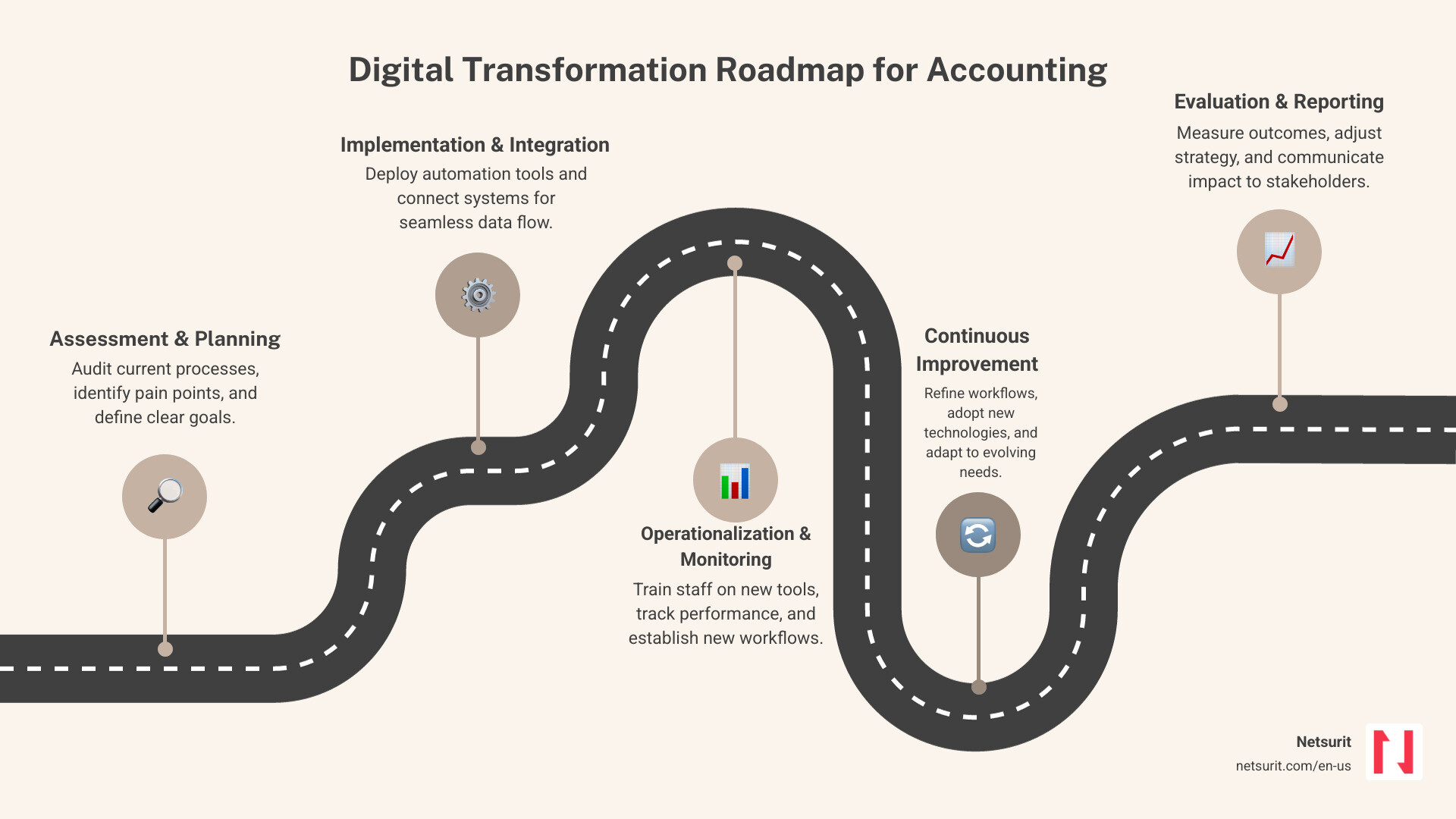
Start by mapping your current workflows—every step from client intake to final report. Flag the pain points: Where do manual tasks slow you down? Where do errors creep in? Most firms find that automating data entry delivers the fastest wins. It’s the foundation that frees up professional time, improves data quality, and builds momentum for broader change. From there, build a roadmap that sequences your next moves—cloud migration, analytics tools, and AI integration—based on where you’ll see the highest return. A Productivity Assessment can help you identify exactly where to focus first.
Works best when: You have leadership buy-in and a clear inventory of your existing processes. Avoid when: You try to automate everything at once without understanding dependencies. Risks: Picking tools that don’t integrate or solve the wrong problems. Mitigations: Start small, measure results, and scale what works.
How does this affect small firms?
Digital change accounting levels the playing field. Small teams gain access to automation, cloud platforms, and AI-driven insights that were once reserved for large firms with big budgets. You can now deliver real-time reporting, sophisticated analytics, and proactive advisory services without adding headcount. A three-person firm in Austin automated invoice processing and expense management in early 2024 and cut month-end close time from five days to two, freeing up capacity to take on four new clients. The operational gap narrows when technology handles repetitive work, allowing smaller firms to compete on service quality and responsiveness rather than sheer staff size.
Is digital change a one-off project?
No. Digital change accounting is a continuous process, not a finish line. Technology evolves, client expectations shift, and new regulations emerge. The tools you deploy this year will need refinement next year. Plan to revisit your systems regularly—quarterly reviews are a good rhythm—to assess performance, adjust workflows, and adopt new capabilities as they mature. Firms that treat digital change as ongoing strategic work stay competitive and secure. Those that launch a project, declare victory, and move on find themselves falling behind within eighteen months. Expect to invest in training, governance updates, and infrastructure improvements as part of your operating rhythm, not as one-time events.
Conclusion: Take Action to Secure Your Firm’s Future
Digital change accounting isn’t a destination you reach and then walk away from. It’s a strategic commitment that requires planning, ongoing adaptation, and smart investment in both technology and people. The firms that treat this as a continuous journey—not a one-time project—will find themselves better positioned to serve clients, scale operations, and stay competitive as the profession evolves.
The evidence is clear: firms that automate routine tasks free their teams to deliver advisory services clients actually value. Those that centralize data in the cloud gain the real-time visibility needed to spot trends and act quickly. And firms that invest in upskilling their staff build resilience against the skills gaps that can stall growth. The alternative—maintaining manual processes and siloed systems—leads to higher error rates, slower service, and clients who move to more responsive competitors.
The path forward starts with honest assessment. Map your current workflows, identify where time and accuracy are being lost, and prioritize the changes that will deliver the fastest return. Automate data entry first, then build toward integrated analytics and advisory services. Invest in training so your team can make the most of new tools. And put governance frameworks in place to protect the data and trust you’re building.
We’ve spent nearly three decades helping organizations modernize their technology infrastructure, and we’ve seen what works—and what doesn’t—when accounting firms accept digital change. At Netsurit, we provide the managed IT, cybersecurity, and AI solutions that make this shift secure, efficient, and aligned with your firm’s growth goals.
Ready to future-proof your firm and transform how you deliver value to clients? Speak to an Expert and let’s build a roadmap custom to where you are today and where you want to be tomorrow.