The Urgent Ransomware Threat to Houston’s Accounting Firms
Securing client tax data from ransomware in Houston requires a multi-layered defense. A recent audit found 68% of local accounting firms have inadequate cybersecurity, with failing grades in application, DNS, and network security. With ransomware involved in 70% of cyberattacks and average small business losses hitting $250,000-$500,000, the stakes are immense. A single breach can mean financial ruin, regulatory fines, and lost client trust.
Quick Action Checklist:
- Implement Multi-Factor Authentication (MFA) on all systems accessing client data.
- Deploy the 3-2-1 backup rule: 3 copies of data, on 2 different media types, with 1 off-site.
- Train employees monthly on phishing and social engineering tactics.
- Create a Written Information Security Plan (WISP) as required by the FTC.
- Monitor your systems 24/7 for suspicious activity.
- Encrypt all sensitive data, both in transit and at rest.
- Test your incident response plan quarterly to ensure rapid recovery.
This guide provides the specific strategies and technical controls to build a robust defense. I’m Orrin Klopper, CEO of Netsurit. For 29 years, we’ve helped over 300 organizations, including many accounting firms, implement cybersecurity frameworks that stop ransomware. Let’s get started.

Understanding the Ransomware Threat to Houston Accounting Firms
Ransomware encrypts your files, but the real damage is the theft of client data. Cybercriminals target accounting firms for Social Security numbers, tax returns, and bank records—the keys to identity theft. This threat is not theoretical; it’s a direct risk to Houston firms.
The consequences are severe. A successful attack costs small businesses between $250,000 and $500,000 in ransom, recovery fees, and lost revenue. Beyond the financial hit, reputational damage can be permanent. When clients learn their data was compromised, trust evaporates, leading to client departures and years of rebuilding credibility. Furthermore, failing to meet FTC and IRS security standards brings regulatory fines, adding insult to injury.
Attackers use simple entry points:
- Phishing emails trick employees into clicking malicious links.
- Unsecured Remote Desktop Protocol (RDP) gives attackers direct network access.
- Software vulnerabilities in unpatched systems create open doors.
Even high-profile targets like the NBA’s Houston Rockets have been hit by ransomware, proving no one is immune. Cybercriminals view accounting firms as high-value targets with weak defenses—a recent audit gave 68% of Houston firms a C+ grade or below for security. By implementing the defenses in this guide, you make your firm a harder target, forcing attackers to move on to easier prey. The official #StopRansomware Guide from CISA offers further federal guidance on building these defenses.
Building Your Technical Defenses: How to Secure Client Tax Data from Ransomware Attacks in Houston
No single tool can stop a determined attacker. A layered security approach, or “defense-in-depth,” creates multiple barriers to protect client data. This strategy combines proactive prevention to block attacks with a rapid recovery plan to minimize damage if a breach occurs. The official #StopRansomware Guide from CISA provides a strong framework for this approach.
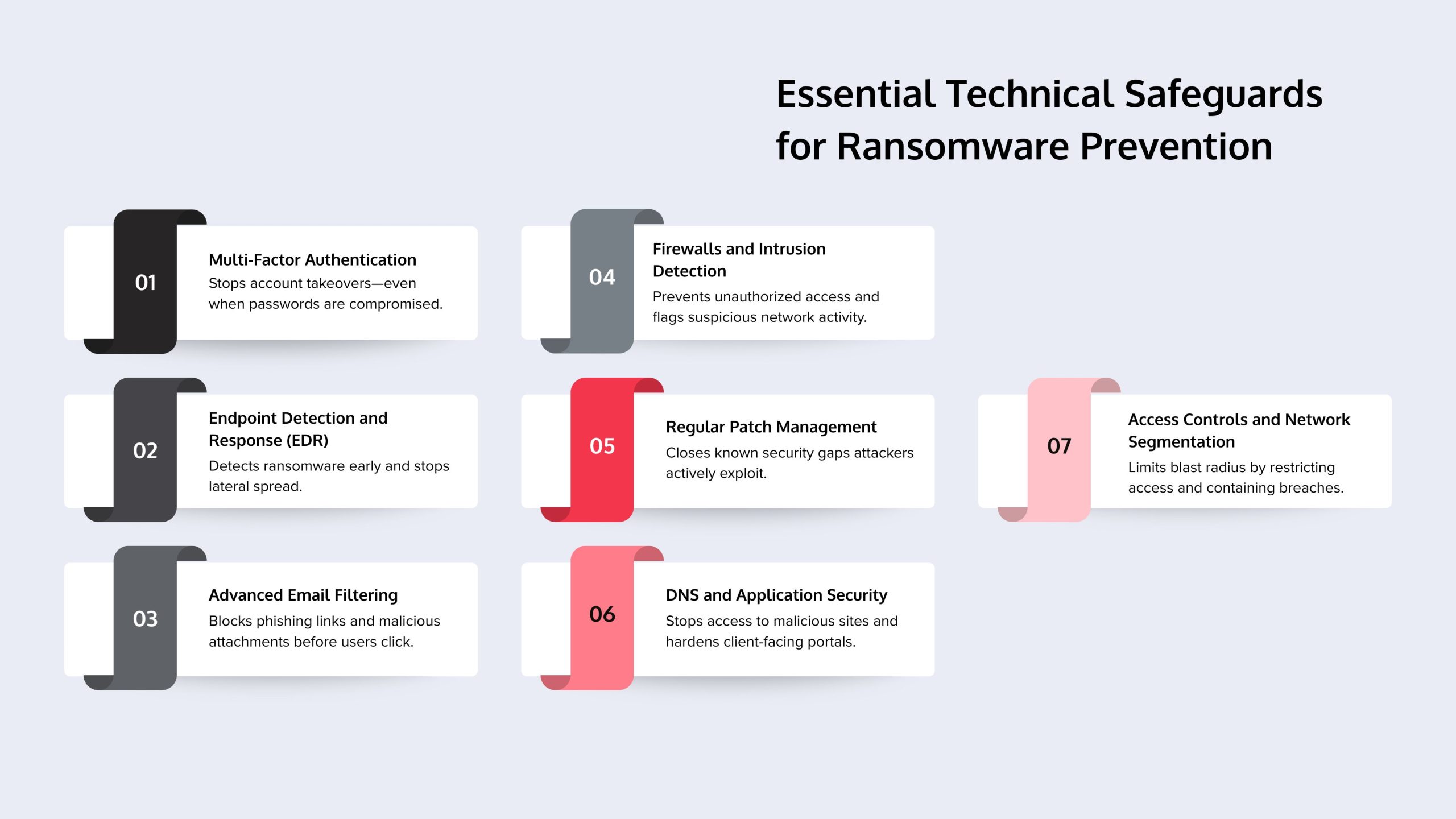
Essential Technical Safeguards for Ransomware Prevention
- Multi-Factor Authentication (MFA): Required by the FTC Safeguards Rule, MFA stops attackers even if they steal a password.
- Endpoint Detection and Response (EDR): This goes beyond traditional antivirus to monitor for suspicious behavior, catching modern ransomware and isolating infected devices automatically.
- Advanced Email Filtering: As phishing is the top entry point, these systems scan for malicious links and attachments before they reach an employee’s inbox.
- Firewalls and Intrusion Detection: A properly configured firewall blocks unauthorized access, while intrusion detection systems monitor traffic for signs of a breach.
- Regular Patch Management: Keep all software, from operating systems to tax platforms, updated to close known security holes that attackers exploit.
- DNS and Application Security: Secure DNS settings prevent users from visiting malicious sites. Hardening client portals and web apps protects against common attack vectors, addressing the D+ security grades common among Houston firms.
- Access Controls and Network Segmentation: Limit user access to only what’s necessary for their job. Disabling unused RDP and segmenting your network contains a breach if one occurs, preventing it from spreading.
The 3-2-1 Rule: Ensuring Data Backup and Recoverability
Your backup strategy is your ultimate insurance policy. The 3-2-1 Backup Rule is the industry standard:
- Three copies of your data (one primary, two backups).
- On two different media types (e.g., a local device and encrypted cloud storage).
- With one copy off-site (the cloud backup satisfies this).
Crucially, backups must be immutable—meaning ransomware cannot delete or alter them. Modern ransomware hunts for and destroys backups first, so this feature is non-negotiable. Finally, test your backups quarterly. A backup that hasn’t been tested for restoration is not a reliable backup.
The Human Element: Fortifying Your Firm with Training and Policies

Technical defenses are useless if an employee clicks a malicious link. The human element is often the weakest link, and criminals exploit it with social engineering. Building a security-first culture through training is a foundational part of protecting client tax data.
Creating a Security-Aware Culture Through Employee Training
Trained employees are your best defense. A continuous training program should include:
- Phishing Simulations: Send realistic fake phishing emails to test and train staff, building muscle memory to spot real threats.
- Password and MFA Policies: Enforce complex, unique passwords and train staff on why MFA is critical for protecting accounts even when passwords are stolen.
- Social Engineering Awareness: Teach staff to recognize and verify urgent or unusual requests, whether by email or phone.
- Physical and Mobile Security: Implement a clean desk policy and train remote employees on secure Wi-Fi practices and device management.
- Safe Reporting: Create a culture where employees can report suspicious activity immediately without fear of blame. This provides an essential early warning.
The IRS emphasizes that security training is every employee’s responsibility, not just IT’s.
Managing Third-Party Vendor and Supply Chain Risk
Your firm’s security is only as strong as your weakest vendor. With cloud attacks increasing by 95% in one year, vetting software and cloud providers is critical.
- Perform Due Diligence: Ask vendors about their security practices, compliance certifications, and incident response plans.
- Use Contractual Requirements: Mandate data protection standards and breach notification timelines in all vendor agreements.
- Share Data Securely: Use encrypted client portals instead of email for sharing sensitive documents.
The Kaseya supply chain attack, where a vendor’s vulnerability led to ransomware attacks on 1,500 of its customers, is a stark reminder. Your vendors’ security is your security.
Compliance and Response: Navigating Legal Duties and Attack Aftermath

Protecting client data is a legal requirement. Houston accounting firms must follow federal and state regulations that dictate how to secure data and respond to threats. Beyond compliance, a practiced response plan is the difference between a quick recovery and a business-ending event.
Meeting Legal and Regulatory Mandates
Under federal law, tax preparers are considered financial institutions and must comply with the FTC’s Safeguards Rule. This requires you to create and maintain a Written Information Security Plan (WISP). A WISP is your operational blueprint for data protection, outlining risk assessments, safeguards, and vendor oversight.
- IRS Publication 4557, “Safeguarding Taxpayer Data,” provides detailed guidance on security steps and is required reading. You can find a guide to creating a WISP in IRS Publication 5709.
- Texas breach notification laws mandate how and when you must inform clients if their data is compromised, with significant penalties for failure to comply.
Your Incident Response Plan: Detecting and Containing an Attack
When an attack happens, a documented plan turns chaos into controlled action.
- Isolate: Immediately disconnect affected systems from the network to stop the ransomware from spreading.
- Assess: Determine which systems and data are affected. Document everything with timestamps for forensic and insurance purposes.
- Report: Contact the FBI’s Internet Crime Complaint Center (IC3), CISA, and your local IRS Stakeholder Liaison. The IRS provides specific data theft reporting guidance for tax pros.
- Do Not Pay the Ransom: Paying does not guarantee data recovery—nearly half of firms that pay get nothing back. It also funds criminal enterprises and marks you as a future target.
- Engage Experts: Bring in a cybersecurity incident response team to contain the threat, preserve evidence, and guide recovery.
- Restore: Use your clean, immutable backups to restore critical systems first, then secondary ones. Test everything before bringing it back online.
Practice this plan quarterly. A rehearsed response is a fast response.
Partnering for Protection: Leveraging Managed IT for Advanced Security
Most Houston accounting firms know they need better cybersecurity but lack the time, budget, or in-house expertise. The audit showing 68% of local firms have inadequate protection confirms this gap.
Partnering with a managed IT service provider (MSP) is the most cost-effective way to close it. You gain access to a team of specialized cybersecurity experts and 24/7 threat monitoring for a fraction of the cost of a single full-time hire. While you focus on clients, your MSP partner manages your security.
A Strategic Partnership for Security
A dedicated MSP partner delivers tangible results to protect your firm:
- Vulnerability Management: We continuously scan your systems for weaknesses and remediate them before attackers can exploit them, directly addressing the security gaps found in Houston firms.
- Compliance Support: We help you build and maintain your WISP, ensuring you meet FTC and IRS requirements and are prepared for audits.
- Disaster Recovery as a Service (DRaaS): Beyond simple backups, DRaaS allows for the rapid restoration of your entire IT environment, minimizing downtime after an attack.
- Proactive Threat Hunting: Our experts actively search your network for advanced threats that automated tools might miss.
- Strategic IT Planning: We align your technology and security with your business goals, ensuring your infrastructure can scale securely as your firm grows.
At Netsurit, we’ve spent 29 years building resilient defenses for organizations like yours. Our approach is designed to fix the specific vulnerabilities common to Houston accounting firms, letting you focus on your practice while we handle the complexities of cybersecurity.
Conclusion: A Multi-Layered Defense is Your Best Offense
Securing client tax data from ransomware requires a continuous, multi-layered defense combining technical controls, employee training, and documented procedures. Key actions include implementing MFA and EDR, maintaining 3-2-1 backups, training your team, and creating a WISP.
However, security is not a one-time project. Threats evolve, and defenses must adapt. With 68% of Houston firms operating with subpar security, going it alone is a significant risk. A strategic partnership provides the specialized expertise and 24/7 monitoring needed to stay ahead of attackers. This approach transforms your security from a liability into a strength, protecting your business and your clients’ trust.
Your clients trust you with their most sensitive financial information. That trust is worth protecting. Explore specialized IT services for accounting firms and take the next step toward comprehensive protection.