Why Tax Preparers Can’t Afford Generic IT Support
Tax preparers need specialized IT providers because your firm holds the keys to your clients’ financial lives—Social Security numbers, income statements, and bank details—and cybercriminals know it. A generic IT provider lacks the deep knowledge of tax-specific regulations, software, and threat landscapes that define your industry.
A specialized partner builds your security around the FTC Safeguards Rule and IRS Publication 4557, not generic best practices. They master platforms like UltraTax CS and ProConnect, understand the phishing and ransomware tactics aimed at tax firms, and have an industry-specific playbook for incident response. They scale your technology for growth, not just fix broken printers.
The stakes are clear. A data breach can cost a small tax firm $50,000 to $250,000, not including the loss of client trust. The IRS and FTC can also impose penalties for failing to maintain a Written Information Security Plan (WISP), which is required by law.
I’m Orrin Klopper, CEO of Netsurit. For 29 years, my team and I have helped hundreds of firms, including dozens of tax practices, modernize their IT to meet compliance mandates and scale securely. We know the cost of getting it wrong isn’t just money—it’s your reputation and your clients’ financial security. This guide details seven areas where a specialized IT partner makes the difference, with real examples from Houston-area firms.
Key 1: Build an Impenetrable Fortress Around Client Data
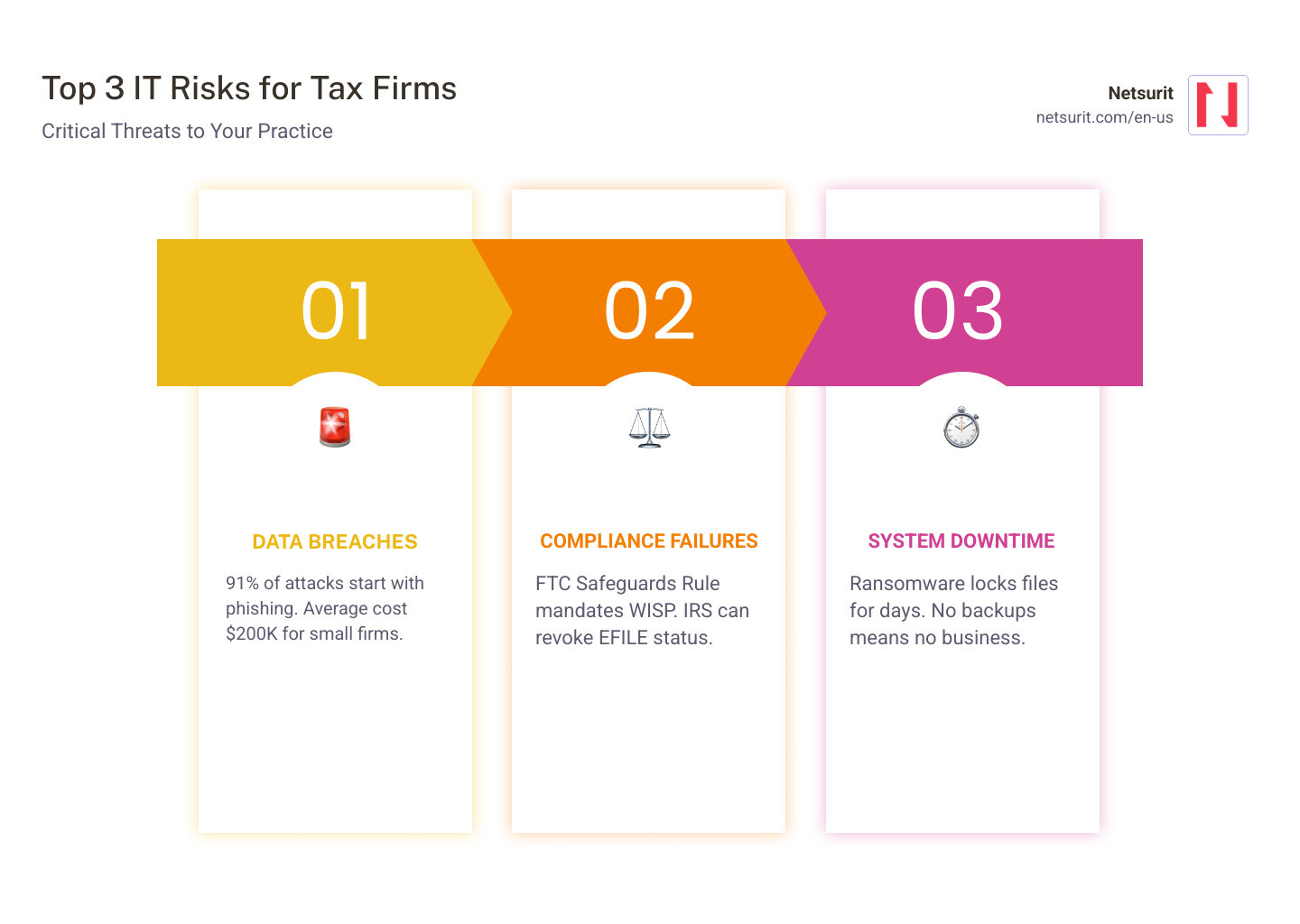
Tax preparers sit on a goldmine of Personally Identifiable Information (PII), making your firm a target regardless of size. The threats are constant: ransomware locking your files before a deadline, phishing scams tricking staff into handing over credentials, and data exfiltration that copies client records for sale on the dark web. A single breach can cost a small firm between $50,000 and $250,000, plus irreparable damage to client trust.
Federal law holds you accountable. The Gramm-Leach-Bliley Act and the FTC Safeguards Rule require you to protect customer information with specific safeguards. The IRS can revoke your EFILE status for security failures, and the FTC can issue fines for lacking a proper Written Information Security Plan. For a detailed breakdown, review the IRS’s Cybersecurity basics for the tax practice.
A specialized IT provider understands the attack patterns targeting tax season and the regulatory frameworks you operate under. They implement layered security that goes beyond a simple firewall, using intrusion detection systems and proactive threat hunting to identify suspicious behavior before it escalates.
For example, when a tax firm in Katy, Texas, opened a malicious email attachment in March 2024, their specialized IT partner’s monitoring system flagged the unusual network traffic of a ransomware attack. The provider isolated the workstation and restored access within 90 minutes, preventing data loss and downtime. Our Cybersecurity Services in Houston are built for these scenarios.
Trade-offs: Implementing a Zero Trust Security Model
A Zero Trust System assumes every access request is potentially hostile until verified. No user or device gets automatic trust.
Works best when… your firm has remote employees and handles high-value client data. It closes security gaps that traditional defenses miss.
Avoid when… you need a quick, low-cost patch and lack the capacity to train your team. Zero Trust is a strategic shift, not just a software install.
Risks… Initial implementation can slow workflows as staff adapt to new verification steps like multi-factor authentication.
Mitigations… Phase the rollout, starting with your most sensitive systems. Pair the technical changes with PCI Security Awareness Training that explains why the new steps are necessary to protect client data.
Key 2: Steer the Complex Maze of Regulatory Compliance
Tax preparers face a dense web of regulations, and non-compliance penalties are severe. The Gramm-Leach-Bliley (GLB) Act and the FTC Safeguards Rule classify you as a “financial institution,” legally requiring you to maintain a Written Information Security Plan (WISP).
The IRS reinforces this through Publication 4557, “Safeguarding Taxpayer Data,” and Publication 5708. Failure to comply can lead to fines, reputational damage, and disciplinary action.
A specialized IT provider builds your systems with compliance as a core component. Unlike generalists who may be unaware of these rules, they implement the specific data encryption, access controls, and audit trails needed to prove you’ve protected client information.
For instance, a Sugar Land tax preparer with international clients needed to meet both IRS and other data residency rules. Their specialized provider configured their systems proactively, preventing potential fines and allowing the firm to serve its global client base confidently.
Your WISP is a living document that must be updated as your firm, regulations, and threats change. A specialized partner helps create, implement, and regularly update this plan, identifying risks and establishing safeguards for employee management and information systems.
They monitor regulatory changes and adjust your systems accordingly, letting you focus on tax preparation, not decoding federal mandates. This approach is fundamental to The Importance of Cybersecurity Compliance and building client trust.
Key 3: Master Your Unique Tax Software and Integrations
Your firm runs a complex ecosystem of specialized software—like UltraTax CS, Lacerte, or Drake Tax—plus client portals and document management systems. A general IT provider won’t know how to fix a tax software error after a Windows update or secure the API between your portal and tax platform. These systems are the backbone of your practice, and mismanagement costs you billable hours.
A specialized IT provider understands the backend requirements for tools like the Thomson Reuters CS Professional Suite and Intuit ProConnect. They can troubleshoot integration issues without long hold times, translating directly into fewer disruptions.
For example, a Katy CPA firm was drowning in manual data entry. Their specialized partner implemented a secure client portal that integrated directly with their tax and document management software. When a client uploads a W-2, it now flows automatically into the right client file, cutting data entry time by 60% and eliminating transcription errors.
Security is just as critical. Your tax software connects to the IRS EFILE system, making it a high-value target. A specialized provider secures these integration points and manages updates carefully, ensuring a patch installed on April 14th doesn’t break your e-filing capability.
This focus on seamless, secure integration is central to a successful Digital Finance Transformation. When your technology works for you, your team can focus on strategic tax planning instead of fighting with software.
Key 4: Guarantee Business Continuity Through Disasters
Your server crashes on April 10th. A ransomware gang demands $50,000. A burst pipe floods your office. For a tax preparer, a backup file on an external drive isn’t a business continuity plan—it’s a hope.
The difference between a generic backup and a real recovery strategy is being down for hours versus days, something you can’t afford during tax season.
A specialized IT provider builds a disaster recovery plan around your firm’s specific deadlines, defining your Recovery Point Objective (how much data you can lose) and Recovery Time Objective (how fast you must be operational).
The plan must include secure, isolated backups stored off-site, logically separated from your network so ransomware can’t reach them. These backups must be tested regularly to confirm they can be restored quickly.
Consider the Conroe CPA firm whose server room flooded. Their physical hardware was destroyed, but their specialized IT partner had implemented a cloud-based disaster recovery solution. Staff were working remotely with full data access within two hours. No deadlines were missed.
An effective plan includes:
- Daily encrypted, off-site backups.
- Cloud-based failover for critical systems.
- Regular, documented testing.
- Defined RPO and RTO metrics.
- A communication protocol for disaster scenarios.
A specialized provider ensures you can continue serving clients no matter what happens. That’s the baseline for a modern tax practice.
Key 5: Boost Firm Efficiency and Improve Client Trust
For tax preparers, time is money and trust is currency. Every hour your team spends on slow systems or manual data entry is an hour not spent on high-value advisory work. Insecure processes also erode the client confidence that drives your business.
A strategic IT partner becomes a profit center by removing technological friction. They automate repetitive tasks, freeing your preparers to focus on tax planning and client relationships.
Secure, user-friendly client portals are a prime example. Instead of emailing unencrypted documents, clients upload everything to a portal that organizes files automatically and creates an audit trail.
A mid-sized CPA firm in Katy implemented this solution. Their new portal integrated with their tax software, allowing clients to upload documents that pre-populated tax forms. The firm cut administrative time by 30%, allowing them to take on 40 new clients without adding staff. Client satisfaction jumped.
Proactive system monitoring also prevents costly disruptions. A specialized provider resolves issues before they cause downtime, patching a server overnight instead of letting it crash on April 14th.
This improved efficiency and security builds client trust, your most valuable asset for referrals and retention. As the Guide to Practice Management for SMPs notes, robust technology is critical for growth.
At Netsurit, our Managed IT Services are designed to turn IT from a cost center into a strategic asset.
Key 6: Choose the Right Partner to Guide Your Firm’s Growth
Your IT partner should understand your business model, not just your network. A specialized provider acts as a strategic advisor, helping you adopt technology that aligns with your growth plans, whether that means opening a new office or adding a service line.
A generalist might keep your computers running, but they lack the context to advise on technology decisions that impact revenue.
A Checklist for Selecting Your Specialized IT Provider
- Verify their experience with tax firms of your size and specialty.
- Test their knowledge of the FTC Safeguards Rule and IRS security publications like Publication 4557. If they can’t discuss WISP requirements fluently, they are not specialists.
- Request references from other tax professionals in the Houston area. Ask how the provider handled a crisis.
- Review their contract for clearly defined response times, security duties, and compliance support. Vague language is a red flag.
- Ask for a technology roadmap that aligns with your firm’s goals. This strategic approach, as outlined in guides like Developing a Technology Adoption Strategy for SMPs, separates partners from vendors.
Our IT Consulting Services include these commitments as standard.
The table below captures the key differences:
| Feature | General IT Provider | Specialized Accounting IT Provider |
| Compliance Knowledge | Basic, generic data privacy | Deep understanding of GLB, FTC Safeguards Rule, IRS Pubs, state laws |
| Software Expertise | General business applications | Expert in UltraTax, Lacerte, ProConnect, QuickBooks, etc. |
| Security Focus | Standard antivirus, firewall | Multi-layered, threat intelligence specific to tax firms |
| Strategic Guidance | Reactive problem-solving | Proactive technology roadmap for growth & efficiency |
| Incident Response | Generic DR plan | Industry-specific playbook for PII breach & tax season continuity |
| Integrations | Limited | Seamless integration of tax, client portal, DMS, accounting software |
For a Katy-based tax practice looking to scale, a specialized provider designs a centralized, secure infrastructure that allows preparers at all locations to access the same client data seamlessly, with audit trails and compliance controls baked in.
Frequently Asked Questions about Specialized IT for Tax Preparers
What is the single biggest IT risk for a small tax practice?
The most dangerous assumption is believing you’re too small to be a target. Attackers use automated tools to find vulnerable networks, and your client data is valuable regardless of your firm’s size.
The most critical vulnerability is the absence of a formal security plan. The FTC Safeguards Rule requires every tax preparer to have a Written Information Security Plan (WISP), as detailed in this IRS plan guide. A specialized provider can scale these measures to be affordable and effective for a practice of any size.
How much should I budget for specialized IT services?
Costs vary by firm size and complexity, but specialized IT should be viewed as an investment that prevents catastrophic loss, not an expense to minimize.
A single data breach can cost a small firm $50,000 to $250,000 in fines, fees, and reputational damage. In contrast, proactive solutions like Managed Detection and Response (MDR) services cost a fraction of that, delivering continuous monitoring, training, and compliance support.
The ROI is clear when compared to a six-figure loss from one ransomware attack.
Can’t my tax software vendor handle my security?
Your software vendor (e.g., Intuit, Thomson Reuters) secures their application and its cloud infrastructure. However, they are not responsible for your firm’s network, computers, Wi-Fi, or employee practices.
The software operates within your environment, and under the FTC Safeguards Rule, you are responsible for securing that environment. Think of your tax software as a secure vault; a specialized IT provider secures the building it’s in, managing your network, endpoints, backups, and employee security training to close the gaps that software vendors cannot cover.
Conclusion
The answer to why tax preparers need specialized IT providers is simple: the cost of getting it wrong is too high. A data breach, compliance violation, or ransomware attack during tax season can destroy a practice. General IT support ignores the unique risks, software, and regulations that define your industry.
A specialized provider understands your world. They build defenses around the WISP you are legally required to have, ensure your tax software integrates securely, and can get you back online in hours, not days, after a disaster.
At Netsurit, we have spent 29 years building IT strategies for professional service firms, including dozens of tax practices across the Houston metro area. We have seen how the right partnership prevents breaches, ensures compliance, and drives growth by eliminating technological friction.
Your firm’s current IT posture likely has gaps. To identify these vulnerabilities before they become costly incidents, start with a professional Accounting Firm IT Services consultation. We will build a roadmap that fits your budget and growth plans, allowing you to focus on serving your clients.