Why Houston Accounting Firms Need AI Solutions for Business Challenges Now
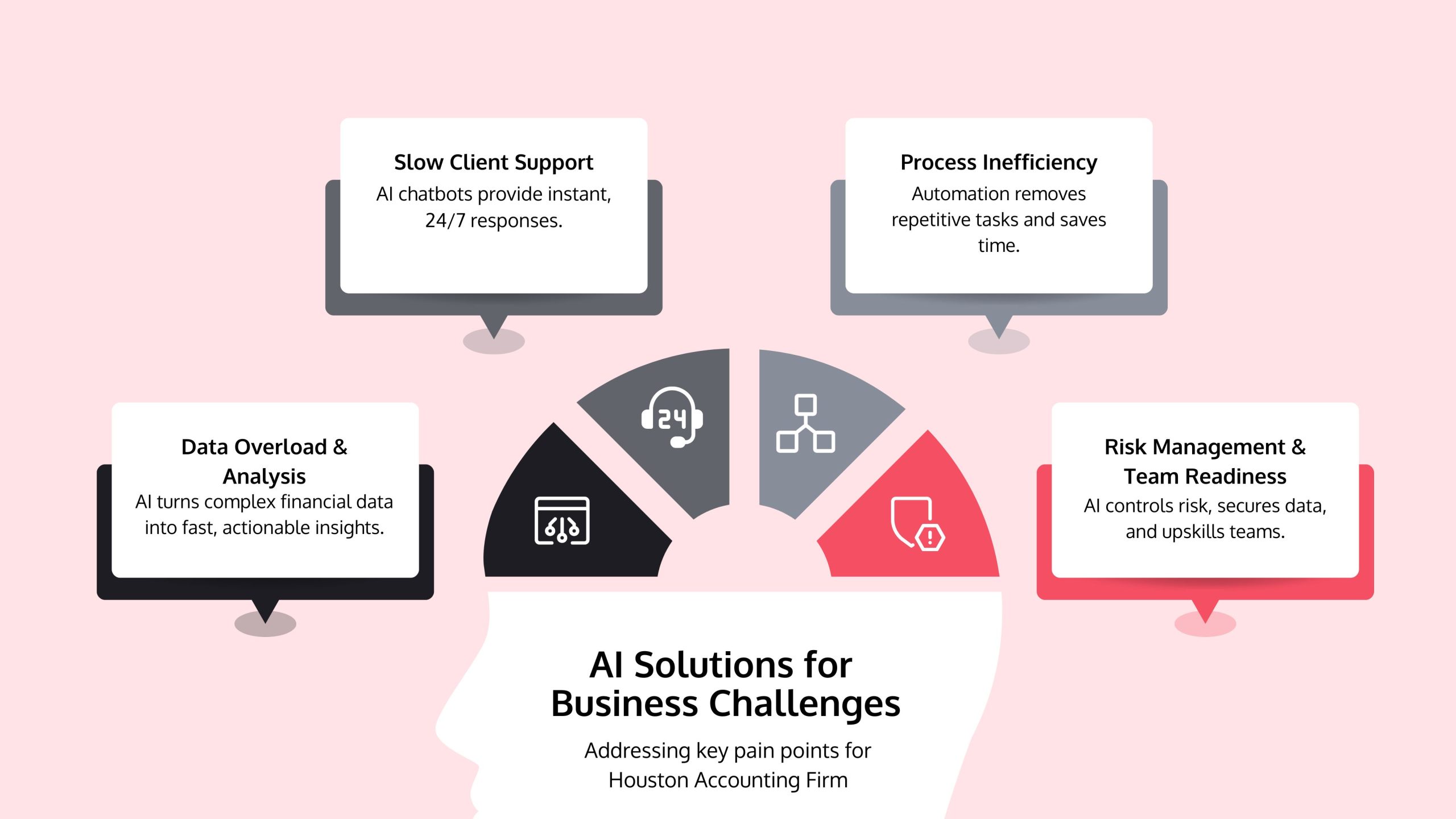
AI solutions for business challenges address three critical pain points for tax and accounting firms in the Houston metro area:
- Data overload: AI-powered analytics clean, organize, and interpret financial data up to 40% faster than manual methods.
- Slow client support: AI chatbots and virtual assistants cut response times from hours to minutes, even during peak tax season.
- Process inefficiency: Automation handles repetitive tasks—invoice processing, document routing, compliance checks—freeing staff for advisory work.
Tax and accounting firms in Houston, Sugarland, Conroe, and Katy face relentless data overload, slow client response times, and inefficient vendor management—especially during tax season. These bottlenecks waste hours and limit growth. AI, when applied with care, can cut through these problems. But most firms don’t know where to start or which challenges AI actually solves.
This guide shows you how to pinpoint the right business challenges for AI, select practical solutions, and manage risks—with examples from local accounting firms. You’ll learn what works, what doesn’t, and what to watch out for before you invest time or money.
The reality: 88% of businesses report regular AI use in at least one function as of 2024, up from 78% a year earlier. Yet two-thirds haven’t scaled AI across their operations, and many struggle to show measurable ROI. The difference? Firms that succeed start with a clear problem, pilot small, and build on proven wins.
The risks: High upfront costs, data security gaps, and staff resistance can derail AI projects fast. Firms that skip data prep or ignore compliance end up with “garbage in, garbage out” results—or worse, regulatory penalties.
I’m Orrin Klopper, CEO of Netsurit, a global IT services and digital change company. Over the past 30 years, I’ve helped more than 300 organizations—including tax and accounting firms—implement ai solutions for business challenges that deliver real results, from managed IT to secure AI adoption roadmaps. Below, you’ll find a step-by-step roadmap custom to the Houston metro area, with concrete examples, trade-offs, and next actions for each challenge.
Cut Data Overload and Speed Up Analysis with AI Tools
Data overload and analysis paralysis slow decision-making, costing firms valuable time and insights. Many Houston-area firms struggle to turn raw data—client financial statements, transaction logs, regulatory updates—into actionable insights quickly. The problem isn’t collecting data; the average person generates 1.7 MB of data per second. The real bottleneck? Only 37-40% of collected data ever gets analyzed, leaving a vast ocean of unused potential sitting in your systems.
AI solutions for business challenges like machine learning and AI-powered analytics can help you clean, organize, and interpret data faster. But here’s the catch: AI only works if you start with the right foundation. Poor data quality means poor results, no matter how sophisticated your tools.
How to select AI tools for data analysis challenges
When you’re drowning in data, the first step isn’t buying the flashiest AI tool. It’s getting your house in order. Focus on data preparation and quality first. AI models are only as good as the data they’re trained on. If your data is inconsistent, incomplete, or biased, AI will amplify those flaws and deliver inaccurate insights. This is the “garbage-in, garbage-out” principle in action. Before you invest in any AI platform, prioritize data governance, clean pipelines, and structured warehouses to ensure integrity.
Next, use AI-powered analytics platforms that integrate with your existing systems. Your goal is seamless integration, not adding another silo that creates more work. Look for platforms that connect with your current ERPs, CRM, and accounting software—tools like DataRobot or Alteryx can analyze large datasets in real time and provide insights for informed decision-making. Integration matters: if your team has to export, reformat, and manually upload data, you’ve just traded one bottleneck for another.
Finally, consider managed cloud services for secure, scalable data storage and processing. Handling vast datasets requires robust infrastructure. Managed cloud services offer the scalability and security you need without the heavy upfront investment in hardware. This allows you to process data efficiently while protecting sensitive client information. AI-powered FinOps, for instance, helps you operationalize data-driven cloud expenditure decisions to balance cost and performance safely.
Example: A Sugarland CPA firm used managed cloud analytics to automate the categorization of client expenses and identify potential tax deductions. This reduced monthly reporting time by 40% in Q1 2024, allowing their team to focus on higher-value advisory services. Their success wasn’t instant—it stemmed from an initial 3-month project dedicated to cleaning and standardizing years of client transaction data before AI implementation. That upfront investment paid off every month after.
Trade-offs box:
- Works best when: Data is well-organized, accessible, and consistently formatted across systems.
- Avoid when: Data is siloed, poorly maintained, incomplete, or you lack the resources for proper data preparation.
- Risks: Garbage-in, garbage-out (inaccurate insights); overreliance on automated outputs without human review; data privacy breaches if not properly secured; wasted investment if data quality isn’t addressed first.
- Mitigations: Regular data audits; human review and validation of AI-generated insights; robust data encryption and access controls; phased rollout starting with one clean dataset.
Automate Client Support and Internal Workflows for Faster Service
Manual client support and repetitive internal tasks drain staff time that could be spent on strategic advisory work. During tax season, Houston-area accounting firms field hundreds of calls about filing deadlines, document requirements, and payment statuses—questions that pull experienced professionals away from complex client cases. Meanwhile, internal approval chains and document routing create bottlenecks that slow everything down.
AI solutions for business challenges like these are increasingly practical. AI chatbots and workflow automation can handle routine queries and processes around the clock, freeing your team for higher-value, personalized client interactions. The data backs this up: 87% of consumers report neutral or positive experiences with AI chatbots, showing they’re no longer a risky experiment but a proven tool.
Steps to implement AI for client service and workflow automation
The key is starting small and building on what works. Begin with a pilot chatbot for common tax questions. Most client inquiries are repetitive—questions about W-2 forms, extension deadlines, or where to send documents. An AI-driven chatbot can answer these 24/7, cutting inbound call volume while providing instant responses. Your human team can then focus on the complex issues that require judgment and empathy. Tools like Chatbot or TARS integrate with most websites without requiring a complete system overhaul.
Next, automate repetitive internal approvals or document routing. Think about how many times a client file needs approval from three different people, or how invoices get passed from inbox to inbox before landing on the right desk. AI-powered workflow automation can intelligently route these processes based on content, priority, and availability. This cuts bottlenecks and speeds up internal operations without adding headcount.
Finally, use virtual assistants to triage client requests 24/7. For inquiries that need human expertise, AI virtual assistants can act as a smart first filter. They gather initial information, understand the client’s intent, and route the request to the most appropriate team member. This ensures no client waits until morning for a response, and your staff get requests that are already organized and ready for action.
Example: A Katy-based accounting firm deployed an AI chatbot in January 2024 to handle common tax season inquiries. The results were immediate: average client response time dropped from 2 hours to 15 minutes, and client satisfaction scores jumped during their busiest period. The firm also saw a 20% reduction in calls handled by human agents, allowing senior accountants to spend more time on complex tax planning and less time explaining Form 1040 instructions.
Trade-offs box:
- Works best when: FAQs and processes are well-documented and consistent; clients are comfortable with digital interactions.
- Avoid when: Interactions require high emotional intelligence or complex, non-standard problem-solving; clients expect only human interaction.
- Risks: Missed nuances in client queries leading to frustration; staff resistance if they feel their roles are threatened; potential for negative experiences if the AI is poorly designed.
- Mitigations: Implement a “human-in-the-loop” escalation path for complex or sensitive issues; clearly communicate the AI’s role to clients and staff; continuously monitor chatbot performance and update its knowledge base based on real interactions.
Control AI Costs, Secure Data, and Address Ethical Risks
AI projects can spiral out of control fast. What starts as a $5,000 pilot can balloon into a $50,000 commitment with unclear returns. Add the risk of a data breach—exposing client tax returns or financial statements—and you’re facing regulatory penalties, lost clients, and reputational damage that takes years to repair. Houston firms must weigh these factors carefully before scaling up ai solutions for business challenges.
The reality is sobering: high initial costs, technical complexity, and ethical concerns rank among the top barriers to AI implementation. AI systems can introduce inaccuracies that require human verification, and the same machine learning techniques that protect us are now being weaponized by attackers in sophisticated phishing and social engineering campaigns.
Managing costs, security, and ethics in AI adoption
To ensure our AI investments deliver value without introducing undue risk, we need a proactive strategy that addresses three critical areas: budget discipline, data security, and ethical safeguards.
Set clear budgets and start with small, high-impact pilots. The adoption of AI technologies involves substantial upfront investment—software licenses, cloud infrastructure, integration work, and staff training. To avoid budget overruns, begin with a pilot project that addresses one well-defined business problem with clear, measurable ROI. Can you cut monthly reporting time by 30%? Reduce client response times by half? These concrete targets let you test the waters, demonstrate value to stakeholders, and refine your approach before committing to larger-scale deployments. This gradual implementation minimizes financial risk and helps you gauge the true cost-benefit ratio.
Use managed cybersecurity and compliance services to protect sensitive data. AI solutions often process vast amounts of sensitive client financial data—tax returns, bank statements, payroll records. This makes robust cybersecurity non-negotiable. AI-powered facial recognition, behavioral analytics, and anomaly detection can strengthen your defenses, but attackers are using the same techniques to breach systems. You need a zero-trust architecture that assumes every access request could be malicious, combined with continuous monitoring and threat detection. Managed security services provide the expertise and 24/7 vigilance most firms can’t afford to build in-house, ensuring you meet compliance requirements for financial data protection and client confidentiality.
Establish policies for data privacy and ethical AI use. Ethical considerations aren’t optional extras—they’re fundamental to responsible AI deployment. We must address potential biases in algorithms (does your AI tool recommend audits more often for certain client demographics?), ensure transparency in decision-making (can you explain to a client why the AI flagged their return?), and protect client privacy at every step. This requires training leaders on AI biases and their ethical, privacy, and compliance implications. Develop clear policies for data stewardship, model security, and adversarial AI attack detection. An AI governance playbook that outlines roles, expectations, and validation processes ensures every team member understands their responsibility.
Example: A Conroe accounting firm partnered with a managed IT provider in March 2024 to implement AI-driven anomaly detection for financial transactions. This included deploying a zero-trust architecture to monitor AI system access and prevent unauthorized data use. Within two months, the system identified and blocked a sophisticated phishing attempt that leveraged AI to mimic client communications, protecting sensitive data and maintaining client trust. The firm estimates this prevented a breach that could have cost $200,000 in regulatory penalties and remediation.
Trade-offs box:
- Works best when: Security and compliance are built into the AI strategy from the start, not as an afterthought; leadership commits ongoing budget for monitoring and updates.
- Avoid when: Budget or leadership buy-in for security and ethical oversight is lacking; your firm doesn’t have clear data governance policies.
- Risks: Data breaches exposing client information; regulatory penalties from HIPAA or IRS violations; reputational harm that drives clients away; algorithmic bias leading to unfair outcomes; high costs without clear ROI.
- Mitigations: Regular security audits and penetration testing; mandatory staff training on AI ethics and data privacy; establish an AI governance task force with cross-functional representation; continuous monitoring and adjustment of AI models; clear incident response plans.
Build an AI-Ready Team: Upskill, Reskill, and Adapt
AI adoption changes job roles and skill needs—that’s not speculation, it’s already happening across Houston accounting firms. McKinsey reports that nine out of ten employees claim to use AI at work, yet resistance remains real. Some staff worry about job displacement as ai solutions for business challenges automate familiar tasks. But here’s what we’ve learned: firms that invest early in upskilling and reskilling their teams adapt faster, see better AI results, and keep their best people engaged.
The reality is straightforward. AI won’t replace your accountants; it will change what they do. Routine data entry and basic compliance checks? AI handles those. Strategic tax planning, complex client advisory, ethical judgment? That’s where your team adds irreplaceable value. The gap between these two realities is bridged by training.
Roadmap for building AI skills in your firm
Start by assessing current skills and identifying gaps. We need an honest inventory of what AI capabilities already exist in our team and where the knowledge holes are. This isn’t just about technical skills like data analysis or prompt engineering—though those matter. It’s also about critical thinking, ethical reasoning in an AI context, and the ability to question AI outputs rather than accept them blindly. For instance, prompt engineering has emerged as an essential skill: the ability to formulate refined questions that extract accurate, useful responses from AI systems. Your senior tax managers may already excel at this kind of structured thinking; they just need to apply it to AI tools.
Offer targeted training on AI literacy and new tools. Generic “AI 101” webinars won’t cut it. We need tiered programs: basic AI literacy for front-office staff who interact with clients, intermediate training for analysts who will use AI-powered tools daily, and advanced sessions for leaders making strategic AI decisions. Build continuous learning into daily workflows rather than treating it as a one-off event. Some firms have even tried reverse mentoring, where younger AI-savvy staff coach senior partners on practical applications and ethical pitfalls. AI’s ability to tailor educational materials to individual needs—a feature already proven in schools—can be adapted to internal training as well.
Encourage cross-functional teams to pilot AI projects. Theory only goes so far. Form small, cross-functional teams to tackle specific AI pilot projects—say, automating a monthly report or deploying a chatbot for a narrow set of client questions. This hands-on approach helps staff understand how AI augments their work and creates new opportunities, not just eliminates tasks. It also surfaces unexpected challenges early, when they’re cheap to fix.
Example: A Houston firm ran a 6-week AI upskilling program in Spring 2024, focusing on prompt engineering for generative AI tools and data interpretation for AI-powered analytics. By June, staff had automated three manual report generation processes, saving an estimated 15 hours per week. More importantly, employee engagement with AI jumped—people stopped seeing it as a threat and started treating it as a tool they controlled.
Trade-offs box:
- Works best when: Leadership actively supports continuous learning and provides clear career pathways for AI-skilled employees.
- Avoid when: Staff are already overloaded, resistant to change, or perceive AI training as an additional burden without clear benefits.
- Risks: Training fatigue; skills mismatch if training isn’t aligned with actual business needs; increased anxiety about job security.
- Mitigations: Offer short, focused training modules (not multi-day marathons); link AI skills directly to career growth and new opportunities; transparently communicate AI’s role in augmenting, not replacing, human roles.
Frequently Asked Questions: AI Solutions for Business Challenges
How do I start implementing AI with a limited budget?
Start small. Pick one business process where inefficiency hurts most—say, answering the same client questions every tax season or manually categorizing expenses. That single pain point is your pilot.
Look for commercial ai solutions for business challenges that plug into your current systems. You don’t need custom development or a six-figure consulting contract. Tools like Microsoft Copilot for Microsoft 365 offer a low-risk entry point for automating routine tasks and drafting client communications. You can explore features and updates on Microsoft’s Copilot Support Website. For broader IT and AI support custom to small businesses, Netsurit’s Small Business IT services can help you identify the right fit without overcommitting.
Pilot before you scale. Test your chosen tool on a small team or a single client segment for 30–60 days. Measure the result—time saved, errors reduced, client satisfaction—then decide whether to expand. This approach keeps costs predictable and proves value before you ask for a bigger budget.
Will AI replace accountants and tax professionals?
No—but it will change what you do every day. AI handles repetitive, rule-based work: data entry, transaction categorization, basic compliance checks. It doesn’t replace judgment, relationship-building, or the ability to interpret a client’s unique financial situation.
What ai solutions for business challenges really do is free you up for higher-value work. Think strategic tax planning, advising clients through complex life events, or spotting opportunities in their financials that no algorithm would flag. Firms that invest in upskilling—teaching staff to work with AI, not against it—will see new advisory and analytical roles emerge. The accountants who adapt fastest will be the ones clients trust most.
What is the single most important factor for successful AI adoption?
Data quality. Full stop.
AI tools are only as reliable as the data you feed them. If your client records are incomplete, inconsistent, or buried in disconnected systems, even the best AI will produce garbage results. This is the “garbage in, garbage out” principle, and it’s the number-one reason AI pilots fail.
Before you buy any tool, invest in data preparation: clean up duplicates, standardize formats, and centralize records. Regular data audits and governance policies matter more than the AI platform you choose. Get your data house in order first, and the AI will follow.
Ready to move forward? Assess your firm’s AI readiness, pick one process to improve, and monitor results closely. Explore Netsurit’s Innovate AI solutions to build your personalized roadmap and get support every step of the way.
Conclusion: Take the First Step Toward Smarter Business Operations
The accounting firms winning in Houston, Sugarland, and Katy aren’t the ones with the biggest AI budgets. They’re the ones who started with a single process, measured what worked, and built from there. AI solutions for business challenges deliver real results—faster reporting, happier clients, leaner operations—but only when you approach them with a clear plan and honest eyes.
Start by assessing where your firm bleeds the most time: is it monthly reporting cycles that drag into weeks, client questions that pile up during tax season, or manual data entry that keeps your best people from advisory work? Pick one process to improve. Run a small pilot. Track the results—time saved, errors reduced, client satisfaction scores—and adjust based on what the data tells you, not what the vendor promised.
The greatest risk in AI adoption isn’t picking the wrong tool. It’s waiting for perfect conditions that will never arrive. Your competitors are already testing chatbots, automating workflows, and upskilling their teams. The gap widens every quarter you delay.
Ready to move forward with a partner who understands both AI and the reality of running an accounting firm? Explore Netsurit’s Innovate AI solutions to build your personalized roadmap—one that fits your budget, your data, and your team’s readiness today.