The Hidden Costs of Manual Reconciliation
Automate reconciliation processes to eliminate the inefficiencies that drain your finance team’s time and introduce costly errors into your books. Here’s what you need to know:
Key Benefits of Automated Reconciliation:
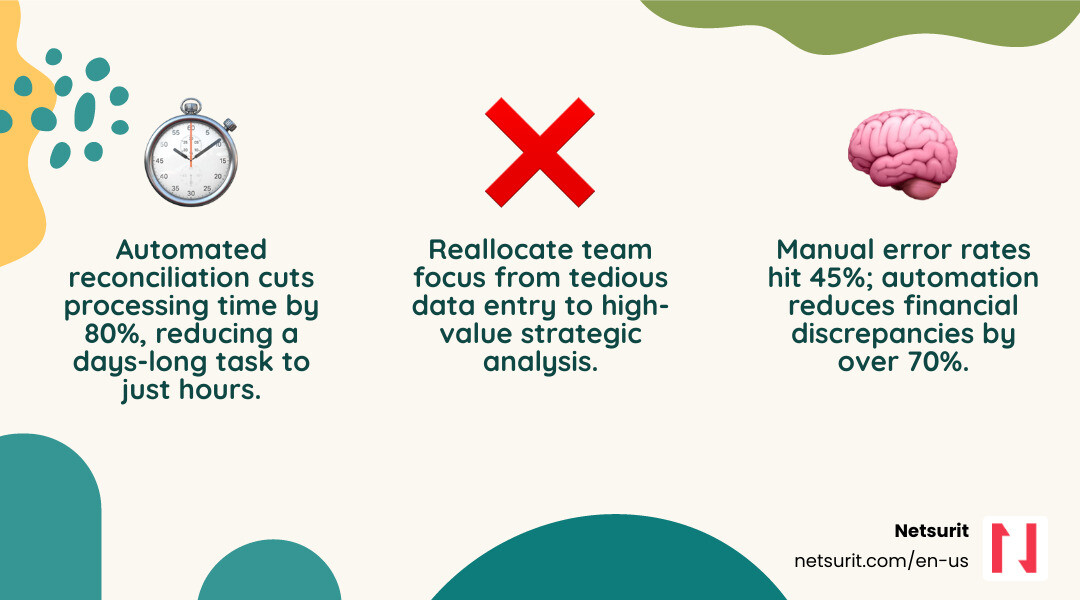
- Speed: Reduce reconciliation time by up to 80% (from days to hours)
- Accuracy: Cut error rates by over 70% (manual processes generate up to 45% error rates)
- Cost: Save thousands monthly in labor costs and error correction
- Visibility: Get real-time financial data instead of waiting 6+ days for month-end close
- Compliance: Create tamper-proof audit trails automatically
- Fraud Detection: Flag suspicious transactions instantly with AI-powered monitoring
Implementation Steps:
- Calculate your current manual reconciliation costs
- Select software that integrates with your ERP and bank feeds
- Configure matching rules and exception workflows
- Train your team on the new system
- Monitor performance and refine rules over time
Manual reconciliation is killing your accounting team’s productivity. If you’re running a firm in Houston, Katy, or Conroe, you know the drill: spreadsheets stacked high, late nights hunting for a missing $127.43, and skilled accountants burning hours on data entry instead of strategic analysis. The research is clear—manual error rates hit 45%, and half of all finance teams still take six or more business days just to close their books.
That’s not just inefficient. It’s expensive and risky. Every hour your team spends manually matching bank statements to ledgers is an hour they’re not analyzing cash flow, advising clients, or catching fraud before it costs you. With occupational fraud siphoning up to 5% of annual revenues globally—nearly $4 trillion—and 30% of fraud cases enabled by weak internal controls, you can’t afford the gaps that manual processes create.
The shift from manual to automated reconciliation isn’t about replacing people. It’s about freeing them to do work that actually moves the needle. Automation handles the tedious matching, applies consistent rules, and flags exceptions instantly. Your team reviews what matters and makes decisions based on accurate, real-time data.
I’m Orrin Klopper, CEO of Netsurit. Over nearly three decades building IT solutions for growing businesses, I’ve seen how the right technology transforms finance operations—and how the decision to automate reconciliation processes becomes a turning point for firms ready to scale without adding headcount. The firms that win in 2025 and beyond are the ones that treat reconciliation as a strategic capability, not a monthly chore.
Manual vs. Automated Reconciliation: A Fundamental Shift
For many years, the image of a finance professional surrounded by towering stacks of paper, carefully comparing ledger entries to bank statements, was standard. This was manual reconciliation: a painstaking, often frustrating, but necessary process. Today, that picture is rapidly changing. In 2024, only 60% of invoices were manually entered into ERP accounting systems, a significant drop from 85% in 2023. This decline highlights a fundamental shift in how businesses approach financial verification.
Manual Reconciliation
Manual reconciliation involves a person physically or digitally comparing two sets of financial records to ensure they match. This typically means exporting data from various systems—your general ledger, subledgers, bank statements, and payment processor reports—and then attempting to align them, often using spreadsheets like Excel. This process is inherently labor-intensive, time-consuming, and notoriously error-prone. Miskeyed figures, omissions, incorrect calculations, and duplicated entries are common, leading to error rates as high as 45%. This manual effort often drains productivity and can hurt team morale.
Automated Reconciliation
Automated reconciliation, on the other hand, uses specialized software to perform these comparisons. It systematically imports data from various sources, applies predefined rules to match transactions, and instantly flags any discrepancies or exceptions. This shift drastically cuts the time spent on tedious data sifting, allowing finance teams to focus on high-impact strategic work. Automated systems minimize risks by applying consistent matching rules, standardizing data inputs, and flagging exceptions instantly, resulting in liftd accuracy and confidence in financial reporting.
Process Comparison
Let’s look at how these two approaches stack up against each other:
| Feature | Manual Reconciliation (e.g., Excel) | Automated Reconciliation (Software) |
|---|---|---|
| Speed | Days or weeks | Minutes or hours |
| Accuracy | Low (error rates up to 45%) | High (errors reduced by over 70%) |
| Audit Trail | Incomplete, easy to alter | Complete, tamper-proof, time-stamped |
| Cost | High labor costs, productivity drain | Lower operational cost, high ROI |
| Scalability | Poor; struggles with volume | High; handles growing data easily |
| Staff Focus | Tedious data sifting | Exception handling & strategic analysis |
The necessity of automating reconciliation processes stems from the increasing size and complexity of today’s financial data sets. As businesses grow and transaction volumes surge, manual methods become unsustainable. Automation can reduce the reconciliation and certification process from hours to minutes, allowing finance teams to handle growing volumes of data and increasingly complex account structures without a corresponding increase in head count or manual effort. This isn’t just about efficiency; it’s about changing reconciliation from a reactive chore into a proactive financial control. For more information on optimizing IT infrastructure to support such automation, consider exploring IT outsourcing services.
Slash Errors and Recapture Hours: The Core Benefits of Automation
Automating your reconciliation processes isn’t just a technological upgrade; it’s a strategic move that delivers tangible benefits across your entire finance operation. From bolstering accuracy to empowering your team, the advantages are clear.
Achieve Unprecedented Accuracy and Reduce Risk
Manual reconciliation is inherently prone to errors, with 95% of reconciliation mistakes arising from human errors. These can include miskeyed figures, omissions, incorrect calculations, and mismatched or duplicated entries. Any of these can lead to significant financial misstatements and costly delays.
Automated systems drastically reduce this risk. By applying consistent, rules-based logic, they eliminate the potential for human oversight. Integrating automation into the financial reconciliation process has been shown to reduce errors by more than 70%. For an accounting firm in Katy, TX, this means using automation to apply consistent matching rules across all client accounts, reducing the risk of miskeyed figures and duplicate entries that can lead to costly write-offs. Automated systems minimize these risks by standardizing data inputs and instantly flagging exceptions, elevating confidence in financial reporting. Financial institutions that automate data integration and transaction matching can reduce their risk of error by as much as 50%. This level of accuracy is crucial for maintaining data integrity and strengthening internal controls, ensuring your financial records are always reliable.
More info about IT audits and assessments
Boost Team Productivity and Strategic Focus
One of the most compelling benefits of automation is its ability to free up valuable human capital. Manual reconciliation drains productivity, consuming significant time that could be better spent. Research shows that just 35% of finance professionals’ time is spent on high-value tasks like generating insights, while the rest is largely consumed by routine data collection and validation.
Automation can reduce account reconciliation time by up to 80%, freeing your team from monotonous data entry. Imagine the impact on a busy finance department in Houston: instead of spending hours sifting through transactions, your team can focus on analyzing financial data, investigating complex exceptions, and providing strategic insights to clients. This shift not only boosts employee morale by eliminating tedious work but also transforms your finance team into a more strategic asset for the business. They can proactively manage cash flow, identify trends, and contribute to business growth, rather than being bogged down in administrative tasks.
Improve Financial Visibility for Smarter Decisions
Timely and accurate financial information is the bedrock of sound business decisions. Unfortunately, manual reconciliation often creates logjams that delay crucial insights. Research shows that half of finance teams still take six or more business days to close, with Excel-driven processes and legacy systems cited as major obstacles.
Automated reconciliation tools eliminate these manually introduced logjams, drastically cutting the time spent on tedious data sifting. By quickly reconciling records, automated systems provide an accurate, real-time or near real-time picture of a business’s cash standing at any given moment. For a growing business in Houston, this means making informed decisions based on up-to-the-minute financial data rather than waiting for a week-old report. This improved visibility allows for better cash flow management, improved forecasting, and agile responses to market changes, directly contributing to business momentum.
Strengthen Compliance and Fraud Detection
In today’s regulatory landscape, robust internal controls and comprehensive audit trails are non-negotiable. Manual processes often fall short, leaving businesses vulnerable to compliance breaches and fraud.
Automated reconciliation software logs every step of the process—from data imports and matching rules to exception handling and access activity—creating a transparent, tamper-proof record. This detailed audit trail is essential for audits and compliance with regulations like the Sarbanes-Oxley Act of 2002, which requires publicly traded companies to establish and maintain internal controls for financial reporting. The Federal Deposit Insurance Corp (FDIC) also requires all financial institutions to create controls, systems, and programs appropriate for their size, nature, scope, and risk.
Beyond compliance, automation is a powerful weapon against fraud. Occupational fraud may cost organizations up to 5% of their annual revenues, approaching $4 trillion annually worldwide. A significant portion of this fraud, 30%, is enabled by a lack of internal controls, and 19% occurs because perpetrators can override existing controls. Automated systems apply consistent rules and instantly flag unusual transactions or patterns that might indicate fraudulent activity. This proactive detection and prevention capability, backed by a tamper-proof audit trail, significantly strengthens your defenses. For an in-depth understanding of the risks, refer to a study on occupational fraud by the Association of Certified Fraud Examiners.
How to Automate Reconciliation Processes: A 5-Step Implementation Guide
Implementing an automated reconciliation system might seem daunting, but by following a structured approach, you can ensure a smooth transition and maximize your return on investment. We’ve broken it down into five essential steps.
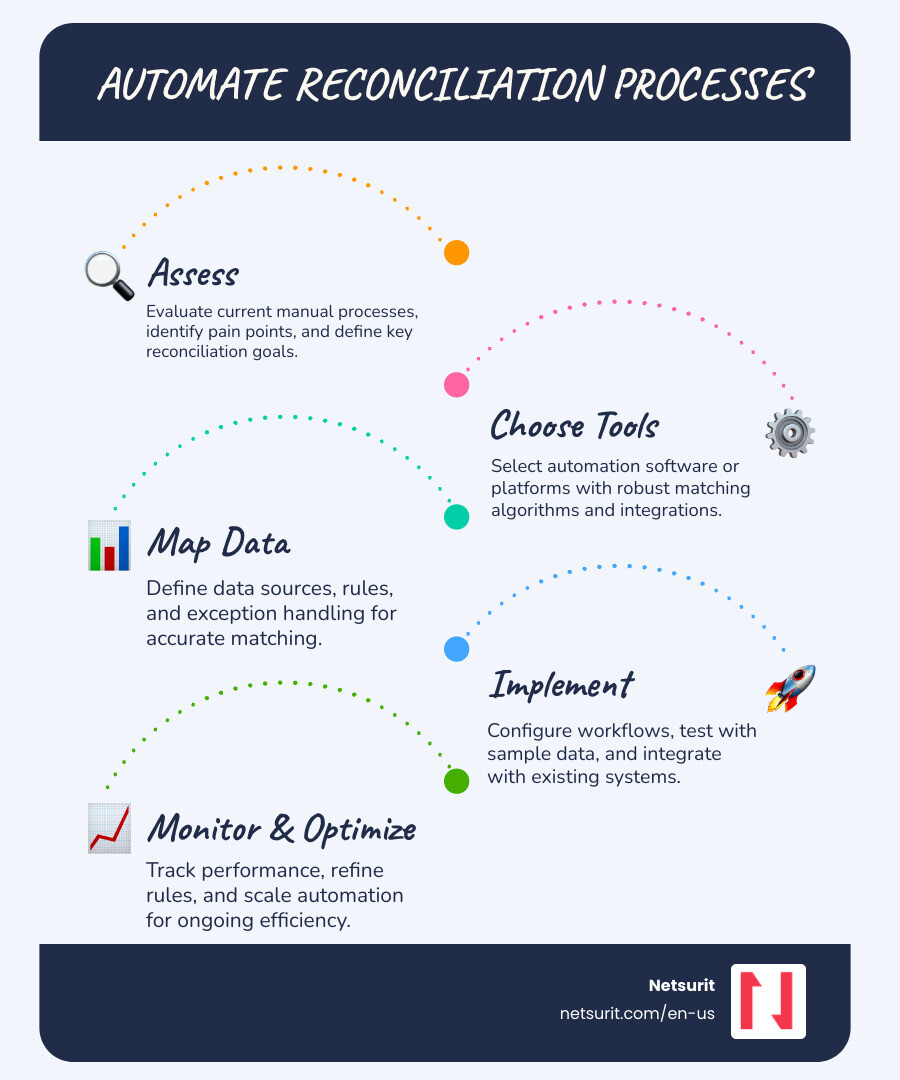
Step 1: Assess Your Current State & Build the Business Case
Before you can fix a problem, you need to understand it. Start by thoroughly documenting your current manual reconciliation processes. Identify bottlenecks, pain points, and the types of errors that frequently occur.
Next, quantify the costs. Calculate the hours your team in Conroe spends on manual reconciliation each month. This includes data gathering, matching, investigating discrepancies, and making adjustments. Multiply this time by their average hourly rate to understand the true labor cost. For example, reconciling 100 accounts manually each month can take over 366 hours, costing upwards of $7,320 per month at an average rate of $20/hour. Present this data alongside the potential time savings (up to 80%) and error reduction (over 70%) to build a compelling business case for the investment. A strong business case demonstrates transformative potential, focuses on measurable results, and is built collaboratively with key stakeholders.
Step 2: Select the Right Technology
Choosing the right automated reconciliation solution is crucial. The market for reconciliation software is booming, projected to grow from $3.52 billion in 2024 to $8.9 billion by 2033. This growth reflects the increasing demand for smarter, faster solutions.
Evaluate potential solutions based on their ability to integrate seamlessly with your existing ERP and accounting systems. Consider the flexibility of their matching rules—can they handle complex scenarios specific to your business? How robust is their exception handling, and do they provide clear audit trails? Look for a tool that offers scalability, ensuring it can grow with your transaction volumes and complexity. Our IT strategy services can help you steer this selection process, ensuring you pick a solution that aligns with your long-term business goals.
More info about IT strategy services
Step 3: Configure and Integrate
Once you’ve selected your software, the next step is configuration and integration. This involves working with your IT partner to connect the software to all your relevant data sources, such as bank feeds, payment processors, and internal ledgers. Modern tools pull data via APIs, bank feeds, and direct ERP connectors, eliminating manual exports entirely.
Configure the matching rules and workflows to automate as much of the process as possible. For example, you might set a rule to automatically match transactions where the invoice number, date, and amount are identical. For transactions with matching amounts but different dates (common for timing differences), you might configure the system to flag them for review rather than automatically matching. Pre-reconciliation data validation is also critical here, checking for required fields, consistent formats, duplicates, and currency integrity before matching begins.
Step 4: Train Your Team and Manage Change
Technology is only as good as the people using it. Effective change management and comprehensive training are vital for successful adoption. Address potential resistance by emphasizing that automation augments their roles, not replaces them. Explain how the tool frees them up from mundane, repetitive tasks to engage in more analytical, strategic, and ultimately more rewarding work.
Provide thorough training focused on how to use the new system, interpret results, and efficiently handle exceptions. Highlight the benefits to them personally, such as reduced stress, less overtime, and more opportunities for professional development. Employee adoption is a common challenge, so making the training approachable and showcasing the positive impact is key.
- Works best when… you have high transaction volumes, multiple data sources, or a need for stringent audit trails.
- Avoid when… your transaction volume is extremely low and simple, making the ROI on software and implementation difficult to justify.
- Risks… Poor data quality can hinder matching accuracy. Resistance to change can derail adoption.
- Mitigations… Implement a data cleanup project before you start. Involve your team early and communicate the benefits clearly.
Step 5: Monitor, Optimize, and Scale
Implementation isn’t the finish line; it’s just the beginning. After launching your automated reconciliation system, continuously monitor its performance. Track key performance indicators (KPIs) such as the auto-match rate, the average time to resolve exceptions, and the frequency of unresolved items.
Use this data to refine your rules and workflows, continuously improving the efficiency of your automated reconciliation processes. As your business evolves, so too should your reconciliation system. New transaction types, payment methods, or business lines may require adjustments to your matching logic. By treating reconciliation as a continuous operational system rather than a static checklist, you ensure it remains optimized and scales effectively with your organization.
The Future of Reconciliation: AI, ML, and Emerging Tech
The landscape of automated reconciliation is constantly evolving, driven by advancements in artificial intelligence, machine learning, and other innovative technologies. These trends promise to make reconciliation even smarter, faster, and more secure.
The Role of AI and Machine Learning in Modern Automated Reconciliation Processes
Modern systems use AI and machine learning to move beyond simple, rule-based matching. While rules-based logic is excellent for straightforward matches, AI and ML excel at handling the “messy middle”—the transactions that don’t quite fit. These technologies can analyze historical data to learn how your team resolves exceptions, then suggest or even automate those resolutions in the future. AI can also identify anomalies and potential fraud that rule-based systems might miss, adapting to changing transaction patterns and continuously improving accuracy and efficiency.
AI-powered platforms are evolving into “digital analysts” that can interpret complex financial data, forecast cash positions, and anticipate risks. Generative AI, for example, can analyze reconciliation results to provide insights and troubleshooting suggestions for inconsistencies, offering AI-suggested steps to resolve them. This means less time spent manually investigating and more time leveraging intelligent insights.
Key Technologies Shaping the Future
The reconciliation software market is projected to grow from $3.52 billion in 2024 to $8.9 billion by 2033, reflecting the growing demand for smarter, faster solutions. This growth is fueled by several key technological advancements:
- Tightly Integrated ERP Systems: Enterprise Resource Planning (ERP) systems act as the central nervous system for a business, creating a unified ledger and a single source of truth for financial data. When automated reconciliation solutions are deeply integrated with ERPs, they streamline data flow and ensure consistency across all financial operations.
- Real-time Data Feeds: The move towards real-time data feeds from banks, payment processors, and other financial institutions enables continuous reconciliation. This means transactions are matched as they occur, providing an immediate, accurate picture of cash flow and reducing the time to financial close.
- Blockchain Technology: Looking ahead, blockchain technology holds the potential to revolutionize reconciliation. By creating an immutable, distributed ledger for transactions, blockchain could make reconciliation instantaneous and inherently trustworthy, particularly for multiparty transactions or interbank settlements. While still nascent in this application, its promise for improved audit reliability is significant.
Automated Reconciliation in Action: Real-World Use Cases
Seeing is believing. Let’s explore how automated reconciliation processes are changing finance operations across various industries right here in our local area.
Banking and Finance
Financial institutions face immense pressure to maintain accurate records, manage liquidity, and comply with strict regulations. Manual reconciliation simply cannot keep pace with the thousands, if not millions, of transactions they process daily.
Consider a credit union in Sugarland, TX, that automates its daily reconciliation of over 10,000 transactions. This includes data from its core banking system, ATM network, and Federal Reserve accounts. This automation reduces a process that once took two full-time employees a full day down to a one-hour review of exceptions. This efficiency ensures accurate liquidity management and helps meet regulatory requirements without a sweat.
E-commerce and Retail
The e-commerce and retail sectors are characterized by high transaction volumes, diverse payment methods, and complex fee structures. Reconciling sales data with bank deposits and payment gateway payouts can be a nightmare with manual methods.
A Houston-based online retailer uses automated reconciliation to match thousands of daily payouts from platforms like Shopify and Stripe against their internal sales records and bank deposits. The software automatically accounts for transaction fees, refunds, and chargebacks, providing a clear, real-time view of daily cash flow. This allows the retailer to quickly identify discrepancies, manage their working capital effectively, and make informed purchasing decisions.
Energy Sector
The energy sector, with its global operations, complex supply chains, and multi-currency transactions, presents unique reconciliation challenges, especially around intercompany transactions.
An oil and gas services company in the Houston Energy Corridor automates its complex intercompany reconciliations. The system matches transactions across multiple subsidiaries operating in different countries and currencies. This automation eliminates a major bottleneck in their month-end close, significantly reducing the time required to prepare consolidated financial statements and ensuring their accuracy, which is vital for investor confidence and regulatory reporting.
Frequently Asked Questions about Automated Reconciliation
We often hear similar questions from businesses considering the leap to automated reconciliation. Here are some of the most common ones:
What is the difference between bank reconciliation and cash reconciliation?
While often used interchangeably, there’s a subtle but important distinction. Bank reconciliation specifically aligns your company’s general ledger with external bank statements. Its primary goal is to identify discrepancies like outstanding checks, deposits in transit, or bank fees that haven’t yet been recorded in your books. Cash reconciliation, on the other hand, is broader. It compares all internal records of cash activity—whether recorded by the bank or not—to provide a comprehensive, immediate view of your total cash position across all accounts and systems. Both are critical for financial accuracy, improving cash visibility, reducing risk, and strengthening overall financial management.
Can automation handle complex, multi-currency transactions?
Absolutely. Modern automated reconciliation solutions are specifically designed to handle complexity. They can manage multi-currency transactions by automatically applying the correct exchange rates and can reconcile intercompany transactions across different subsidiaries, even those with varying accounting standards or currencies. This capability is essential for businesses with international operations, ensuring consistency and accuracy in consolidated financial statements.
How do I choose the right automation tool for my business?
Choosing the right tool is a strategic decision. We recommend focusing on four key factors:
- Scalability: Can the solution grow with your business as transaction volumes increase and your operations become more complex?
- Integration: Does it seamlessly connect with your existing ERP system, accounting software, and bank feeds? Look for robust API capabilities.
- Compliance: Does it provide a comprehensive, tamper-proof audit trail and support your regulatory requirements?
- Ease of Use: Is the interface intuitive for your finance team, and does the vendor offer strong support and training?
Selecting a tool that matches your specific business needs and has a strong support system is paramount.
Conclusion: Move from Manual Matching to Strategic Insight
The era of manual reconciliation is rapidly drawing to a close. The hidden costs—in errors, wasted time, and missed strategic opportunities—are simply too high for any forward-thinking business to bear. To automate reconciliation processes is not merely an operational improvement; it’s a strategic imperative that transforms your finance function.
By eliminating manual drudgery, you empower your finance team to become a forward-looking, value-driving force, focusing on insights, analysis, and strategic growth. This shift delivers unprecedented accuracy, boosts productivity, provides real-time financial visibility, and fortifies your compliance and fraud defenses. At Netsurit, we understand the IT backbone required to support such a change. We can help you implement the right technology and strategy to make this change seamless, releaseing your business’s full potential.
More info about managed IT services in Houston