Why AI for Financial Due Diligence Matters Now
AI for financial due diligence transforms how organizations scrutinize financial health, identify risks, and structure deals—cutting review cycles from weeks to days while improving accuracy. Here’s what you need to know:
| Key Benefit | Impact |
|---|---|
| Speed | 80% reduction in initial data exploration time |
| Accuracy | 31% improvement in valuation precision |
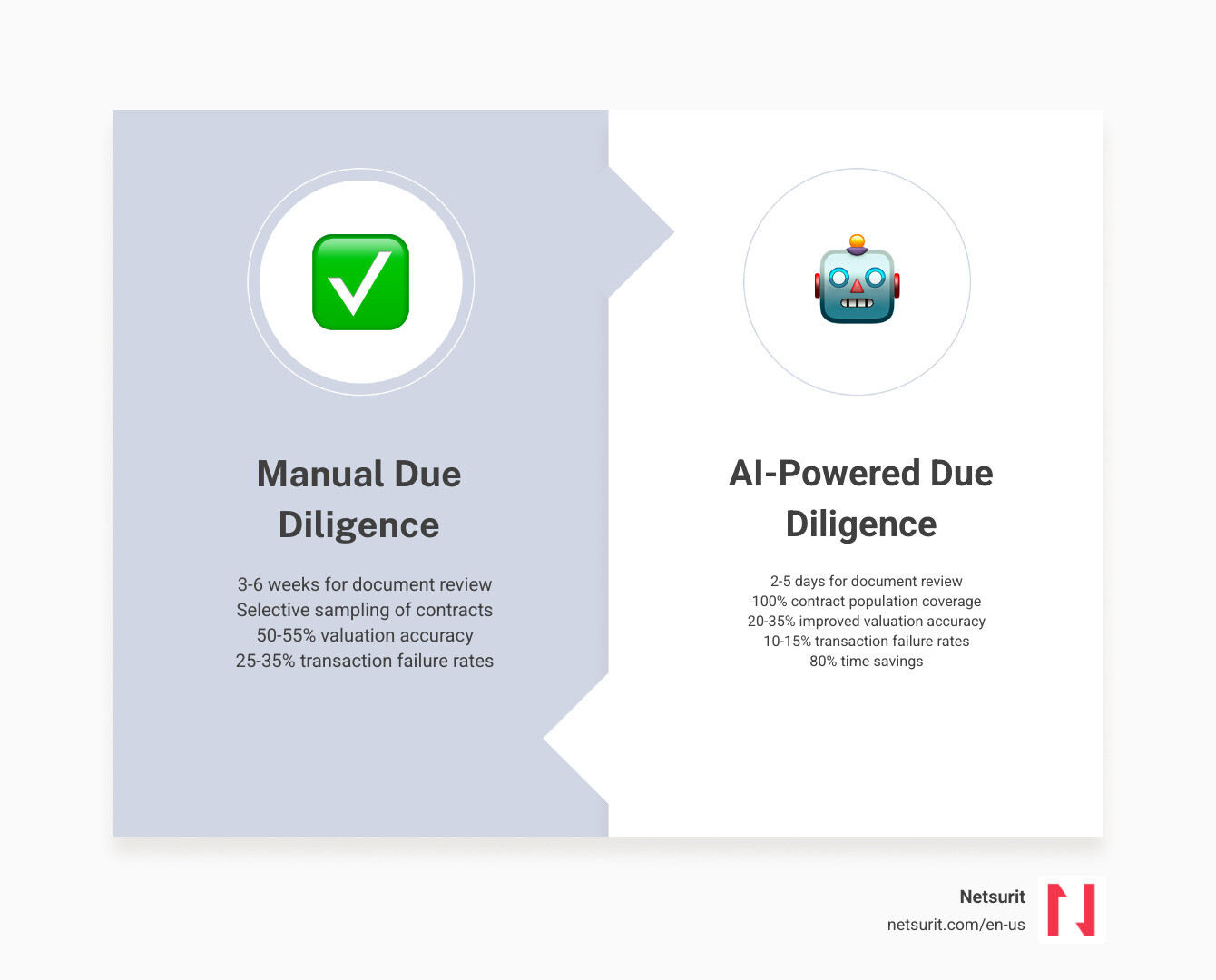
| Risk Reduction | 22% fewer transaction failures (10-15% vs. 25-35%) |
| Scalability | Analyze 100% of contracts instead of samples |
| Early Detection | Flag anomalies and fraud patterns invisible to manual review |
Traditional financial scrutiny in M&A transactions—the painstaking examination of balance sheets, contracts, tax filings, and operational metrics—has always been a bottleneck. Manual processes leave room for missed red flags, subjective interpretations, and rushed conclusions under tight deal timelines. The cost? Value leakage, post-close surprises, and deals that should never have closed.
AI changes this equation. Natural Language Processing (NLP) extracts critical clauses from thousands of legal documents in minutes. Machine learning models like XGBoost predict merger success with 62% precision by analyzing patterns across 20,000+ historical transactions. Platforms such as Kira.ai, Imprima AI, and KPMG’s AiDa automate data extraction, flag compliance issues, and benchmark financials against industry peers—all while maintaining audit trails for regulatory scrutiny.
But speed without governance creates new risks. AI can “hallucinate” false data, inherit bias from training sets, or expose sensitive information if deployed carelessly. The firms winning with AI treat it as an amplifier for human judgment, not a replacement. They customize models with proprietary deal data, build prompt libraries for consistent outputs, and enforce human-in-the-loop reviews at every decision point.
The shift from reactive post-close integration to proactive pre-deal intelligence is already measurable. Organizations using AI-driven due diligence report 90% faster VDR structuring, elimination of human indexing errors, and the ability to detect cross-contract liabilities that manual sampling would miss. For business leaders tired of unreliable processes and security gaps, AI offers a strategic edge—if implemented with discipline.
I’m Orrin Klopper, CEO of Netsurit, and over the past decade I’ve guided organizations through IT transformations that include deploying secure, scalable infrastructure for AI for financial due diligence workflows. From my experience, the difference between AI chaos and AI advantage comes down to data governance, the right architecture, and a people-first approach that keeps humans in control.
This guide walks you through the technical frameworks, proven use cases, implementation risks, and emerging capabilities—like agentic AI and continuous monitoring—that make financial scrutiny faster, sharper, and safer. Whether you’re evaluating your first AI tool or scaling across a portfolio, you’ll find actionable steps to move from potential to performance.
Simple AI for financial due diligence glossary:
- AI-powered financial analysis
- Data analytics auditing
- Machine learning audit
Accelerating Deal Cycles with AI for Financial Due Diligence
In the high-stakes world of M&A, time is the enemy of deal certainty. We have seen traditional due diligence processes drag on for months as analysts manually sift through Virtual Data Rooms (VDRs) overflowing with unstructured PDFs, Excel sheets, and scanned legal documents. This manual slog doesn’t just exhaust your team; it creates a window for market shifts or competitor counter-offers to derail the transaction.
By integrating AI for financial due diligence, we shift the focus from data collection to data interpretation. AI-powered VDRs now use intelligent indexing to structure thousands of files in hours rather than weeks. For example, Imprima AI Due Diligence reports a 90% reduction in VDR structuring time, virtually eliminating the human error inherent in manual folder organization. This speed directly translates to AI Productivity gains that allow your senior partners to spend their time on negotiation strategy rather than document sorting.
Automating Routine Data Extraction
The first hurdle in any financial review is getting the data into a usable format. We utilize tools like Kira.ai and Imprima to automate the “read and extract” phase. These platforms scan balance sheets, income statements, and cash flow statements to pull specific line items into a centralized dashboard.
This automation is particularly vital for firms managing high-volume transactions. By leveraging AI Tools to Reduce Manual Data Entry in Accounting Firm, teams can ingest 100% of the target company’s contracts to identify change-of-control clauses, renewal dates, and penalty structures. Instead of sampling 10% of contracts and hoping for the best, you gain a comprehensive view of the target’s obligations.
Reducing Transaction Failure Rates
M&A transactions fail for many reasons, but poor valuation and unforeseen risks top the list. Scientific research indicates that AI-supported deals show a failure rate of only 10-15%, compared to 25-35% for traditional deals. This 22% reduction in failure rates stems from the AI’s ability to detect “liquidity traps” and compliance violations that a human reviewer might miss during a late-night session.
Furthermore, the Scientific research on AI in M&A risk management highlights a 31% improvement in valuation accuracy. When your team uses AI to analyze historical data from over 20,000 global deals, they aren’t just guessing the target’s worth—they are benchmarking it against a decade of market reality.
Trade-offs: Automated Extraction
- Works best when: Processing standardized documents like SEC filings, 10-Ks, or large-scale lease agreements where the AI has high familiarity with the layout.
- Avoid when: Dealing with handwritten notes, poor-quality photocopies, or highly non-standardized local contracts that lack clear headers.
- Risks: Over-reliance on extraction without verifying the underlying context of legal clauses can lead to misinterpreting a “standard” clause that has a non-standard rider.
- Mitigations: We recommend a mandatory human-in-the-loop (HITL) review for any data points flagged with confidence scores below 90%.
Technical Frameworks: NLP, ML, and Predictive Modeling
To understand how AI for financial due diligence works, we have to look under the hood at three core technologies: Natural Language Processing (NLP), Machine Learning (ML), and Predictive Analytics. These aren’t just buzzwords; they are the engines that turn “dead” data into actionable intelligence.
NLP allows the system to “understand” the nuances of human language in financial documents. Unlike simple keyword searches, NLP identifies concepts. If an auditor asks, “What are the debt maturity profiles?”, the AI doesn’t just look for the word “debt”—it identifies tables, footnotes, and clauses related to lending agreements. For a deeper dive into how these models handle complex SEC filings, see LLMs for Financial Document Analysis.
Leveraging NLP for Document Review in AI for Financial Due Diligence
In the Houston metro area, legal and financial documents often involve complex joint operating agreements or intricate energy sector leases. Using Kira.ai, firms can automatically identify and extract these specific provisions across thousands of pages. This is the Best Way to Automate Accounting Firm Workflows with AI because it ensures consistency. A human might interpret a “change of control” clause differently at 8:00 AM than at 8:00 PM; the AI interprets it the same way every time.
Predictive Analytics and Valuation Accuracy
Predictive analytics takes historical performance and projects it into the future. In M&A, this is critical for synergy estimation. Will the combined entities actually save on overhead? Or will the integration costs swallow the benefits? By using Beyond the Numbers: Using Predictive Analytics for Strategic Accounting, analysts can run thousands of Monte Carlo simulations to see the range of likely outcomes.
We often point clients toward our On-Demand Webinar: AI in Finance to see how these models handle non-linear patterns in revenue. Traditional DCF models often miss these, but neural networks excel at spotting them.
Example: Houston Metro Scrutiny A mid-market accounting firm in Katy, TX, recently utilized predictive ML models to audit a target oilfield services provider. By May 2025, the AI identified a 14% discrepancy in projected maintenance CapEx that manual reviewers had missed. The model flagged that the target’s aging fleet would require significant overhauls not accounted for in the seller’s pitch deck, preventing a $12 million overvaluation before the final bid.
Strategic Use Cases: Fraud Detection and Risk Mitigation
One of the most powerful applications of AI for financial due diligence is its ability to act as a digital private investigator. Fraudsters and companies attempting to conceal assets often hide their tracks in complexity—intercompany transfers, shell companies, and inflated invoices.
AI thrives on this complexity. By analyzing the “full population” of transactions rather than just a sample, AI identifies outliers that don’t fit the established business pattern. This is a core part of Digital Finance Transformation: moving from “checking the boxes” to “finding the needles.”
Identifying Financial Irregularities and Concealment
Forensic accounting is traditionally a slow, expensive process. However, AI can now scan years of ledger data to detect circular funding patterns or duplicate invoicing in seconds. If a target company is using shell companies to inflate revenue, the AI’s network theory analysis will flag the lack of external economic substance in those transactions. As we discuss in AI to the Rescue: Fixing Your Business Problems with Smart Tech, these tools provide an immediate defensive layer against “creative accounting.”
ESG Benchmarking and Compliance
In May 2025, environmental, social, and governance (ESG) factors are no longer optional. A target company with hidden environmental liabilities or a supply chain dependent on unethical labor is a ticking time bomb. Diligent AI for ESG allows deal teams to benchmark a target’s sustainability reports against 26 different ESG categories. This ensures that you aren’t just buying a company’s past profits, but also its future regulatory compliance.
Trade-offs: Fraud Detection Models
- Works best when: Analyzing high-volume transaction data (millions of rows) for patterns of circular funding or “round-tripping” revenue.
- Avoid when: Qualitative “soft” information, such as a secret verbal agreement between two CEOs, is the primary risk factor. AI cannot hear what wasn’t written.
- Risks: High false-positive rates can lead to “alert fatigue,” where the audit team starts ignoring red flags because the system is too sensitive.
- Mitigations: We advise tuning models using your firm’s proprietary historical deal data to align the AI’s sensitivity with specific industry norms (e.g., energy vs. retail).
Managing Implementation Risks and Governance
We must be honest: AI is not a magic wand. If you feed it bad data, it will give you bad insights—at a much faster rate. Implementation of AI for financial due diligence requires a robust governance framework to manage risks like “hallucinations” (where the AI makes up facts) and algorithmic bias.
Our approach at Netsurit is to help firms build “private” AI environments. Feeding sensitive client data into a public LLM like the free version of ChatGPT is a recipe for a data breach. Instead, you need a secure, containerized solution where your data stays your data. For more on this, see Ready to Work Smarter? Let’s Talk AI.
Overcoming Hallucinations and Bias
Hallucinations often occur when an AI is asked to summarize a document it hasn’t fully “read” or when it tries to fill in gaps in a poorly scanned PDF. We mitigate this by using Retrieval-Augmented Generation (RAG). This forces the AI to cite its sources. If it claims the target has $50 million in debt, it must provide a link to the exact page and paragraph in the 10-K where it found that number. This “trust but verify” model is essential, a topic we explored in the BDO Webinar: AI, Accountants and the Death of Quick Fix.
Establishing Ethical AI Governance
Regulatory bodies are increasingly scrutinizing how AI is used in financial decisions. You must maintain an audit trail that shows why an AI flagged a risk. If a deal is blocked or a valuation is slashed based on an AI’s output, you need to be able to explain the logic to stakeholders and regulators. Our Accounting Firm IT Services focus on building these transparent systems that satisfy both internal auditors and external regulators.
Example: Sugarland Compliance Standards A tax firm in Sugarland, TX, implemented a private LLM instance to ensure client data never left their secure environment. By establishing a “Prompt Library” for their analysts—pre-vetted questions designed to extract specific tax liabilities—they reduced report generation time by 60%. Most importantly, they maintained strict adherence to Texas data privacy regulations, ensuring that no sensitive PII (Personally Identifiable Information) was ever exposed to public training sets.
Scaling Scrutiny with Agentic AI for Financial Due Diligence
The future of financial scrutiny lies in “Agentic AI.” Unlike standard AI that waits for a prompt, an AI agent is designed to achieve a goal. You might tell an agent, “Analyze this VDR and find all risks associated with the target’s intellectual property in Southeast Asia.” The agent will then break that down into sub-tasks: find the IP filings, check for litigation, verify ownership, and summarize the findings.
This evolution is moving due diligence from a one-time “event” to a continuous process. As noted in the McKinsey on Gen-AI in due diligence materials, this shifts the analyst’s role from a manual laborer to an orchestrator of multiple specialized agents.
The Shift to Continuous Post-Transaction Monitoring
The value of due diligence shouldn’t end at the closing dinner. We help firms implement AI for continuous monitoring post-transaction. By keeping the AI “plugged in” to the new subsidiary’s financial systems, you can ensure that the synergies identified during the deal are actually being realized. This ongoing vigilance is a key finding in Optimizing Due Diligence with AI, which shows that AI-driven firms maintain higher ROI long after the deal is done.
Building Specialized Agents for Financial Tasks
Leading firms are now building specialized agents for niche tasks. AiDa by KPMG is a prime example of a proprietary agent-based system that builds reports by progressing from general trends to specific anomalies. Whether you use a platform like Tribe AI or build your own, the goal is the same: create a “team” of digital analysts that never sleep, never get bored, and never miss a decimal point.
Frequently Asked Questions about AI for Financial Due Diligence
How much time does AI save in the initial data exploration phase?
AI-powered tools typically reduce initial data exploration time by 80%. In our experience with Houston-area firms, this allows deal teams to move from three weeks of manual document sorting to just 2-3 days of targeted, high-value analysis.
Can AI accurately predict the success of a merger?
While no tool can guarantee success, models like XGBoost have achieved up to 62% precision in predicting merger outcomes. This is a significant step up from the 50-55% accuracy rates of traditional manual frameworks, largely because AI can process non-linear risks that humans often overlook.
What are the biggest risks of using AI in financial reviews?
The primary risks are “hallucinations” (generating false data), algorithmic bias (reflecting errors in training data), and data privacy breaches. We mitigate these through private cloud deployments, RAG (Retrieval-Augmented Generation) for source citing, and mandatory human-in-the-loop validation.
Conclusion
The era of manual, sample-based financial scrutiny is ending. For firms in New York, Texas, and beyond, AI for financial due diligence is no longer a futuristic luxury—it is a competitive necessity. By automating the routine, identifying the hidden, and predicting the probable, AI allows you to move faster and with more confidence than ever before.
At Netsurit, we specialize in the “unglamorous” but essential work of building the data foundations and secure architectures that make AI work. We help you transition from data overload to decision clarity, ensuring your technology helps you scale rather than holding you back. If you are ready to modernize your deal flow, let’s explore how we can integrate Digital Transformation for Accounting into your next transaction.
Next Action: Audit your current VDR process. If your team is spending more than 48 hours on manual document indexing, it’s time to pilot an AI-driven extraction tool.