Auditing Smarter: How AI Transforms Internal Controls
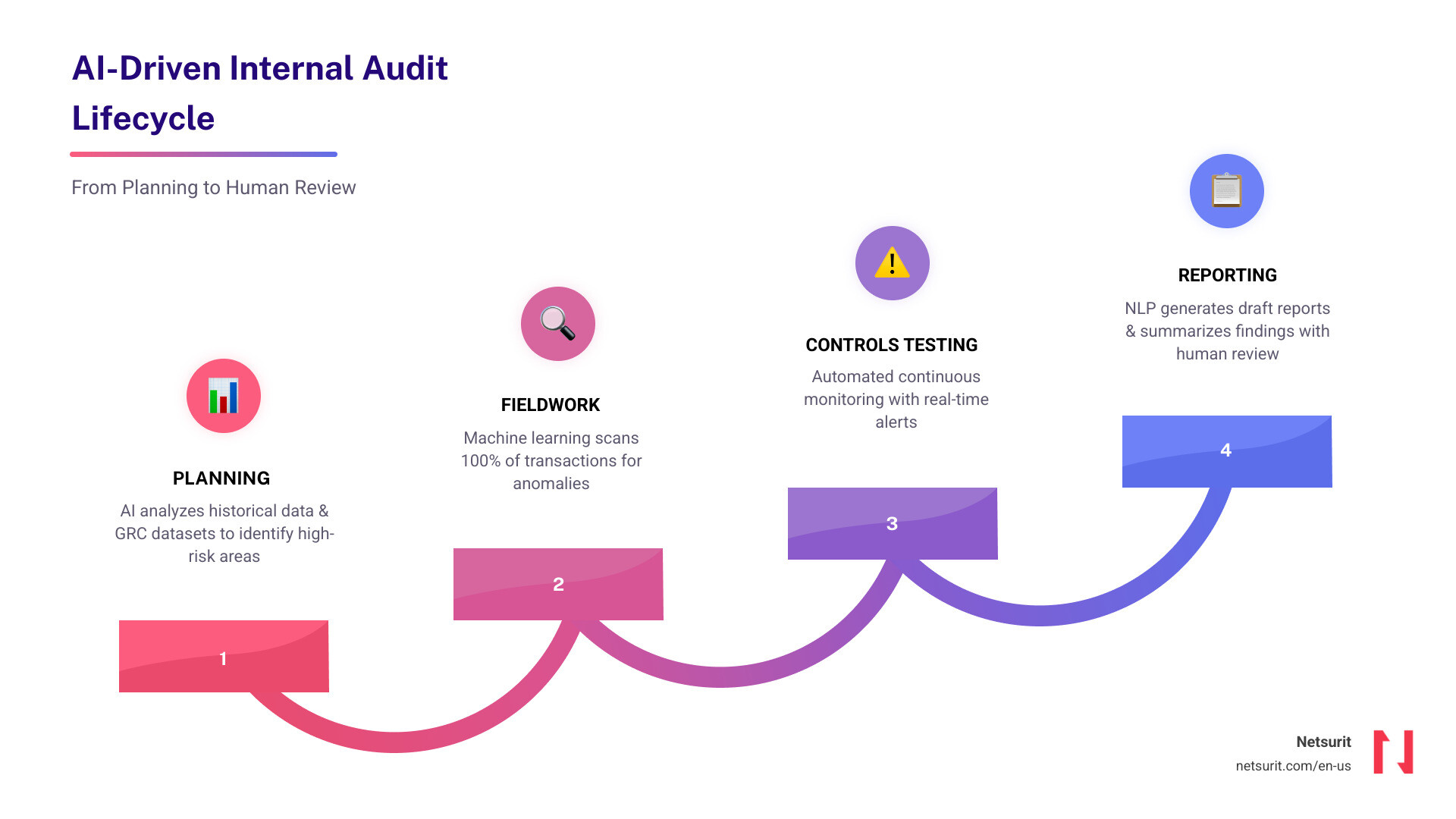
AI in internal audit is shifting how organizations detect fraud, assess risk, and manage compliance — moving from slow, manual sampling to continuous, data-driven analysis across 100% of transactions.
Here is what that means in practice:
| What AI Does in Internal Audit | Result |
|---|---|
| Analyzes every transaction, not just a sample | Catches risks traditional audits miss |
| Detects anomalies in real time | Reduces fraud detection time by up to 60% |
| Automates routine tasks like reconciliations and report drafts | Cuts control testing time by up to 40% |
| Monitors controls continuously | Replaces periodic audits with always-on oversight |
| Processes unstructured data (contracts, emails, meeting notes) | Broadens risk coverage beyond financial data |
Traditional audits rely on periodic sampling. That means most transactions go unchecked, risks surface late, and audit teams spend the bulk of their time on administrative work rather than judgment-heavy analysis. With data volumes growing and regulatory pressure rising, that model is breaking down.
AI does not fix everything — implementation costs are real, hallucinations in AI outputs are a known risk, and 40–60% of AI adoption efforts fail without the right governance in place. But for organizations that get it right, the gains are significant: machine learning achieves 85% fraud detection accuracy versus 60% for traditional methods, and the global AI in audit market is projected to reach $11.7 billion by 2033.
This guide covers what actually works, what to watch out for, and how to build a foundation for AI-driven auditing your team can trust.
I’m Orrin Klopper, CEO of Netsurit, and over nearly three decades of guiding organizations through digital transformation — from cloud adoption to AI integration — I’ve seen how the right technology strategy separates firms that thrive from those that fall behind, including in high-stakes areas like AI in internal audit. What follows draws on that experience, combined with the latest research, to give you a practical, honest roadmap.
Quick AI in internal audit definitions:
- Data analytics auditing
- Machine learning audit
- Reduce audit risk
AI’s Growing Footprint in Internal Audit: Trends and Adoption

The shift toward AI in internal audit is no longer a “future” trend; it is a current operational reality. Statistics show that 39% of auditors currently use AI, and an additional 41% plan to implement it by 2026. This rapid adoption is fueled by a global market for AI in audit that is projected to reach $11.7 billion by 2033, growing at a staggering CAGR of 27.9%.
We see a fundamental change in how audit leaders view their role. Eight out of 10 global decision-makers believe AI will meaningfully improve reporting and audit/risk processes by 2027. This confidence stems from the technology’s ability to move the needle on core metrics: pilot projects using AI frequently experience efficiency improvements of up to 50%.
Adoption Trends in Houston Accounting Firms
In the Houston metro area—spanning the energy hubs of the Energy Corridor to the medical and professional services in Sugarland and Katy—the pressure to modernize is intense. Firms in Conroe and The Woodlands are increasingly using AI to manage complex supply chain audits and regulatory compliance. For these local businesses, AI is the only way to process the sheer volume of data generated by cloud platforms and global operations without ballooning headcount.
Practical Use Cases: From Fraud Detection to Reporting
The most immediate impact of AI in internal audit is the death of manual sampling. Why check 50 invoices when you can check 50,000 in the same amount of time?
| Feature | Manual Sampling | AI-Driven Analysis |
|---|---|---|
| Data Coverage | 0.5% – 5% of transactions | 100% of transactions |
| Risk Detection | Reactive, misses hidden patterns | Proactive, identifies anomalies |
| Efficiency | High labor cost per item | Low marginal cost per item |
| Continuous Monitoring | Periodic (Quarterly/Annual) | Always-on, real-time alerts |
By leveraging tools like MindBridge or AuditBoard, teams can analyze 100% of transaction populations. This transition ensures that no “needle” stays hidden in the haystack. For more on the tools driving this change, you can explore more AI tools for accounting.
Enhancing Fraud Detection with AI in internal audit
Machine learning is significantly more effective at spotting fraud than traditional rules-based systems. Research indicates that AI-powered anomaly detection is 70% more effective than manual solutions, achieving 85% accuracy in pattern recognition.
Consider a mid-sized logistics firm in Katy. By implementing AI, they can flag duplicate payments or vendor master data changes that happen at 2:00 AM on a Sunday—red flags that a human auditor might miss during a standard month-end review. AI can also identify “split purchases” designed to bypass approval thresholds or anomalous expense claims that fall just under the radar of manual spot-checks.
Key fraud indicators AI can detect:
- Unusual transaction volumes or spikes in activity.
- Access log anomalies (e.g., employees accessing systems during off-hours).
- Duplicate payments across different vendors or periods.
- Unauthorized changes to vendor bank account details.
- Anomalous expense claims that deviate from historical peer averages.
Streamlining Reporting and Documentation
Natural Language Processing (NLP) is the workhorse of the reporting stage. It can reduce time spent on administrative tasks and manual regulatory reviews by 30% to 40%. Instead of spending days drafting a report, auditors can use AI to summarize findings from thousands of workpapers instantly.
Tools like Microsoft Copilot are already helping teams draft process narratives from interview transcripts and meeting notes. You can discover how Copilot changes your workday to see how these efficiencies manifest in standard documentation workflows.
Navigating Risks and Ethical Challenges
We must be realistic: AI is not a “set it and forget it” solution. One of the biggest hurdles is the non-deterministic nature of Large Language Models (LLMs). An AI might provide the correct answer 95% of the time, but the remaining 5% can involve “hallucinations”—confidently stating facts or standards that do not exist. In an audit context, a 5% error rate in logic is unacceptable without human intervention.
Data privacy is the other major concern. Feeding sensitive financial data into a public version of ChatGPT is a recipe for a data breach. To mitigate this, firms must use enterprise-grade, private instances of AI tools where data is encrypted and not used to train the public model.
Building a Secure Foundation for AI in internal audit
To ensure responsible use, audit teams should align with The IIA’s updated AI auditing framework. This includes maintaining SOC 2 compliance and ensuring that every AI-generated insight is validated by a human auditor. This “human-in-the-loop” approach ensures that professional skepticism remains the cornerstone of the audit, even when the heavy lifting is done by an algorithm.
Trade-offs of AI Integration
- Works best when: You are analyzing high-volume, structured data (like T-code logs or accounts payable) for pattern recognition.
- Avoid when: You are interpreting subjective legal nuances, complex ethical dilemmas, or human intent that requires deep contextual understanding.
- Risks: Data leakage via public models, “black box” algorithms that can’t explain their reasoning, and over-reliance on AI that dulls an auditor’s natural skepticism.
- Mitigations: Use private cloud environments, implement “Explainable AI” (XAI) tools, and require mandatory human sign-off for all AI-generated findings.
Strategic Implementation and Future Outlook
Implementing AI in internal audit requires a phased approach. You don’t need to automate your entire department overnight. Start by building a “prompt library”—a collection of vetted, effective queries that your team can use to get consistent results from LLMs.
Foundational implementation steps:
- Define Objectives: Identify which manual tasks (e.g., SOD conflict flagging) are the biggest bottlenecks.
- Assess Capabilities: Determine if your current data is “clean” enough for AI to process.
- Select Tools: Choose between enterprise solutions like Microsoft Copilot or specialized audit platforms like MindBridge.
- Pilot Projects: Run a small-scale test on a single audit area, such as payroll or T&E expenses.
- Scale and Upskill: Train your staff on AI literacy and expand the use case to broader risk assessments.
- Continuous Monitoring: Regularly audit the AI itself to ensure it hasn’t developed bias or drift.
Foundational Steps for Audit Leaders
Leaders in Houston-area firms should focus on demonstrating immediate ROI. For example, using AI to cut control testing time by 40% is a powerful metric to bring to the board. We recommend exploring AI for business problems to see how these technologies integrate with broader organizational goals.
What to Watch Next: Agentic AI in Houston Energy Audits
The next frontier is “agentic AI”—AI systems that don’t just answer questions but can autonomously perform tasks. In the Houston energy sector, we expect to see AI agents that continuously monitor SOX controls and predict control failures before they occur. These “persistent” AI sessions will act like a digital junior auditor that never sleeps, flagging risks in real-time across complex global supply chains.
Frequently Asked Questions about AI in Auditing
Will AI replace human internal auditors?
No. AI automates the “drudge work” of data extraction and pattern matching. It cannot replace the professional judgment, ethical reasoning, and stakeholder relationship management that define a senior auditor’s role. It shifts the auditor from a “data processor” to a “strategic advisor.”
How does AI improve audit accuracy compared to sampling?
Traditional sampling is a game of probability; you hope your sample represents the whole. AI eliminates that guesswork by analyzing 100% of the data. This allows it to find “outlier” transactions that would never be caught in a 5% or 10% sample.
What are the primary security risks of using AI in audits?
The main risks are data leakage (using public AI tools with private data), hallucinations (incorrect AI outputs), and “shadow AI” (employees using unapproved AI tools). Mitigate these by using enterprise-licensed tools and maintaining strict human oversight.
Conclusion: Your Next Steps Towards AI-Powered Audits
AI is no longer a luxury for the Big Four; it is a necessity for any internal audit function that wants to remain relevant. By moving from sampling to 100% population analysis, you aren’t just working faster—you’re providing a higher level of assurance to your stakeholders.
The path forward involves a blend of the right technology and a commitment to upskilling your team. To see how your firm can begin this journey, learn more about digital transformation for accounting with Netsurit. We are here to help you navigate the complexities of AI, ensuring your audit function is a driver of business momentum rather than a bottleneck.
Next Action: Schedule a review of your current manual audit processes to identify one high-volume area—like accounts payable or access logs—as a candidate for an AI pilot project.