
Why Your Financial Reporting Process Needs an Upgrade
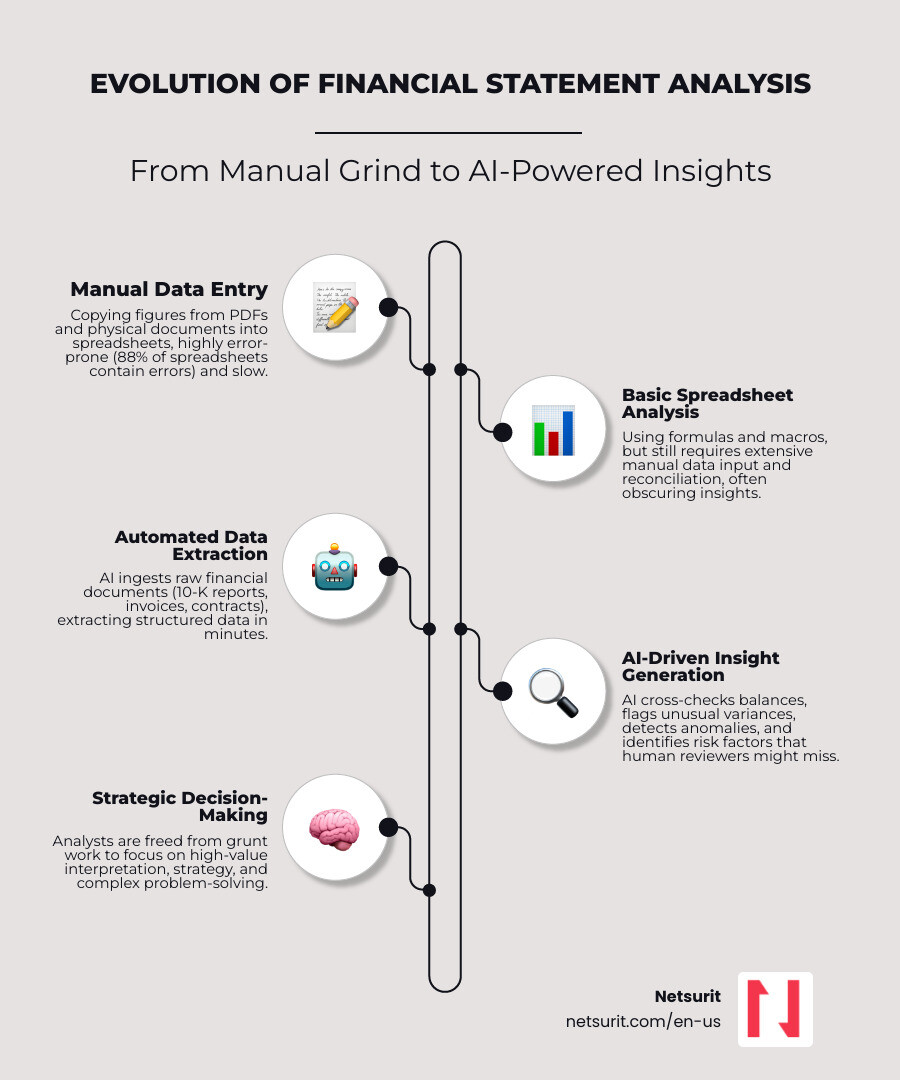
Financial statement analysis is notoriously tedious, slow, and prone to error. For accounting firms and corporate finance teams, this manual grind wastes billable hours and obscures strategic insights. AI for financial statements changes this by automating data extraction, reducing errors, and delivering faster, deeper analysis.
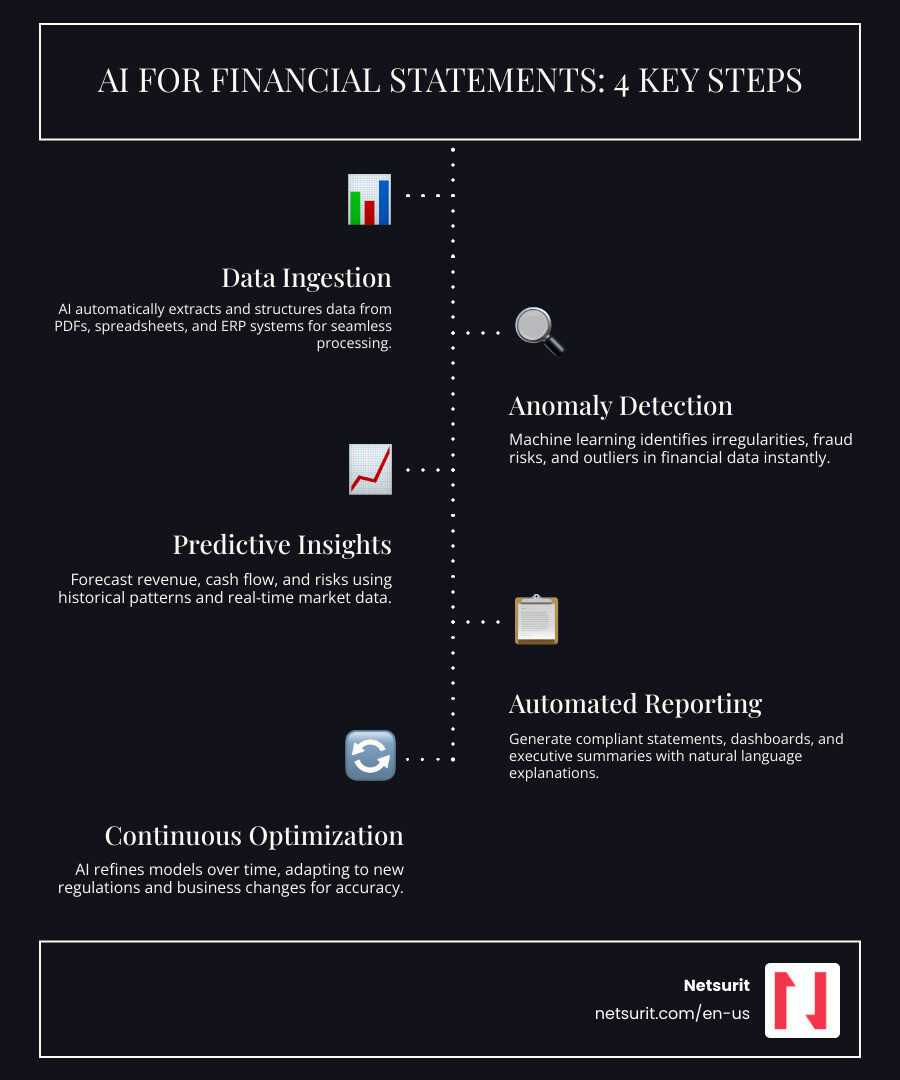
AI doesn’t replace skilled analysts—it automates the grunt work. It ingests raw financial documents, extracts structured data, cross-checks balances, and flags unusual variances. This frees your team to focus on high-value strategy and decision-making instead of copy-paste loops. With nearly 88% of spreadsheets containing errors, the case for automation is clear.
Roughly 97% of leaders in financial reporting plan to use more generative AI within three years. Those who adopt it now gain a competitive edge through faster close cycles, fewer errors, and the capacity to serve more clients without proportionally growing headcount.
I’m Orrin Klopper, CEO and co-founder of Netsurit, a global IT services and digital change company. Over the past decade, I’ve helped hundreds of organizations modernize their IT infrastructure and workflows, including deploying secure, compliant systems that enable AI for financial statements. The firms that succeed with AI treat it as a strategic partner, not a magic bullet.
Why Traditional Financial Analysis Is Broken (And How AI Fixes It)
Traditional financial analysis, particularly involving financial statements, is a painstaking process riddled with inefficiencies. The sheer volume and complexity of financial documents demand significant human effort, often leading to delays and inaccuracies. This is where AI for financial statements steps in, addressing these pain points head-on.
Here are the main inefficiencies AI can resolve:
- Manual data extraction: Analysts spend countless hours manually extracting data from diverse sources like SEC filings, annual reports, and earnings releases. This isn’t just tedious; it’s a bottleneck. AI, especially with Natural Language Processing (NLP), can automate this, rapidly pulling relevant figures and text from documents, regardless of their format.
- Spreadsheet errors: It’s a sobering fact: nearly 88% of spreadsheets, including those used in finance, contain errors. These mistakes, often due to manual input or formula errors, can lead to flawed financial models and incorrect decisions. AI-powered validation tools can cross-check data, identify inconsistencies, and flag potential errors far more reliably than human review alone.
- Time consumption: The analysis process is inherently slow. The average 10-K report length has roughly doubled between the early 2000s and late 2010s. Imagine the time required to comb through hundreds of pages for key information. AI significantly cuts down this time, processing vast datasets in minutes, allowing for real-time analysis and faster decision-making.
- Buried insights: Critical information is often buried in footnotes, Management Discussion and Analysis (MD&A) sections, or obscure appendices. Manually sifting through these dense reports can lead to missed details and suboptimal investment decisions. AI can pinpoint these crucial insights, summarizing complex documents and highlighting key risk factors or opportunities.
AI doesn’t just automate; it improves. It improves accuracy by reducing human error, provides deeper insights by analyzing patterns across massive datasets, and accelerates the entire financial reporting cycle.
Example: A Katy, TX Accounting Firm
A mid-sized accounting firm in Katy, TX, found itself dedicating over 40 hours per client each quarter to financial reporting. Their process involved manually keying data from various PDFs into Excel spreadsheets, a labor-intensive task prone to transcription errors. By implementing an AI for financial statements tool, they dramatically cut this process to under five hours. The system not only automated the data entry and reconciliation but also flagged unusual variances in accounts payable that the team had previously overlooked. This early detection prevented a potential overpayment to a vendor, saving the firm and its client significant resources and headaches.
The Core AI Technologies Changing Financial Statements
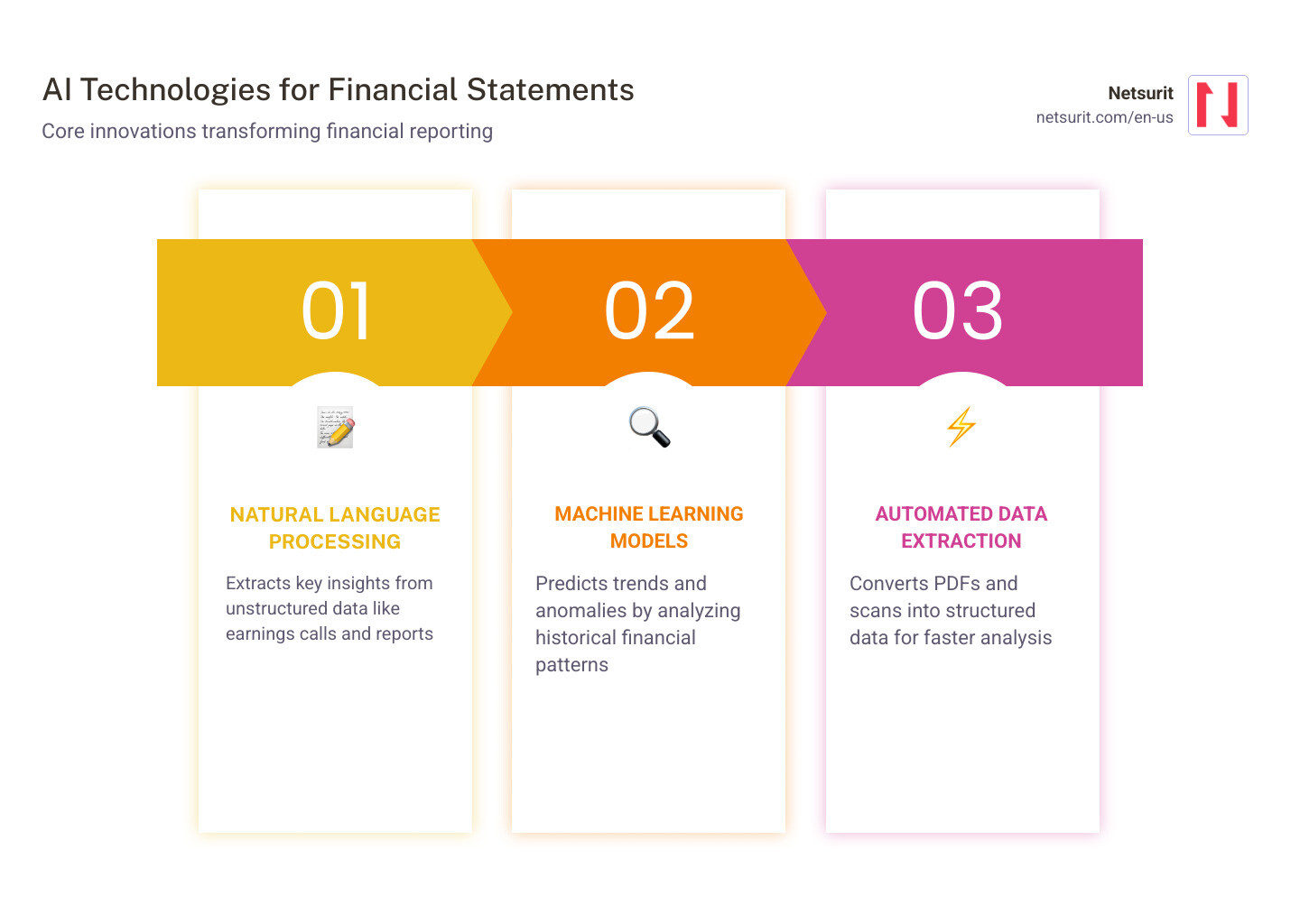
The revolution in financial statement analysis is powered by several key AI technologies, each bringing unique capabilities to the table. Understanding these technologies is crucial for any firm looking to integrate AI for financial statements.
- Machine Learning (ML): This is the foundation of many AI applications. ML algorithms learn from historical data to identify patterns, make predictions, and automate tasks. In finance, ML models can predict earnings changes, detect anomalies that might indicate fraud, and forecast market trends by analyzing vast amounts of quantitative data.
- Natural Language Processing (NLP): Financial documents are rich in text. NLP allows AI to understand, interpret, and generate human language. This is vital for extracting information from unstructured text in SEC filings, contracts, and news articles, summarizing lengthy reports, and even answering natural language queries about financial data.
- Generative AI: This advanced form of AI, exemplified by models like GPT-4, can create new content, whether it’s drafting financial reports, summarizing lengthy documents, or generating insights based on complex data. It accelerates document creation and transforms raw data into actionable narratives.
- Large Language Models (LLMs): A subset of generative AI, LLMs are trained on massive text datasets, enabling them to understand context, generate coherent text, and perform complex reasoning tasks. Research shows that LLMs like GPT-4, especially with chain-of-thought prompting, can even outperform human financial analysts in predicting earnings changes.
- AI Agents: These are AI systems designed to autonomously perform multi-step tasks by orchestrating different AI tools and data sources. For financial analysis, an AI agent could be tasked with gathering all relevant data for a due diligence report, analyzing it for risks, and then drafting a summary, all with minimal human intervention.
How to Choose the Right AI Tool for Your Firm
Selecting the right AI for financial statements tool for your firm in the Houston metro area requires a strategic approach. It’s not about adopting the flashiest technology, but the one that best fits your specific needs and workflows.
- Pinpoint where to save time: Start by identifying the most time-consuming, repetitive, and error-prone tasks in your current financial workflows. Is it data entry, reconciliation, report generation, or anomaly detection? Target these high-impact areas for AI automation.
- Match tools to your data needs: Consider the type and volume of data you handle. Do you primarily work with structured data in spreadsheets, or do you need to extract insights from unstructured text in PDFs and legal documents? Some tools excel at quantitative analysis, while others leverage NLP for textual data.
- Demand trustworthy outputs: Financial analysis requires accuracy and verifiability. Look for AI tools that provide clear, trustworthy outputs, offering features like source citations or explanations of their reasoning. This helps maintain audit trails and builds confidence in the AI’s results.
- Check system integration: An AI tool is only as good as its ability to integrate with your existing systems. Ensure it can connect seamlessly with your accounting software, ERP, BI tools, and data storage solutions. This prevents data silos and streamlines your overall workflow.
- Prioritize security: Financial data is highly sensitive. Security should be a non-negotiable. Verify that any AI vendor complies with industry standards (e.g., SOC 2 Type II), data privacy regulations (e.g., GDPR, CCPA), and offers robust features like encryption and role-based access controls. Our cybersecurity consulting experts can help you assess and secure your AI deployments.
- Plan for growth: Choose a scalable solution that can handle increasing data volumes and evolving analytical needs as your firm grows. Consider the vendor’s roadmap and their ability to support future features.
- Calculate ROI: Before committing, develop a clear return on investment (ROI) model. Quantify the time savings, error reduction, and improved insights to demonstrate the tangible financial benefits of the AI implementation.
Introduction
Why Traditional Financial Analysis Is Broken (And How AI Fixes It)
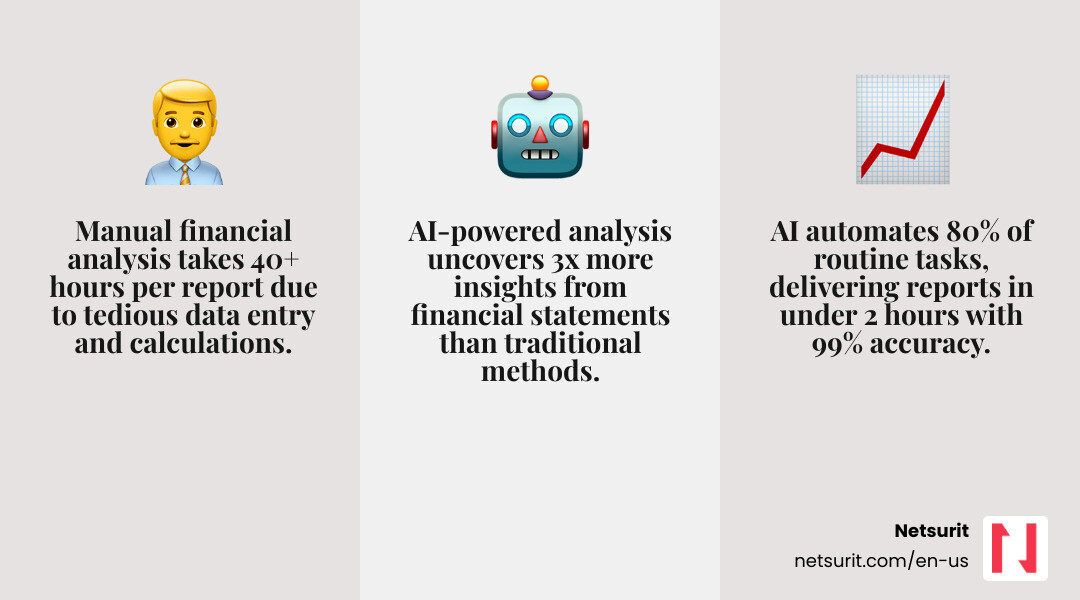
Traditional financial analysis is a painstaking process riddled with inefficiencies. The sheer volume of financial documents demands significant human effort, often leading to delays and inaccuracies. The average 10-K report, for instance, has roughly doubled in length between the early 2000s and late 2010s, making manual review increasingly impractical.
AI for financial statements directly addresses these inefficiencies:
- Manual Data Extraction: AI automates pulling data from diverse sources like SEC filings and annual reports. Instead of copy-pasting, AI tools can ingest documents and structure data for analysis in minutes.
- Spreadsheet Errors: By automating data capture and validation, AI significantly reduces the risk of human error. Nearly 88% of spreadsheets contain errors, a risk AI mitigates by cross-checking data and flagging inconsistencies.
- Time Consumption: AI drastically cuts analysis time. What takes an analyst days—sifting through hundreds of pages—an AI can do in moments, enabling faster reporting and decision-making.
- Buried Insights: AI can pinpoint and summarize key information hidden in dense reports, such as specific clauses in contracts or subtle changes in accounting policies mentioned in footnotes.
AI doesn’t just make things faster; it makes them smarter. It improves the quality of financial reporting and provides a level of accuracy that manual processes cannot match. For firms in Houston, this means turning data into actionable intelligence more efficiently.
Example: A Katy, TX Accounting Firm
A mid-sized accounting firm in Katy, TX, dedicated over 40 hours per client each quarter to manually keying data from PDFs into Excel. By implementing an AI for financial statements tool, they cut this process to under five hours. The system automated data entry and reconciliation and also flagged unusual variances in accounts payable that the team had previously overlooked. This early detection prevented a significant overpayment, saving the firm and its client valuable resources.
The Core AI Technologies Changing Financial Statements
The revolution in financial statement analysis is powered by several key AI technologies. Understanding them is crucial for any firm looking to integrate AI for financial statements.
- Machine Learning (ML): The foundation of many AI applications, ML algorithms learn from historical data to identify patterns, predict earnings changes, and detect anomalies that might indicate fraud.
- Natural Language Processing (NLP): Financial documents are rich in text. NLP allows AI to understand and interpret human language, which is vital for extracting information from unstructured text in SEC filings, contracts, and news articles.
- Generative AI: This advanced form of AI, including models like GPT-4, can create new content. It can draft sections of financial reports, summarize lengthy documents, and transform raw data into actionable narratives.
- Large Language Models (LLMs): A subset of generative AI, LLMs are trained on massive text datasets, enabling them to perform complex reasoning tasks. Research shows that LLMs like GPT-4 can even outperform human financial analysts in predicting earnings changes.
- AI Agents: These are systems designed to autonomously perform multi-step tasks. An AI agent could be tasked with gathering all relevant data for a due diligence report, analyzing it for risks, and then drafting a summary with minimal human intervention.
How to Choose the Right AI Tool for Your Firm
Selecting the right AI for financial statements tool for your firm in the Houston metro area requires a strategic approach, not just adopting the flashiest technology.
- Pinpoint where to save time: Identify the most time-consuming, repetitive, and error-prone tasks in your current workflows. Target these high-impact areas first.
- Match tools to your data needs: Consider the type of data you handle. Do you work with structured spreadsheets or need to extract insights from unstructured PDFs? Some tools excel at quantitative analysis, while others leverage NLP for text.
- Demand trustworthy outputs: Financial analysis requires accuracy. Look for AI tools that provide source citations or explain their reasoning to maintain audit trails and build confidence.
- Check system integration: Ensure the tool can connect seamlessly with your existing accounting software, ERP, and BI tools. Our cloud consulting services can help ensure a smooth transition.
- Prioritize security: Financial data is highly sensitive. Verify that any AI vendor complies with industry standards (e.g., SOC 2 Type II) and offers robust features like encryption and access controls.
- Plan for growth: Choose a scalable solution that can handle increasing data volumes and evolving analytical needs as your firm grows.
- Calculate ROI: Before committing, develop a clear return on investment (ROI) model. Quantify the time savings, error reduction, and improved insights to demonstrate the tangible benefits.
Practical Applications of AI for Financial Statements
The power of AI for financial statements extends far beyond mere data processing. It’s revolutionizing specific financial tasks, making operations more efficient, accurate, and strategic.
Using AI for Financial Statements in Due Diligence
Due diligence is notoriously document-heavy and time-sensitive. AI can drastically cut down the time and resources required:
- M&A Transactions: During mergers and acquisitions, AI can rapidly scan and analyze vast amounts of financial and legal documents, standardizing targets for diligence and comparing unit economics.
- Contract Review: AI platforms can review thousands of contracts and agreements in minutes, identifying key clauses, risks, and obligations that would take human analysts weeks. Investcorp, for example, reported saving hundreds of hours using an AI platform for this purpose.
- Identifying Red Flags: AI can sift through entire data rooms, flagging unusual clauses, inconsistencies in revenue recognition, or potential liabilities that might escape human detection. This can cut the time to identify targets by up to 30% while improving prediction accuracy by over 20%.
- Productivity Boost: One consulting firm saw a 35% increase in productivity within the first month of deploying generative AI for data extraction and document analysis.
Example: A Private Equity Firm in The Woodlands
A private equity firm in The Woodlands was considering a major acquisition. The due diligence process traditionally took weeks. By integrating an AI for financial statements platform, the firm scanned the target’s entire data room in under two hours. The AI automatically flagged non-standard liability clauses in supplier contracts and identified subtle inconsistencies in revenue recognition practices. This allowed the firm to negotiate a more favorable deal and mitigate risks, saving millions in potential future liabilities.
Enhancing Risk Management and Compliance with AI for Financial Statements
Risk management and regulatory compliance are non-negotiable in finance. AI offers powerful tools to strengthen these areas:
- Anomaly Detection: AI algorithms monitor financial data in real time, identifying unusual patterns that could indicate fraud, errors, or emerging risks.
- Fraud Prevention: By analyzing vast datasets, AI can detect subtle indicators of fraudulent activities that might be missed by traditional rule-based systems.
- Regulatory Compliance: AI can help firms keep up with evolving regulations by analyzing updates, ensuring internal processes align with new requirements, and automating compliance checks.
- Internal Controls: AI can be used to validate internal controls by continuously monitoring data flows and transaction processing, ensuring adherence to established policies.
For firms managing sensitive financial data, ensuring robust IT infrastructure and managed IT services for compliance are crucial alongside AI implementation.
Human vs. Machine: Integrating AI into Your Workflow
The question isn’t whether AI can analyze financial statements, but how to integrate it effectively into human-centric workflows. It’s a collaboration, not a competition.
Recent research from the University of Chicago highlights this dynamic. A study comparing GPT-4 to human analysts in predicting earnings changes found that GPT-4, using a “chain-of-thought” prompt, was accurate 60% of the time—seven percentage points better than the human average.
This doesn’t mean humans are obsolete. AI excels at processing vast amounts of data and identifying patterns, while humans provide critical judgment and oversight. The key is leveraging AI’s strengths to augment human expertise.
Best practices for integrating AI for financial statements into your workflow emphasize:
- Transparency: You need to understand how the AI arrived at its conclusions. Tools should provide source citations and explain their reasoning, allowing human analysts to verify the output.
- Verifiability: AI-generated insights must be traceable back to the original data. This is critical for auditing and accountability.
- Human-in-the-loop oversight: AI should augment, not replace. Humans must remain responsible for critical judgment calls and final decisions. This approach mitigates risks like AI “hallucinations.”
- AI Governance: Establish clear guidelines and controls for AI usage to manage risks, ensure regulatory compliance, and address ethical considerations.
Best Practices for a Smooth AI Integration
Successfully integrating AI for financial statements into your firm, especially in a dynamic market like Houston, involves more than just purchasing software.
- Start with high-value tasks: Begin with specific, high-impact tasks that are time-consuming or error-prone, such as automating calculations or standardizing competitor metrics.
- Ensure source citation: Prioritize AI solutions that clearly explain their data extraction methods and provide verifiable links to source documents.
- Phased implementation: Roll out AI solutions in stages, starting with less sensitive use cases. This allows your team to gain familiarity and validate accuracy before moving to more critical workflows.
- Upskill your team: Invest in training for your finance professionals so they can formulate effective prompts and interpret results.
- Leverage IT expertise: Integrating new AI systems requires robust IT infrastructure and cybersecurity. Partnering with experienced providers for cloud consulting for integration ensures your systems are secure, scalable, and optimized for AI.
Example: A CPA Firm in Conroe
A CPA firm in Conroe, TX, began its AI journey by using a generative AI tool like Gemini to summarize the Management’s Discussion and Analysis (MD&A) section of quarterly reports. This low-risk, high-value task helped the team build confidence in AI’s capabilities and refine their prompting skills before considering more complex applications like automated financial statement validation.
The Future of Financial Analysis: What to Watch Next
The trajectory of AI for financial statements is clear: it’s moving towards greater autonomy, deeper insights, and more personalized applications. The future is about intelligent partnership.
We can anticipate several transformative shifts:
- Autonomous AI agents: Imagine AI agents that can autonomously gather data, perform complex analyses, and draft complete, board-ready financial reports with predictive insights.
- Hyper-personalization: AI will enable financial analysis and reporting to be customized to an unprecedented degree, with personalized forecasts and risk assessments.
- Real-time analysis: The speed of AI will lead to near real-time financial analysis, empowering rapid decision-making and proactive strategy adjustments.
- Predictive regulation: AI will not only help with compliance but also assist in anticipating regulatory changes by analyzing legislative trends and public sentiment.
- Impact on finance roles: AI automates routine tasks, elevating the role of finance professionals to focus on strategy, interpretation, and high-level decision-making. This shift is already underway, with 97% of leaders in financial reporting planning greater use of generative AI within the next three years.
What to Watch Next
As we look ahead, focus on two key developments. First, the emergence of multi-modal AI will revolutionize how we interact with financial reports. These systems will natively interpret charts, images, and tables within financial documents, not just text. This means AI can correlate a bar graph’s data with its accompanying narrative, providing a richer, more accurate understanding. Second, the rise of “explainable AI” (XAI) is becoming a crucial standard. As AI takes on more critical tasks, regulators and stakeholders will demand that models show their work—explaining how they arrived at a conclusion, rather than just providing an answer. This transparency will be vital for trust and accountability in AI-driven financial analysis.
Frequently Asked Questions about AI in Financial Analysis
How does AI improve the accuracy of financial statements?
AI improves accuracy by minimizing human error in manual data entry and spreadsheet management. It can process and cross-reference vast datasets in seconds, identifying inconsistencies and anomalies that a human analyst might miss. This automated verification ensures a higher degree of integrity in the final numbers.
Will AI replace financial analysts?
No, AI is an augmentation tool, not a replacement. It automates repetitive tasks like data extraction and reconciliation, freeing up professionals to focus on strategic interpretation, complex problem-solving, and applying human judgment—tasks that AI cannot perform. The analyst’s role shifts from data entry to strategic advisor.
What are the biggest risks of using AI for financial statements?
The primary risks are data security, model unreliability, and over-reliance. Sending sensitive financial data to an unsecured AI tool creates significant privacy risks. Models can also “hallucinate” or generate incorrect information. These risks are mitigated by using enterprise-grade AI platforms, ensuring human oversight, and maintaining rigorous cybersecurity consulting protocols to protect sensitive data.
Conclusion
AI for financial statements is no longer a futuristic concept but a practical tool that gives accounting and finance firms a decisive competitive edge. By boosting efficiency, reducing errors, and open uping deeper insights, AI empowers your team to move beyond manual data processing and focus on strategic value. The key is to start small with a high-impact problem and build from there, ensuring your IT infrastructure is secure and ready for the transition. As a trusted IT partner for firms across Houston, Sugarland, Conroe, and Katy, Netsurit helps businesses implement AI solutions securely and effectively. Learn how Netsurit supports the financial services industry and helps you steer this transformative journey.