How to Implement AI Accounting in Houston: What You Need to Know First
Houston implement AI accounting systems in 2026 looks nothing like it did three years ago — and if your firm is still running on manual reconciliations and spreadsheet-based close processes, you’re already falling behind.
Quick answer for Houston businesses ready to act:
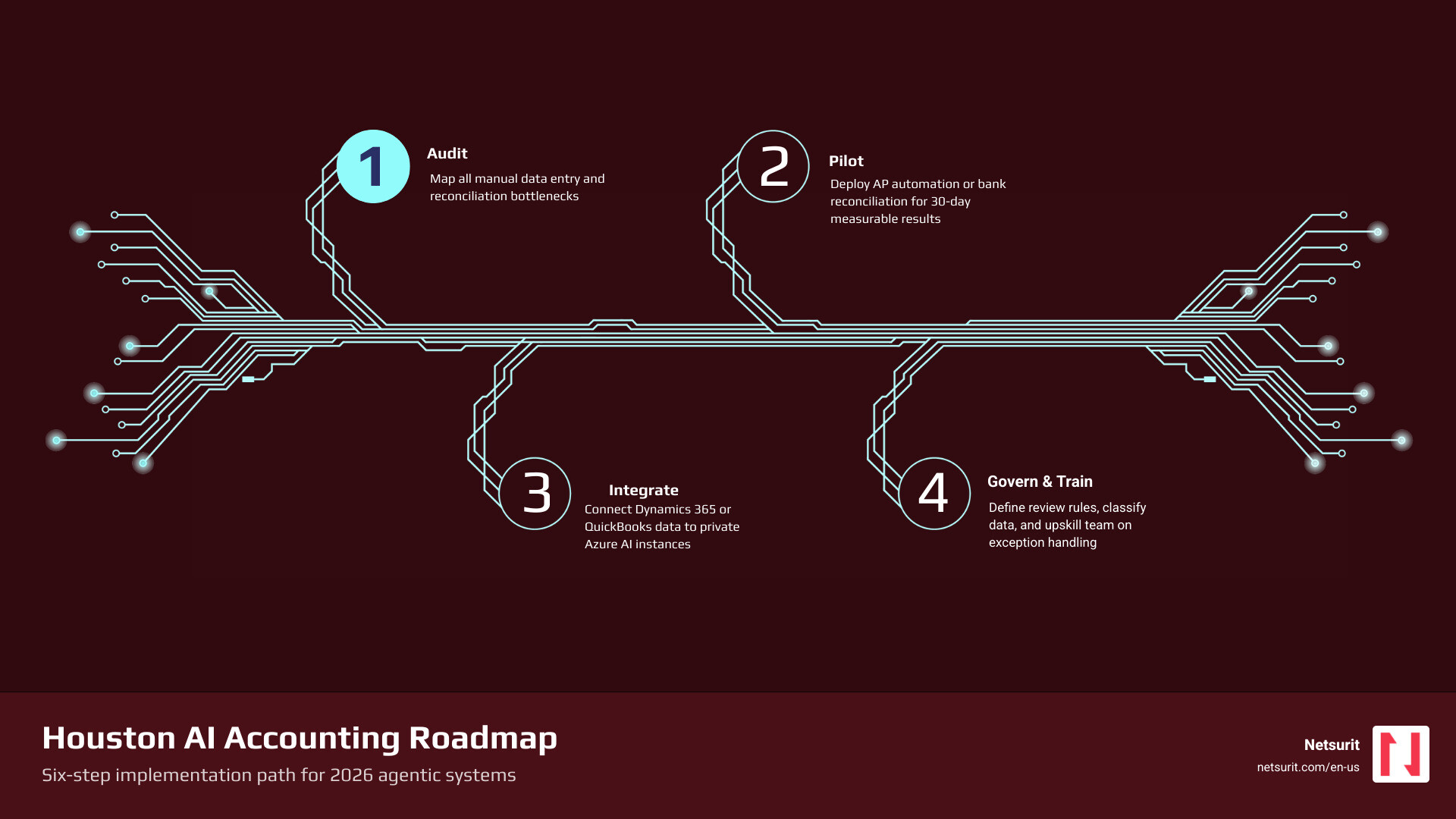
- Audit your current workflows — identify where manual data entry, reconciliation, or reporting eats the most staff time.
- Start with accounts payable or bank reconciliation — these are high-volume, structured processes where AI delivers measurable results within 30 days.
- Choose an integrated platform — Microsoft Dynamics 365 Business Central with Copilot, or a platform like HighRadius, connects directly to your existing ERP or QuickBooks data.
- Set governance rules before you deploy — define which outputs require human review, and classify your financial data (confidential vs. internal vs. public).
- Train your team on exception review, not data entry — your CPAs should be checking AI outputs, not re-entering transactions.
- Secure the environment — use private AI instances (such as Azure OpenAI Service) so your client data never trains a public model.
Here’s why this matters now. Houston’s accounting sector faces a real squeeze: a persistent talent shortage and rising transaction volumes — particularly in energy, logistics, and professional services — are pushing traditional automation past its limits. A Cypress-area plumbing company with 11 employees cut its accounts payable workload from 40 hours a month to just 6 hours after deploying AP automation. That’s not a pilot program result — that’s a real operational shift. Across industries, firms using AI-enhanced accounting report 30–50% reductions in manual staff hours and a 30% faster financial close.
The shift driving these results is the move from rule-based automation to agentic AI — systems that don’t wait for instructions. They reconcile, flag anomalies, cross-reference contracts, and generate draft outputs ready for professional review. The trade-off: these systems require deliberate governance, clean data infrastructure, and human oversight to avoid costly errors.
This guide gives you a practical roadmap — not a pitch for AI in the abstract.
I’m Orrin Klopper, CEO and co-founder of Netsurit, a global IT services and digital transformation company that has spent over 30 years helping businesses modernize through managed IT, cloud, and AI solutions — including helping Houston-area firms navigate the shift to Houston implement AI accounting with the governance and infrastructure to do it right. The sections that follow draw on that hands-on implementation experience, not theory.
Beyond Bookkeeping: Autonomous Workflows for Houston Firms
By May 2026, the accounting landscape in Houston has moved past simple “bots” that follow rigid if-then rules. We are seeing businesses in Sugar Land, Katy, and Conroe deploy agentic systems that function as autonomous digital employees. These agents don’t just move data from point A to point B; they reason through discrepancies. If a vendor invoice doesn’t match a purchase order, the AI agent doesn’t just flag it—it searches the email history for a price adjustment confirmation and presents the reconciled evidence to the bookkeeper for a final click.
From Assistance to Autonomy
Traditional automation required us to tell the computer exactly what to do. In 2026, we focus on “Agentic AI,” where the system initiates work based on a goal. For example, instead of a staff member starting the month-end close, the AI agent monitors the calendar and begins reconciling bank feeds as they arrive. This shifts your team’s role from “doing the work” to “reviewing the work.”
The 95% Rule
Our goal for any Houston firm implementing these tools is the “95% Rule”: aiming for 95% of journal entries to be posted automatically without human intervention. This is particularly effective for recurring revenue streams common in Houston’s service and energy sectors. By automating the high-volume, low-complexity tasks, you free up your senior staff to handle the 5% of complex transactions that actually require a CPA’s judgment.
| Feature | Traditional Bookkeeping | AI-Enhanced Accounting |
|---|---|---|
| Speed | 3–5 days for monthly close | Real-time or < 24 hours |
| Accuracy | Prone to human data entry error | 99% accuracy in data extraction |
| Cost | High (linked to billable hours) | Scalable (linked to transaction volume) |
| Focus | Historical recording | Predictive insights |
How AI Is Changing Bookkeeping
AI Accounting Optimization Houston: The Future of Financial Efficiency
Trade-offs in Autonomous Accounting
- Works best when: You are processing high-volume, structured data, such as a Sugar Land plumbing fleet’s daily invoices or a Katy-based retail chain’s daily sales reconciliations.
- Avoid when: The business context is highly subjective, such as interpreting a unique, one-off legal settlement or a complex M&A earn-out clause that hasn’t happened before.
- Risks: There is a risk of “black box” logic where the AI makes a decision but the staff doesn’t know why. This can lead to compliance issues if an auditor asks for the rationale behind a specific categorization.
- Mitigations: We recommend mandatory human-in-the-loop (HITL) verification for any transaction over a specific dollar threshold (e.g., $5,000) and maintaining a clear audit trail of why the AI made each decision.
High-Impact Use Cases for Houston SMBs
Houston controllers are no longer just “historians” looking at what happened last month. They are becoming “strategists” who use real-time data to guide the business. This shift is made possible by automating the most grueling aspects of Client Accounting Services (CAS).
Accounts Payable (AP) Automation
In 2026, AI agents handle three-way matching—comparing the purchase order, the receiving report, and the invoice—with nearly perfect accuracy. For a mid-sized oilfield service company in Conroe, this can save over 70 hours of manual labor every month. Instead of chasing down paper trail discrepancies, the AP clerk becomes an AP Manager, overseeing the system’s performance and managing vendor relationships.
Tax Prep and Audit Readiness
Tax season in Houston used to be a frantic scramble. Now, AI platforms like Zeni or HighRadius ingest source documents throughout the year. These tools apply prior-year context to identify R&D tax credit opportunities or flag anomalies that might trigger an IRS audit. By the time your tax professional sits down to prepare the return, the data is already organized, categorized, and linked to the source documents.
Predictive Forecasting and Cash Flow
Static budgets are a thing of the past. Houston businesses are now using AI to monitor liquidity in real-time. These systems provide dynamic liquidity warnings that can trigger 60 days before a projected cash crunch. For example, if your AI detects a slowdown in collections from a major client in the energy sector, it can automatically adjust your cash flow forecast and alert the CFO to postpone a major equipment purchase in Katy.
Accounting AI Cash Flow Houston
AI Financial Analysis Tax Houston
The 2026 Tech Stack: Microsoft-Centric Solutions
For the majority of the businesses we support in the Houston metro area, the most stable and secure way to Houston implement AI accounting is through the Microsoft ecosystem. Most firms are already using Microsoft 365, so layering in AI features doesn’t require a total overhaul of your IT infrastructure.
Microsoft Dynamics 365 Business Central
This is the core ERP for scaling firms. In 2026, it features Copilot, an AI assistant that handles bank reconciliations through natural language. You can literally ask the system, “Why is there a $200 discrepancy in the Frost Bank account?” and it will provide a reasoned explanation based on pending transactions or duplicate entries. It also allows for natural language financial reporting, turning complex data into a readable summary for your board of directors.
Integration Strategy: The Azure Data Lake
Don’t let your data stay trapped in siloed systems. We often help firms connect their QuickBooks, Xero, or legacy ERP data into a centralized Azure data lake. This allows for advanced analysis across all your business functions. By centralizing the data, your AI agents have a “single source of truth” to work from, which significantly reduces the risk of hallucinations or conflicting reports.
The Implementation Roadmap
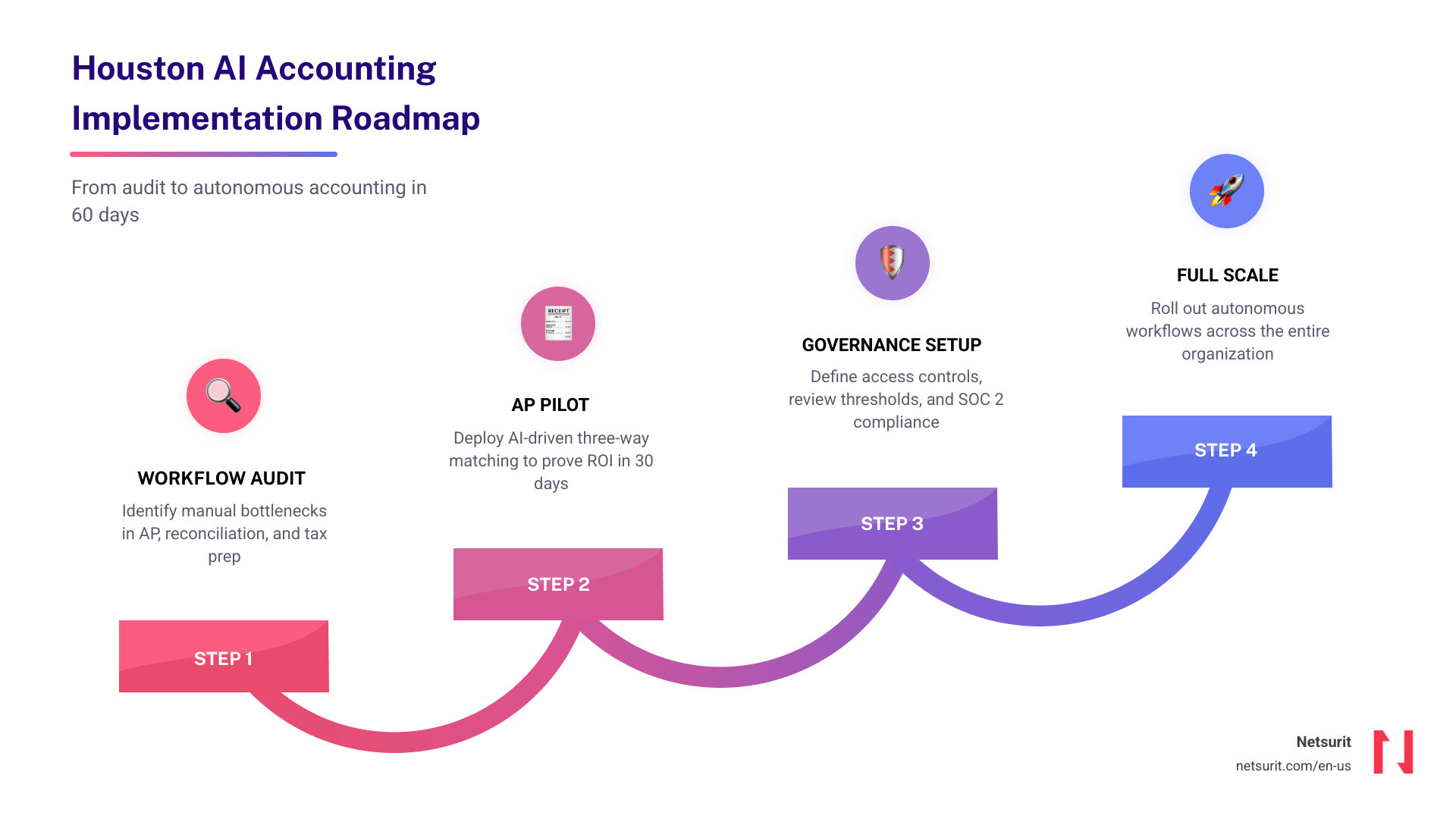
- Workflow Audit (Days 1-10): Identify the specific manual tasks that are slowing you down.
- AP Pilot (Days 11-40): Implement AI-driven accounts payable for one department to prove the ROI.
- Governance Setup (Days 41-50): Define who has access to what data and what the review thresholds are.
- Full Scale (Day 60+): Roll out autonomous accounting across the entire organization.
Microsoft Dynamics 365 Business Central Migration Consulting | Houston TX
Deploying AI in Houston: A Roadmap for Modern Accounting
Security, Governance, and Texas Data Privacy
Financial data is the crown jewel of your business, making it a prime target for cybercriminals. Implementing AI in locations like Katy or Conroe requires more than just a password; it requires a robust security architecture that complies with Texas-specific privacy expectations.
Private AI Infrastructure
The biggest mistake we see is staff using public AI tools (like the free version of ChatGPT) to summarize sensitive financial statements. This can leak your data into public training models. To Houston implement AI accounting safely, you must use private AI instances, such as the Azure OpenAI Service. This ensures your financial data stays within your “tenant”—meaning it is never used to train models for other companies.
Compliance and Performance
By 2026, SOC 2 Type II certification and Multi-Factor Authentication (MFA) are the bare minimum. We also implement Zero Trust architectures, where every access request is verified, regardless of where it comes from. Additionally, you need to monitor your network performance. Agentic AI requires low-latency connections to process real-time data. If your network in The Woodlands is lagging, your AI might time out, leading to incomplete data processing or “hallucinations” where the AI tries to fill in the gaps with incorrect information.
AI Server Setup Katy TX 77449 | Private AI for Katy Small Businesses
Cybersecurity Services in Houston
The Human Element: Upskilling for the “Digital Senior” Role
A common fear in Houston accounting firms is that AI will replace the CPA. In reality, AI replaces the “data entry clerk” portion of the job. This creates a new, more valuable role: the “Digital Senior.” These are professionals who understand the accounting principles but are also experts at managing the AI systems that do the heavy lifting.
Prompt Engineering for Accountants
Your staff needs to learn how to talk to these systems. Instead of spending hours digging through a general ledger to find a variance, a Digital Senior uses prompt engineering to query the model: “Explain why our fuel expenses in the Conroe division are 15% over budget compared to the Sugar Land division, accounting for recent regional price spikes.” The AI does the digging; the human does the interpreting.
Shifting to High-Value Advisory
When you remove 40 hours of data entry from a bookkeeper’s month, they can spend that time on client relationship management or M&A advisory. Houston firms that embrace this shift are finding that their staff is actually less “bored” and more engaged because they are solving complex business problems rather than just checking boxes.
How Houston Firms Use AI to Stop Being Bored
Trade-offs in Staff Transformation
- Works best when: Training is hands-on and uses your firm’s own anonymized historical data so the team can see the AI’s accuracy for themselves.
- Avoid when: Leadership treats AI as a “set and forget” tool to cut costs. If the goal is only to reduce headcount, you will lose the institutional knowledge needed to oversee the AI.
- Risks: Cultural resistance is real. If staff fear they are being replaced, they may “quiet quit” or even sabotage the implementation.
- Mitigations: We recommend transparent AI roadmaps that show staff how their roles will evolve. Incentive-based upskilling programs can turn skeptics into champions.
Frequently Asked Questions
How much time can Houston businesses save?
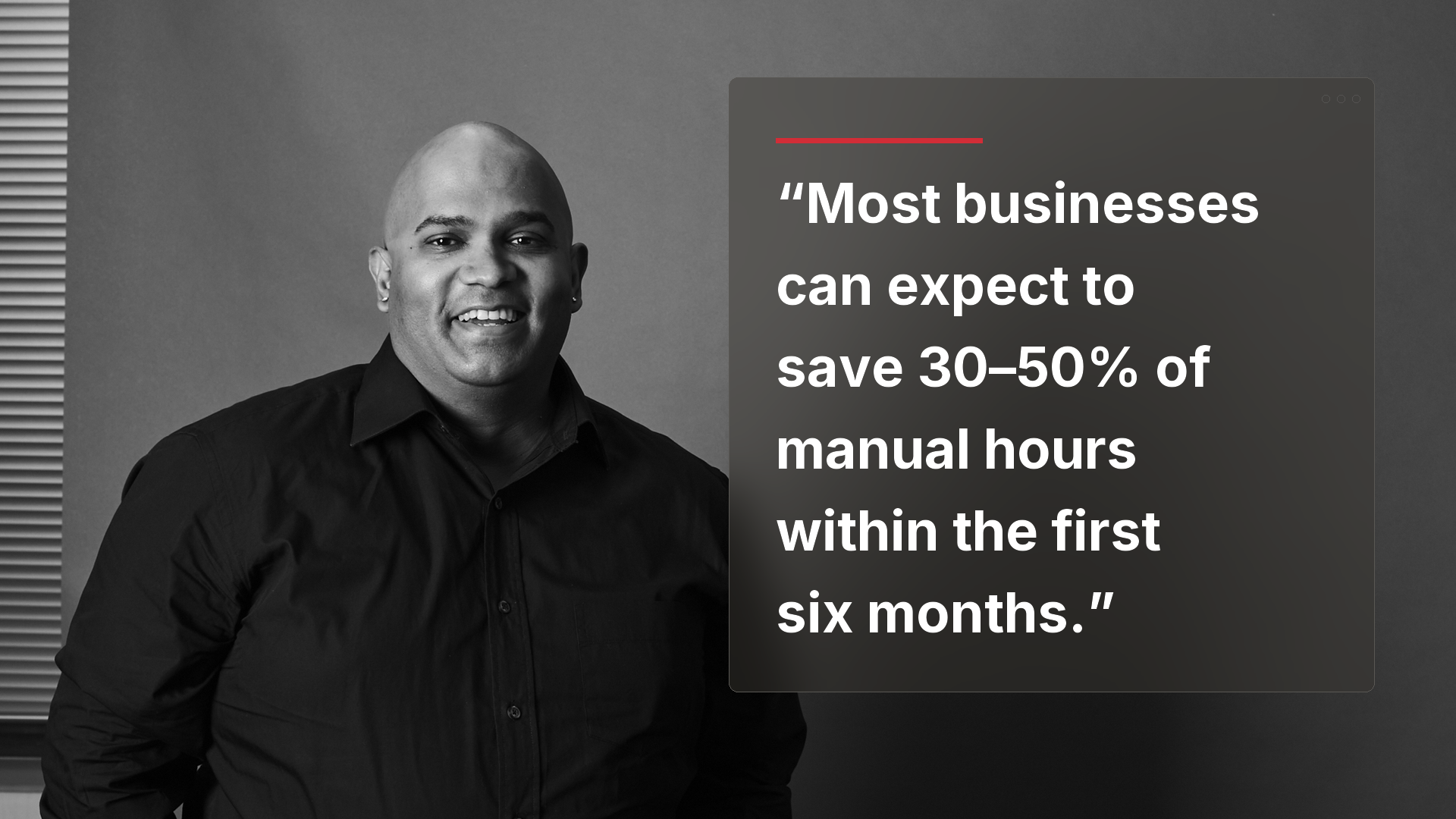
Most businesses can expect to save 30–50% of manual hours within the first six months. This typically manifests as a 30% faster monthly close, allowing your team to provide financial insights to leadership much earlier in the month.
Is AI accounting secure for sensitive Texas financial data?
Yes, but only if you avoid public tools. By using enterprise-grade, private AI environments (like those built on Azure) that carry SOC 2 compliance and strict data non-training clauses, your data remains completely private and secure.
Does AI replace the need for a CPA?
Absolutely not. AI is a powerful tool, but it lacks business context and professional skepticism. You still need a CPA to provide final legal sign-off, handle complex tax strategies, and offer the human touch that clients expect in high-stakes financial decisions.
Conclusion
Strategic AI adoption is no longer optional; it is the only viable response to the accounting talent shortage and the increasing complexity of the Houston business environment. Firms that move to Houston implement AI accounting through agentic workflows by 2026 will achieve higher margins and provide significantly more value to their clients than those stuck in the manual past.
Next Action: Audit your current manual entry bottlenecks. If your team is spending more than 10 hours a week on reconciliation or data entry, it’s time to modernize. Contact Netsurit to discuss a Microsoft-based AI roadmap tailored to your Houston firm’s specific needs.
Modernize your accounting with Microsoft Solutions