
Manual Regulatory Reporting Is Breaking — Here’s How AI Fixes It
AI for regulatory reporting is the practice of using machine learning, natural language processing, and generative AI to automate how organizations collect, process, and submit compliance data — replacing slow, error-prone manual workflows.
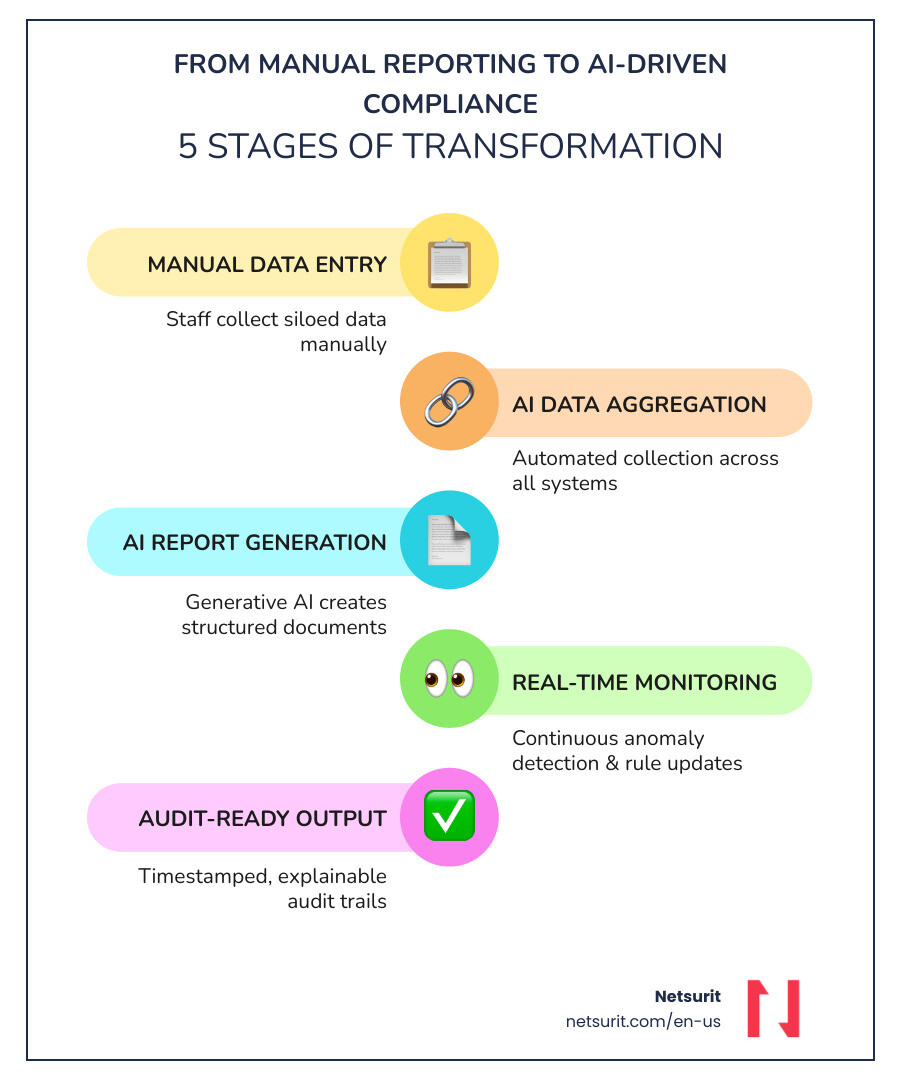
Here’s how it works at a glance:
| Step | Manual Approach | AI-Driven Approach |
|---|---|---|
| Data collection | Staff pull data from multiple systems manually | AI aggregates data from all sources automatically |
| Report generation | Compliance officers draft reports by hand | Generative AI produces structured, audit-ready documents |
| Error checking | Periodic manual review | Continuous real-time anomaly detection |
| Regulatory updates | Staff research changes manually | AI monitors and applies rule changes automatically |
| Audit trail | Spreadsheets and email chains | Automated, timestamped audit logs |
The scale of the problem is real. Compliance officers spend up to 70% of their time on manual documentation tasks. The average cost of non-compliance has reached $14.82 million — nearly triple the $5.47 million cost of implementing proper automated systems. In 2023, North America alone absorbed 95% of the $4.6 billion in global financial penalties for anti-money laundering violations.
That math is hard to ignore.
AI copilots don’t replace your compliance team. They handle the repetitive, high-volume work — data aggregation, document drafting, false-positive filtering — so your team can focus on judgment calls that actually require human expertise.
I’m Orrin Klopper, CEO and co-founder of Netsurit, a global IT services and digital transformation company that has spent nearly three decades helping organizations build the technical foundations they need to adopt AI safely — including AI for regulatory reporting. In this guide, I’ll walk you through exactly how to implement AI copilots in your compliance workflows, what it costs, and where the real risks lie.
Terms related to AI for regulatory reporting:
- Machine learning for compliance
- Data analytics auditing
- AI-powered financial analysis
The High Cost of Manual Compliance

Legacy compliance is a “death by a thousand spreadsheets.” For decades, firms have relied on manual data entry, where a single typo in a SAR (Suspicious Activity Report) or a missed field in a tax filing can trigger an audit. This manual friction creates data silos; information sits in payroll, then moves to accounting, then to a compliance officer’s inbox, losing context at every hop.
The financial stakes are staggering. In 2023, North America accounted for 95% of the $4.6 billion in global financial penalties for anti-money laundering (AML) violations. Beyond the fines, the operational cost of simply “doing” compliance is ballooning. UK banks and fintechs, for instance, spend approximately £21,400 per hour combating financial crime—totaling over £38.3 billion annually.
When you rely on manual checks, you aren’t just paying for the labor; you are paying for the inevitable human error that leads to 90% of flagged alerts being false positives. This inefficiency turns compliance into a cost center that drains resources away from growth.
The Breaking Point for Houston Accounting Firms
In the Houston metro area—from the energy-focused firms in Katy to the medical device innovators in Conroe—the regulatory burden is reaching a tipping point. A mid-sized tax firm in Sugarland might handle hundreds of state reports, payroll taxes, and sales tax returns simultaneously. When these tasks are manual, the resource strain prevents the firm from taking on new clients.
We see this often: a firm spends 70% of its staff hours just keeping the lights on with documentation. By adopting ai tools to reduce manual data entry in accounting firm workflows, these firms can reallocate their smartest people to high-value advisory roles rather than data-entry drudgery.
How AI for Regulatory Reporting Transforms Data into Compliance
AI for regulatory reporting isn’t a single “app.” It’s a combination of three core technologies working in tandem:
- Machine Learning (ML): Identifies patterns in transaction data that humans miss. It learns what “normal” looks like for your business and flags deviations.
- Natural Language Processing (NLP): Reads and interprets thousands of pages of new regulations. NLP can “understand” a new SEC filing or a change in Texas tax law and map it to your internal policies.
- Generative AI (GenAI): Drafts the actual reports. It takes the raw data and the regulatory requirements and combines them into a structured, human-readable document.
| Metric | Manual Reporting | AI-Driven Reporting |
|---|---|---|
| Data Processing Speed | Days or weeks | Milliseconds |
| Error Rate | High (Human fatigue) | Low (Algorithmic precision) |
| Audit Readiness | Reactive (Scrambling for docs) | Proactive (Always-on audit trail) |
| Scalability | Requires more hires | Scales with compute power |
Reducing False Positives with AI for Regulatory Reporting
One of the biggest drains on a compliance team is the “false alarm.” Traditional systems use static rules (e.g., “flag any transaction over $10,000”). This results in a sea of noise. Advanced AI models use risk scoring to look at context—who is sending the money, where is it going, and what is their history?
By using platforms like Lucinity or similar AI copilots, organizations can achieve a 90% reduction in false positives. This allows your team to focus on the 10% of alerts that actually represent a threat. If you’re looking for the best way to automate accounting firm workflows with ai, starting with anomaly detection is often the highest-ROI move you can make.
Automating SAR and HIPAA Documentation
For financial institutions, generating Suspicious Activity Reports (SAR) is a grueling process of data aggregation. In healthcare, HIPAA audits require proof of data integrity that is difficult to maintain manually.
Tools like Drata and AlignX AI automate these frameworks. Instead of a quarterly “check-up,” these systems provide real-time monitoring. If a data bucket in your cloud environment becomes public—violating HIPAA—the AI flags it instantly and can even auto-remediate the issue before a breach occurs. This transforms compliance from a “snapshot” into a continuous stream of protection.
A Step-by-Step Guide to Implementing AI Copilots
Implementing AI for regulatory reporting requires a structured approach. You can’t just “turn it on” and expect 100% accuracy.
- Needs Assessment: Identify which regulations are your biggest bottlenecks. Is it AML? HIPAA? Sales tax?
- Data Cleansing: AI is only as good as the data you feed it. You must remove duplicates and standardize formats (e.g., ensuring all dates are MM/DD/YYYY).
- Model Selection: Choose between “off-the-shelf” copilots or custom-trained models. For most mid-market firms, a specialized copilot is the most cost-effective entry point.
- Integration: Connect the AI to your “sources of truth”—your ERP, CRM, and banking portals.
For more details on setting the foundation, check out our AI productivity services.
Integrating AI for Regulatory Reporting into Legacy Systems
The biggest hurdle is often the “old” software. Many Houston businesses still rely on legacy ERPs that don’t talk to modern AI. The solution is middleware or API connections.
For example, Lucid Financials can act as a bridge, pulling data from QuickBooks and payroll systems, then mapping that data to regulatory fields automatically. This “data mapping” ensures that when a regulator asks for a specific metric, the AI knows exactly which ledger entry to pull from.
Establishing Governance and Audit Trails
Regulators are skeptical of “black box” AI. If you submit a report generated by AI, you must be able to explain how the AI reached its conclusion. This is called Explainable AI (XAI).
We recommend implementing data governance frameworks that include:
- PII Protection: Ensuring Personally Identifiable Information is masked or encrypted.
- Timestamped Logs: Every change the AI makes must be logged for auditors.
- Human-in-the-Loop (HITL): A human must sign off on the final report before submission.
Measuring ROI and Performance Metrics
How do you know if your AI for regulatory reporting is actually working? You need to track specific KPIs. Organizations embracing automated reporting typically see 30–40% reductions in compliance-related expenses within the first 12 months.
Key Metrics to Track:
- Time to Audit Readiness: How long does it take to pull all required documents for a surprise audit? (Target: Under 4 hours).
- False Positive Rate: Are your investigators spending time on real threats or noise?
- Penalty Avoidance: Track the reduction in late-filing fees and reporting errors.
- Staff Utilization: Are your compliance officers doing more analysis and less data entry?
To dive deeper into the financial impact, watch our on-demand-webinar-ai-in-finance.
What to Watch Next: 2026 and Beyond
The landscape is shifting from “AI as a tool” to “Agentic AI.” By 2026, we expect to see:
- Multi-modal AI: Systems that can read handwritten notes, scanned PDFs, and video data for compliance checks.
- Agentic Workflows: AI that doesn’t just flag an error but proactively contacts a vendor to fix a missing invoice.
- Real-time Regulatory Updates: AI that updates your internal policies the moment the EU AI Act or local Texas regulations are amended.
Managing Risks: Transparency and Explainability
The biggest risk in AI for regulatory reporting isn’t that the AI will be wrong—it’s that you won’t know why it was wrong. A recent McKinsey survey found that 40% of respondents identified explainability as a key risk in adopting Generative AI, but only 17% were actively addressing it.
To build trust with regulators, you must use interpretable models. If an AI flags a transaction for potential money laundering, it should provide a “citation”—linking to the specific internal policy or federal regulation it used to make that judgment.
Trade-offs of AI Adoption
| Works best when… | Avoid when… |
|---|---|
| Data is digitized and standardized across the organization. | Regulatory rules are undergoing active litigation or are highly ambiguous. |
| You have high-volume, repetitive reporting tasks. | You have a “one-off” complex legal scenario that requires subjective moral judgment. |
| Risks | Mitigations |
| Model Hallucinations: AI creating “facts” that don’t exist. | Mandatory human review (HITL) of all final filings. |
| Black Box Decisions: Inability to explain an AI’s logic to an auditor. | Use of XAI (Explainable AI) tools and detailed audit logging. |
Frequently Asked Questions about AI for Regulatory Reporting
How does AI reduce the cost of compliance?
AI reduces costs by automating the 70% of manual tasks that currently bog down compliance teams. By reducing false positives and accelerating data aggregation, firms can avoid the “compliance tax”—the need to hire more staff just to handle increased paperwork. It also drastically reduces the $14.82 million average cost of non-compliance by catching errors before they reach regulators.
Can AI handle multi-jurisdictional reporting requirements?
Yes. Modern AI copilots are designed to be “jurisdiction-aware.” They can apply different rules to the same data set—for example, processing a transaction under both Texas state law and federal AML requirements simultaneously. This is particularly useful for Houston firms with international operations.
What is the difference between an AI copilot and an autonomous system?
An AI copilot works with a human. It provides suggestions, drafts reports, and flags anomalies, but a human stays in control and makes the final decision. An autonomous system makes decisions without human intervention. For regulatory reporting, we almost always recommend a copilot approach to ensure accountability and meet legal standards.
Conclusion
AI for regulatory reporting is no longer a luxury for global banks; it is a survival requirement for any firm navigating the current regulatory avalanche. By shifting from reactive manual documentation to proactive AI-driven monitoring, organizations can reduce compliance expenses by up to 40% within the first year.
At Netsurit, we provide the technical foundation and AI expertise to help your firm implement these systems safely and at scale. Whether you’re in Houston, Sugarland, or Katy, we help you turn compliance from a burden into a competitive advantage.
Ready to transform your compliance? Explore our digital transformation solutions for accounting.