AI in Forensic Accounting Is Changing How Fraud Gets Caught
AI in forensic accounting is transforming how investigators detect fraud, trace funds, and build court-ready evidence. Here is what you need to know up front:
| What AI Does in Forensic Accounting | Why It Matters |
|---|---|
| Scans millions of transactions in hours | Cuts investigation time from months to weeks |
| Flags anomalies humans would miss | Improves fraud detection rates from ~23% to ~67% |
| Extracts data from PDFs and handwritten docs | Turns unstructured records into usable evidence |
| Monitors transactions in real time | Shifts fraud response from reactive to proactive |
| Identifies patterns across multiple entities | Exposes complex, multi-layered financial schemes |
Financial fraud costs organizations over $4.7 trillion annually worldwide. Traditional forensic accounting methods – manual ledger reviews, sampling-based audits, weeks of document sorting – were not built for that scale.
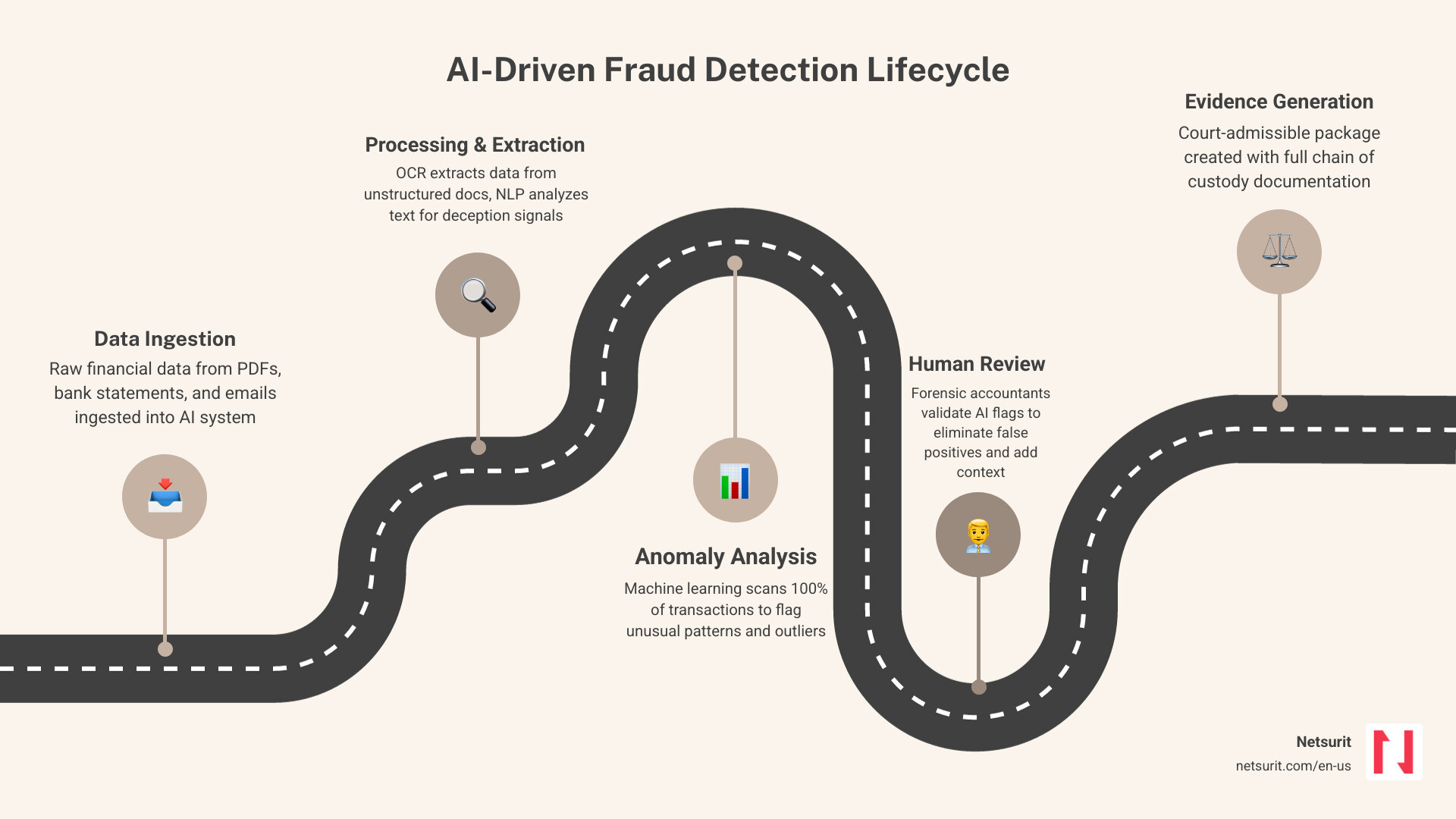
AI changes the math. Machine learning models can review 100% of transactions, not just a sample. Natural language processing (NLP) reads emails for deception signals. Optical character recognition (OCR) pulls data from decades-old paper records with up to 99% accuracy.
But AI is not a silver bullet. Models hallucinate. Algorithms carry bias. And no software can replace a forensic accountant’s judgment in a courtroom. The firms that get this right use AI for speed and pattern recognition, then apply human expertise to interpret what the data actually means.
This guide covers the tools, the trade-offs, the real-world cases, and the risks – so you can make informed decisions about integrating AI into your forensic workflow.
I’m Orrin Klopper, CEO of Netsurit, where I’ve spent nearly three decades helping organizations navigate digital transformation – including the adoption of AI in forensic accounting and financial operations across our global client base. That experience shapes everything in this guide, and I’ll point you toward practical steps, not just theory.
Simple guide to AI in forensic accounting:
- Data analytics auditing
- Machine learning audit
- Reduce audit risk
Defining the Shift to AI in Forensic Accounting
Modern financial investigations are no longer about finding a needle in a haystack; they are about analyzing the entire haystack in seconds. The shift toward AI in forensic accounting represents a move from manual “detective work” to high-tech algorithmic analysis. Traditional methods relied on human accountants spotting a single red flag. Today, AI identifies clusters of anomalies across millions of data points simultaneously.
Key technologies driving this shift include:
- Anomaly Detection: Machine learning (ML) models identify transactions that deviate from established norms, such as “round-dollar” entries or weekend postings.
- Pattern Recognition: AI connects disparate data points across multiple entities to uncover circular funding schemes.
- Data Extraction: Advanced OCR technology converts static bank statements into dynamic, searchable intelligence.
Research highlights that AI-driven implementations have reduced fraud detection time from an average of six months down to just 2.5 months. By automating accounting firm workflows, we allow senior investigators to stop acting as data entry clerks and start acting as strategic analysts. For a deeper technical dive, see the Scientific research on AI in forensic accounting.
Why General AI in Forensic Accounting Falls Short
While tools like ChatGPT and Microsoft Co-Pilot for Finance are excellent for drafting memos or creating Excel formulas, they are dangerous when used for high-stakes forensic work. General-purpose AI is non-deterministic, meaning it can provide different answers to the same query about 5% of the time.
The primary risks include:
- Lack of Traceability: Generative AI often cannot show the specific “source document” for a calculated figure, making the output inadmissible in court.
- Hallucinations: LLMs may “invent” transactions or balance totals if the input data is messy or incomplete.
- Privacy Gaps: Using free versions of general AI tools can expose sensitive client data to public training sets, violating regulatory standards.
Purpose-Built AI in Forensic Accounting for Legal Defensibility
To win a case in court, your evidence must have a verified chain of custody. Specialized platforms like Valid8, FraudFindr, and DocuClipper OCR technology are designed for this exact purpose. Unlike ChatGPT, these tools provide source-linked outputs. If a software flags a $50,000 transfer as suspicious, it provides a direct link to the specific PDF page and line item where that data originated.
Trade-offs: Specialized Forensic AI
- Works best when: Handling unstructured bank statements (PDFs) and requiring court-admissible evidence.
- Avoid when: Performing simple internal budget queries or basic memo drafting.
- Risks: High initial software costs and specific training requirements.
- Mitigations: Use platforms that offer 24-hour data turnaround to prove ROI quickly.
Example: A Sugar Land medical practice suspected internal embezzlement. Traditional auditing would have taken months to reconcile three years of patient co-pays. Specialized AI identified the $150,000 discrepancy in 48 hours by flagging “split” transactions that bypassed the main ledger.
High-Stakes Tools for Data Extraction and Reconciliation
The “grunt work” of forensic accounting—typing data from bank statements into Excel—is the most common source of human error. AI-powered tools to reduce manual entry eliminate this bottleneck. AutoEntry data extraction and similar platforms use AI to reach 99% accuracy in capturing dates, payees, and amounts from poor-quality scans.
Streamlining Evidence with Specialized Platforms
For practitioners in the Houston metro area, choosing the right “stack” is critical for maintaining a competitive edge.
- Ocrolus & 1040SCAN: These excel at high-volume document processing, particularly for tax-related forensics.
- BlackLine & Trintech reconciliation: These platforms automate the matching of millions of transactions, surfacing duplicates and exceptions instantly.
- SmartVault Accounting Pro: Provides the secure, governed environment needed to store sensitive evidence while maintaining a digital audit trail.
Example: During a partnership dispute in Katy, TX, a construction firm used AI to scan 5,000 handwritten receipts. The system identified duplicate billings to a shell company that a human auditor had missed during three previous annual reviews.
Lessons from the Past: Case Studies and AI Potential
Historical accounting scandals provide a sobering look at what happens when human oversight fails. In the HealthSouth fraud case, executives inflated earnings by $1.4 billion through fake entries. WorldCom misclassified over $11 billion in expenses. In these cases, the fraud was often “hidden in plain sight” within massive datasets that were too large for humans to audit manually.
According to Research on Big Data in Modern Forensic Accountancy, AI could have flagged these issues years earlier. For instance, Lehman Brothers used “Repo 105” transactions to temporarily move billions off their balance sheet. Modern AI models trained on “off-balance-sheet” patterns would have identified the cyclical nature of these moves as a high-risk anomaly.
Example: If AI had been deployed during the Olympus Corporation cover-up of $1.7 billion in losses, machine learning models would have flagged the unusual “consulting fees” that were mathematically inconsistent with industry benchmarks in real-time.
Navigating Risks: Hallucinations, Bias, and the Human Element
Despite the power of AI in forensic accounting, we must acknowledge its failure modes. Data quality remains the biggest hurdle—if the input data is “dirty,” the AI output will be flawed. Furthermore, “black box” algorithms can be difficult to explain to a jury. If you cannot explain how the AI reached its conclusion, the evidence may be thrown out.
We advocate for a hybrid approach. Organizations should follow a Withum AI strategy that prioritizes responsible adoption. This includes regular BDO Webinars on AI risks to stay updated on the latest “hallucination” trends.
Trade-offs: Automated Fraud Detection
- Works best when: Screening 100% of transactions rather than using traditional sampling.
- Avoid when: Contextual “soft” evidence (like intent or verbal agreements) is the primary factor.
- Risks: Algorithmic bias leading to false accusations against specific vendors.
- Mitigations: Implement a “Human-in-the-loop” protocol where every AI flag is reviewed by a Senior Forensic Accountant.
The Future of Financial Forensics: 2026 and Beyond
Looking ahead to May 2026, the field will move toward “Continuous Forensic Monitoring.” Instead of investigating fraud after it happens, AI will act as a 24/7 digital sentry.
Watch for these three trends:
- Explainable AI (XAI): New models that provide a “narrative” of why a transaction was flagged, making AI findings more defensible in court.
- Blockchain Analytics: As more B2B transactions move to distributed ledgers, AI will be used to trace “untraceable” crypto-assets.
- Federated Learning: This federated learning research suggests a future where firms can train AI on fraud patterns from other companies without ever sharing private client data.
To prepare for these shifts, we recommend watching an On-demand webinar on AI in finance.
Example: By May 2026, expect “Continuous Forensic Monitoring” to become standard for Conroe-based mid-market enterprises, moving away from “after-the-fact” investigations to real-time fraud prevention.
Frequently Asked Questions about AI in Forensic Accounting
Will AI replace forensic accountants?
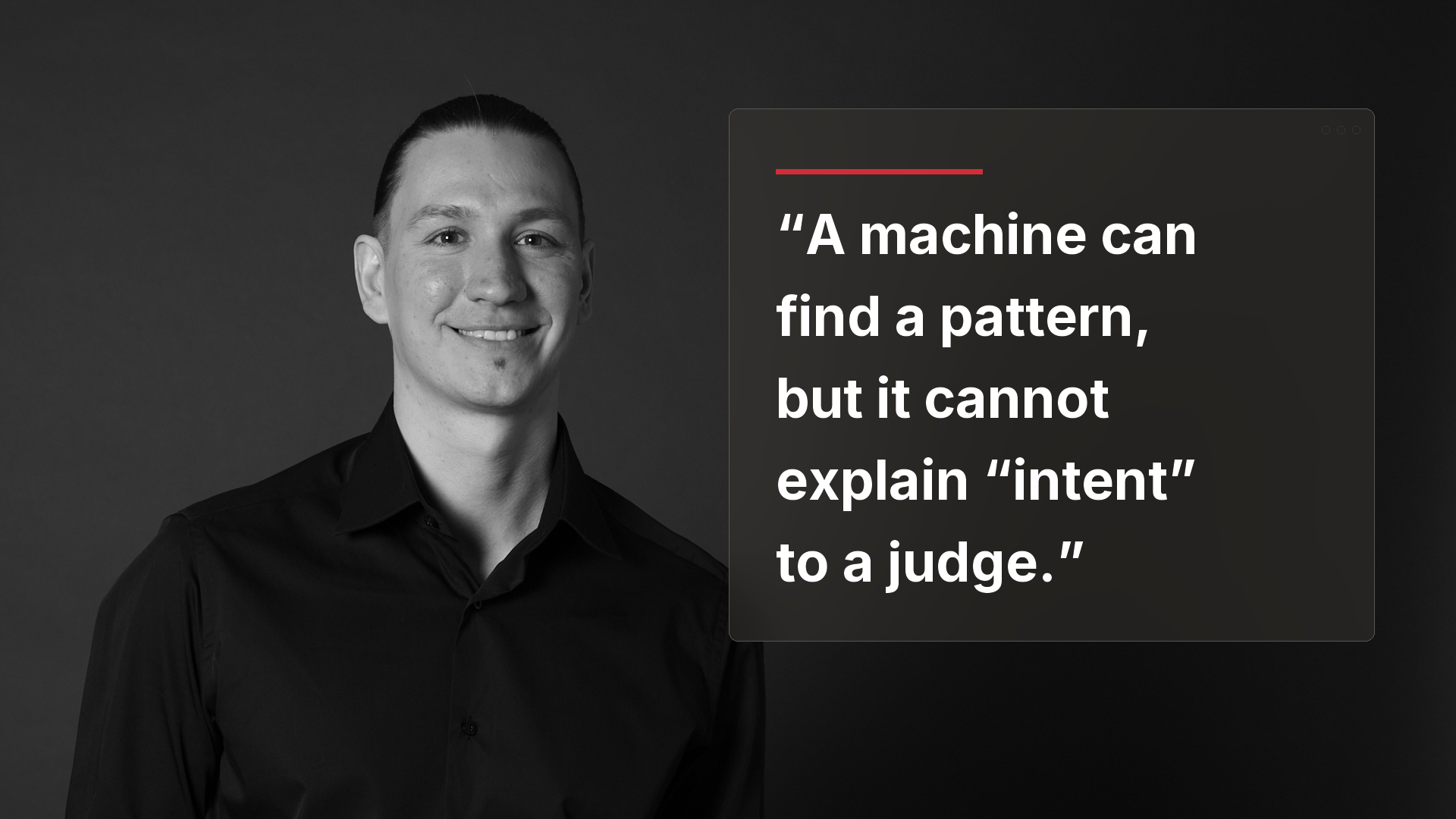
No. AI handles the “grunt work” of data sorting and pattern detection, but humans are required for expert testimony, ethical judgment, and interpreting complex legal contexts. A machine can find a pattern, but it cannot explain “intent” to a judge.
How accurate is AI in detecting financial anomalies?
Tools like DocuClipper boast 99% accuracy in data extraction. However, the “detection” of fraud still requires human validation. AI flags irregularities, but only a human can determine if that irregularity is a legitimate accounting error or a deliberate crime.
Is AI-generated evidence admissible in court?
Only if the tool maintains a clear chain of evidence. You must use specialized forensic software that provides “traceable” results, allowing you to show exactly which source document (e.g., a specific bank statement) produced the data point in question.
Conclusion
At Netsurit, we believe that the integration of AI in forensic accounting is no longer optional—it is a necessity for managing modern data volumes. Organizations in Houston, Katy, and beyond must balance this technological speed with rigorous human oversight to ensure results are both accurate and legally defensible.
Ready to transform your accounting firm’s digital strategy? Contact us to see how we can help you implement a secure, AI-driven workflow that protects your clients and your reputation.