Why Growing Accounting Firms Hit a Technology Wall
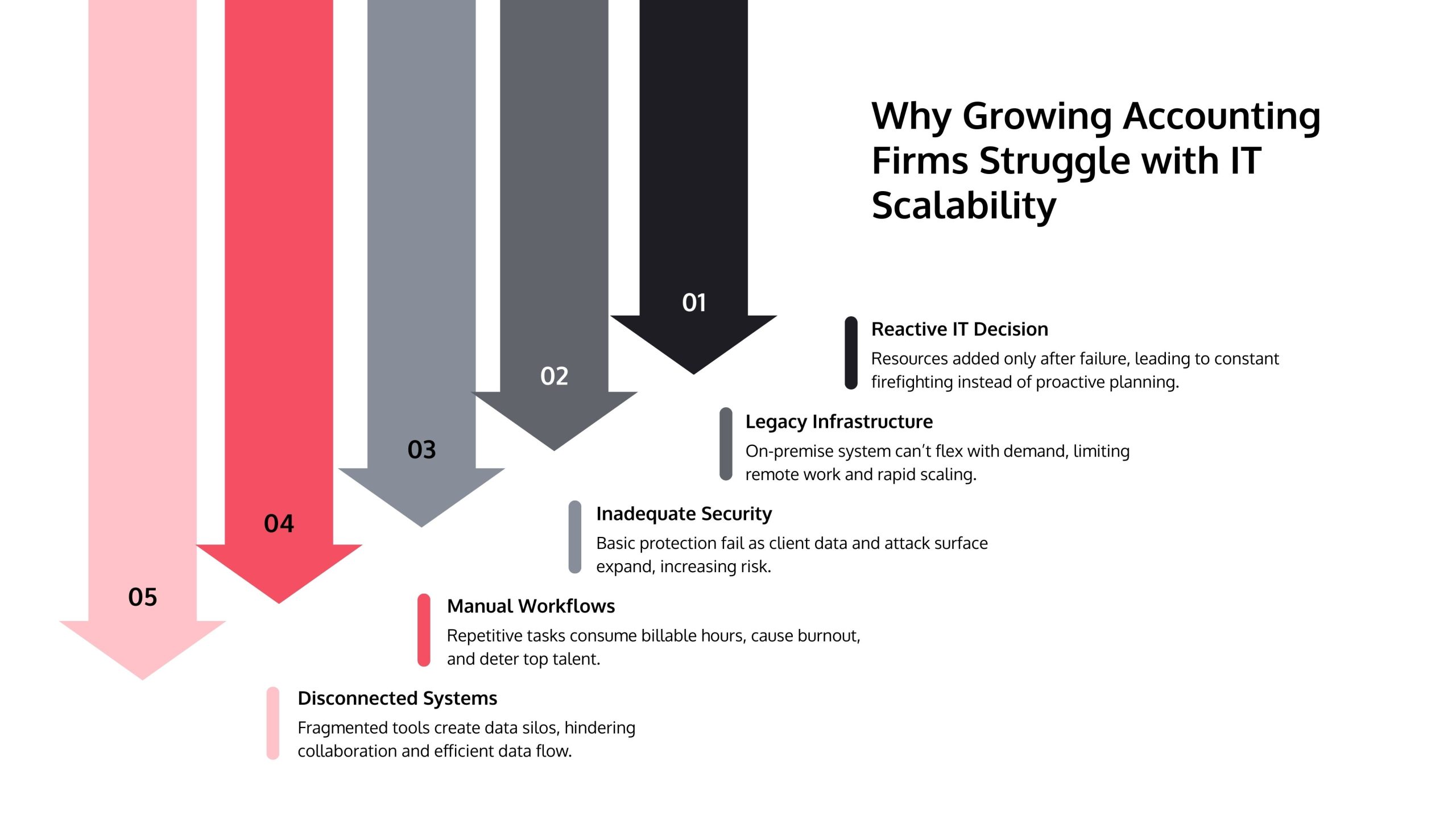
Why do growing accounting firms struggle with IT scalability? They struggle because success outpaces their technology foundation. As client volume increases, firms face five critical bottlenecks: reactive IT decisions that patch problems instead of preventing them, on-premise infrastructure that can’t flex with demand, inadequate security that scales poorly with risk, manual workflows that burn out top talent, and disconnected systems that create data silos. The result is a firm where growth creates operational drag—slower response times, rising security incidents, and partners spending hours on technology instead of clients.
Quick answer: Growing accounting firms struggle with IT scalability due to:
- Reactive technology decisions – Adding resources only after systems fail
- Legacy infrastructure – On-premise servers that can’t support remote work or rapid scaling
- Security gaps – Basic protections that don’t grow with the firm’s attack surface
- Manual processes – Repetitive tasks that waste billable hours and drive turnover
- Fragmented systems – Disconnected tools that prevent data flow and collaboration
The financial cost is real. Firms pushing billing rates up 16% in two years (per AICPA-CIMA data) are often masking technology problems by overworking their teams. Meanwhile, firms with scalable Client Advisory Services infrastructure achieved 17% median growth in 2023—nearly double the industry average—because their technology enables expansion instead of blocking it.
I’m Orrin Klopper, CEO of Netsurit, and I’ve spent nearly 30 years helping professional services firms solve why do growing accounting firms struggle with IT scalability through strategic infrastructure modernization. This guide gives you five practical ways to turn your technology from a growth barrier into a competitive advantage.
1. Build a Future-Proof Foundation
Here’s the hard truth: why do growing accounting firms struggle with IT scalability? Because they’re fighting fires instead of preventing them. Your firm’s growth requires a deliberate plan, not a series of panicked reactions when systems crash during tax season. A proactive IT strategy transforms your technology from an unpredictable cost center into a strategic asset that actually supports your growth trajectory.
The difference is stark. I’ve watched firms make reactive decisions for years—buying whatever laptop is on sale when a new hire starts, patching security holes after a breach attempt, upgrading servers only when they literally can’t handle one more client file. This approach creates a Frankenstein infrastructure where nothing talks to each other and every problem takes twice as long to solve.
Take Martinez & Associates, a firm that grew from two people to 18 employees. They made every technology decision in response to immediate pain. The result? A $150,000 emergency overhaul during their busiest tax season because their patchwork of non-integrated applications and security gaps finally collapsed under the weight of their success. That’s not a technology problem—it’s a planning problem.
A strategic IT Strategy Services roadmap anticipates your firm’s evolution through distinct phases. Solo practitioners have different needs than five-person teams, and five-person teams face different challenges than 20-person firms. Your technology plan should map to a 3-5 year vision that addresses each growth stage before you reach it. This means standardized hardware procurement, pre-configured software stacks, documented onboarding processes, and a security framework that scales with your risk profile.
The investment is real but predictable. We recommend allocating 8-12% of gross revenue to technology, with specific percentages dedicated to infrastructure, software licenses, and support. Our guide on How to Create a Business IT Strategy breaks down exactly where those dollars should go. This isn’t reckless spending—it’s building a “Never Down” foundation that delivers 100% uptime and 24/7 support when your team needs it.
The trade-offs are straightforward. This approach works best when your firm has a clear 3-5 year growth plan and partners who are willing to treat technology as a strategic investment. Avoid this approach when you’re in pure survival mode with zero resources for planning—though even then, a basic strategy beats pure reaction. The main risk is over-investing in technology that doesn’t align with near-term goals, which is why regular IT Audits and Assessments are essential to keep your strategy grounded in business reality.
Why you need a proactive IT strategy for your growing accounting firm
The math is compelling. Firms that build scalable technology foundations consistently outperform industry benchmarks in revenue growth, staff retention, and firm valuation. Scalability creates flexibility—your team can work from anywhere. It creates stability—systems don’t crash when you land a major new client. And it creates long-term value—buyers pay premiums for firms with documented, transferable technology operations instead of systems held together by one overworked IT person’s heroic efforts.
Your strategic roadmap should address capacity planning (how many users can your systems handle?), disaster recovery (what happens when—not if—something breaks?), security posture (how do you protect client data as your attack surface grows?), and workflow automation (where are you wasting billable hours on manual processes?). These aren’t IT questions—they’re business questions that determine whether your growth accelerates or stalls.
Houston Example: The Cost of Reactive IT
A mid-sized firm in Katy, TX, landed five new accountants to handle a client surge. Great news, except they had no procurement plan. Their office manager bought five different laptop models based on whatever was in stock at local retailers that week. Within 30 days, their single IT person was drowning in a support nightmare of incompatible software versions, security gaps, and configuration inconsistencies.
One laptop couldn’t run their tax software efficiently. Another had a consumer-grade operating system that violated their professional liability insurance requirements. A third came with bloatware that conflicted with their security tools. The firm spent over 60 hours troubleshooting problems that a standardized procurement plan would have prevented entirely. A proactive strategy means pre-configured hardware, consistent security baselines, and streamlined onboarding that turns new hires productive on day one instead of day thirty.
That’s the difference between reactive chaos and strategic growth. One approach treats technology as an afterthought. The other treats it as the foundation that determines how high you can build.
2. Achieve True Flexibility and Remote Capability with the Cloud
On-premise servers and desktop-bound software are relics that chain your firm to the office. The cloud offers the elasticity to scale resources up or down on demand, supporting a larger client base, bigger datasets, and a flexible workforce without massive capital expenditure. Firms offering scalable Client Advisory Services (CAS) are seeing 17% median growth, nearly double the industry average, largely driven by cloud-based tools.
- Works best when… You need to support a hybrid/remote workforce and provide clients with real-time access to data.
- Avoid when… You have specific compliance requirements that mandate on-premise data storage (an increasingly rare scenario).
- Risks… Poorly managed migration can lead to downtime and data loss. Cloud security can be compromised if not configured correctly.
- Mitigations… Partner with a Cloud Consulting expert to plan and execute a phased Cloud Migration.
How cloud solutions address IT scalability
Why do growing accounting firms struggle with IT scalability? A major reason is their commitment to outdated infrastructure that simply can’t flex with demand. When you’re running on-premise servers and traditional desktop software, every new client, every additional team member, and every seasonal surge becomes a capacity crisis. Your systems slow down. Files become inaccessible. Your team wastes hours waiting for applications to respond or for VPN connections to stabilize.
The data tells the story clearly. Firms that built scalable Client Advisory Services on cloud platforms achieved 17% median growth in 2023—nearly double the 9.1% overall industry rate. That gap isn’t about better accountants or smarter partners. It’s about infrastructure that enables growth instead of strangling it.
Cloud-based solutions solve the core scalability problem by decoupling your capacity from physical hardware. Need to add five new users during tax season? That’s a few clicks, not a server upgrade project. Client data volumes doubling year over year? Cloud storage expands instantly without you touching a single hard drive. Cloud accounting software and cloud storage give you the flexibility to grow at your actual pace, not at the pace your server room allows.
Beyond raw capacity, the cloud fundamentally changes how your team works. Remote work enablement becomes seamless—your staff in Conroe access the same files at the same speed as your downtown Houston office, with no clunky VPN bottlenecks. Real-time data access means faster decisions and better client service. Your clients can log in to see their financials whenever they want, from wherever they are, which is increasingly what they expect from a modern firm.
The alternative is painful. Firms stuck on legacy systems face data scattered across incompatible applications, manual reconciliation nightmares, and compliance blind spots. When you can’t integrate your tools, every process becomes a custom workaround that only one person understands. That’s not scalability—that’s a ticking time bomb.
Proper system integration through Managed Cloud Services ensures your infrastructure stays current, secure, and optimized. This isn’t just about moving files to Dropbox. It’s about building a foundation that makes Why Cloud Computing is Important obvious every single day—when your team collaborates effortlessly, when onboarding a new client takes minutes instead of days, and when your technology budget becomes predictable instead of punctuated by emergency capital expenditures.
Houston Example: Opening up Hybrid Work
A 20-person firm in Conroe, TX, struggled with collaboration after adopting a hybrid work policy. Accessing files on their office server was slow and unreliable via VPN. By migrating their file server and core applications to a managed private cloud, they provided seamless, secure access for all employees, regardless of location, and eliminated the bottleneck of their office’s internet connection.
3. Protect Your Clients and Your Reputation with Scalable Cybersecurity
As your firm grows, so does your attack surface. More employees, more clients, and more data create more opportunities for cybercriminals. An unscalable security posture—one that relies on basic antivirus and hope—is a direct threat to your clients’ sensitive financial data and your firm’s reputation. A scalable security framework grows with you, adding layers of protection as your risk profile changes.
- Works best when… Implemented as a core part of your IT strategy from the beginning.
- Avoid when… Never. Foundational security is non-negotiable.
- Risks… A single data breach can lead to catastrophic financial loss, regulatory fines, and irreversible reputational damage.
- Mitigations… Implement a multi-layered defense, including Managed Detection and Response (MDR), regular Cyber Security Training Benefits, and a robust Backup and Disaster Recovery plan.
The security implications of inadequate IT scalability
Here’s a sobering reality: why do growing accounting firms struggle with IT scalability often comes down to security. As we add clients and staff, the volume of sensitive data we handle grows exponentially. Tax returns, financial statements, Social Security numbers, bank account details—it’s all prime material for cybercriminals. The legal, accounting, and management services industries consistently rank in the top five for reported data breaches. We’re targets, plain and simple.
The problem compounds when security measures don’t scale alongside growth. A firm that protects 10 employees with basic antivirus and a simple firewall faces disaster when it reaches 30 employees. Organizational growth has a direct, linear relationship with cybersecurity needs—your defenses must expand with your size and complexity. Yet many firms keep using the same security setup they had as a three-person shop, creating vulnerabilities that attackers exploit with alarming efficiency.
The consequences go beyond headlines. A single data breach can trigger major regulatory fines, destroy decades of trust, and send clients fleeing to competitors. When a tax professional emails sensitive financial data without encryption, or stores client information in unsecured spreadsheets, they’re not just risking their firm—they’re risking their clients’ financial lives. The reputational damage alone can be catastrophic, and in a profession built on trust, that reputation is nearly impossible to rebuild.
Scalable security means implementing a security-first architecture from day one. This includes multi-factor authentication that prevents unauthorized access even when passwords are compromised, strong password policies enforced across all systems, and automatic software patching to close vulnerabilities before attackers exploit them. For growing firms, a robust approach incorporates zero-trust principles (verify everything, trust nothing), defense-in-depth (multiple layers of protection), and encryption for data at rest and in transit.
The investment in comprehensive Cyber Security Services isn’t optional—it’s foundational to sustainable growth. As your firm expands, your security framework should adapt automatically, adding protection as your risk profile changes. This is precisely Why is Cyber Security Important? for accounting firms: without it, growth becomes a liability rather than an asset.
Houston Example: A Close Call with Phishing
A wealth management accounting firm in Sugarland, TX, hired three junior accountants. Without a formal security onboarding process, one new hire fell for a sophisticated phishing email, giving an attacker access to their inbox. Luckily, their managed security provider detected the unusual login and locked the account within minutes, preventing a major breach of high-net-worth client data.
4. Boost Productivity and Retain Top Talent Through Smart Automation
Your best people are burning out on mundane, repetitive tasks. Meanwhile, top graduates are choosing forward-thinking firms that use technology to automate drudgery and free up time for strategic, high-value advisory work. Disconnected systems and manual data entry not only kill productivity but also make your firm an unattractive place to work. An integrated, automated tech stack is your secret weapon in the war for talent.
- Works best when… You identify and automate high-volume, low-complexity tasks first.
- Avoid when… The process requires significant human judgment and nuance that AI cannot yet replicate.
- Risks… Poorly implemented automation can create more work than it saves.
- Mitigations… Start with a Productivity Assessment to identify the best opportunities for automation and ensure new tools integrate with your existing stack.
How outdated IT impacts efficiency
Here’s a question that should keep you up at night: why do growing accounting firms struggle with IT scalability when it comes to keeping their best people? The answer is brutally simple. Outdated IT doesn’t just slow things down—it actively drives your top performers out the door.
When your systems can’t talk to each other, every task becomes a slog. Your senior accountants spend hours copying data from one platform to another, reconciling information that should flow automatically, and waiting for frozen screens during peak season. This isn’t just inefficient; it’s soul-crushing. The accounting profession already faces a significant talent shortage, and manual processes accelerate burnout among the people you can’t afford to lose.
The financial impact is measurable. Firms with visible AI strategies are seeing 3.1 times more ROI than those sticking with legacy workflows. But the real cost shows up in your recruitment efforts. Top graduates and experienced professionals now actively screen for firms that offer modern tools. They want to spend their time on complex tax strategy and client advisory work, not manual data entry. When your firm’s IT can’t scale to eliminate the grunt work, you’re competing for talent with one hand tied behind your back.
The “capacity crunch” that plagues growing accounting firms stems directly from this problem. Without automation, the only way to handle more clients is to hire more staff—a linear, expensive, and increasingly impossible approach given today’s talent market. Your competitors who’ve acceptd AI Productivity solutions are scaling without proportionally increasing headcount, and they’re using that efficiency as a recruiting advantage.
The solution lies in workflow automation and system integration. When different tools connect seamlessly, data flows without human intervention, errors drop, and your team gets real-time insights instead of spending days building reports. AI-powered document recognition can extract data from tax documents automatically, cutting data entry time by 70% or more. That’s not just a productivity gain—it’s a complete change of how your firm operates and what kind of work environment you can offer.
This represents the core of Digital Transformation of Small and Medium-Sized Professional Services Firms: replacing repetitive tasks with strategic thinking, and making your firm a place where talented people actually want to build their careers. The firms winning the talent war aren’t offering higher salaries—they’re offering better work.
Houston Example: Winning the Talent War
A tax firm in downtown Houston was losing top candidates to larger competitors. They implemented an AI-powered tool to automate the extraction of data from client-provided tax documents. This cut data entry time by over 70%, allowing them to offer new hires immediate exposure to complex tax analysis and client-facing work. This focus on meaningful work became a key differentiator in their recruiting efforts.
5. Diagnose Your Bottlenecks: Why Growing Accounting Firms Struggle with IT Scalability
If you’re experiencing growth, you’ve likely seen the warning signs. Systems slow to a crawl during peak season, onboarding a new employee takes weeks instead of days, and your IT support costs are unpredictable and rising. These aren’t just growing pains; they are symptoms of an unscalable IT infrastructure. Firms often try to solve this by simply pushing their teams harder—a recent AICPA-CIMA survey found billing rates jumped 16% in two years—but this only leads to burnout and masks the underlying technology problem.
Common signs that an accounting firm’s IT systems are not scalable
The warning signs of why do growing accounting firms struggle with IT scalability show up in daily operations long before a complete system failure. Frequent system crashes during tax season aren’t inevitable—they’re a clear signal that your infrastructure can’t handle current demand, let alone future growth. When applications freeze or respond sluggishly, your team loses productive hours and clients notice the delays.
Slow performance during peak periods is particularly telling. If your systems work fine in July but grind to a halt in March, you’ve hit a capacity ceiling. Excessive wait times for IT Support are another red flag—when your IT person or vendor is constantly firefighting, there’s no bandwidth for strategic improvements.
Onboarding delays reveal integration problems. When bringing on a new staff member takes three weeks instead of three days, you’re dealing with manual processes and disconnected systems. The same goes for client onboarding—if setting up a new client requires touching five different systems and multiple data re-entries, you’ve created unnecessary friction that limits growth.
Disparate systems that don’t communicate force your team into manual data shuttling. This creates data silos where information lives in isolated pockets—your tax software doesn’t talk to your practice management system, which doesn’t sync with your client portal. The result is duplicate work, inconsistent data, and errors that damage client trust.
Unpredictable and rising IT costs signal a reactive approach. When you’re constantly patching problems instead of preventing them, expenses spiral without improving capability. These are all Common IT Problems that tell you your firm has outgrown its current IT foundation.
The primary IT infrastructure challenges
The infrastructure barriers that create these symptoms fall into five categories. Legacy hardware and on-premise servers built for a different era can’t support today’s cloud applications, remote work, or data volumes. A server purchased in 2018 might have worked fine for ten local users but collapses under the weight of twenty hybrid workers accessing cloud-based tax software simultaneously.
Software licensing issues become expensive surprises. Your tax preparation software may support five concurrent users, but adding three new hires requires a costly mid-year license upgrade—or worse, you find the software doesn’t scale beyond a certain user count at all. This forces either expensive workarounds or a complete platform change.
Network constraints throttle productivity in ways that aren’t always obvious. Insufficient bandwidth means cloud applications load slowly. Outdated network equipment creates bottlenecks where data queues up waiting to pass through. A firm in The Woodlands area of Houston recently finded their five-year-old router was limiting their entire team to a fraction of their internet service capacity.
Lack of integration is perhaps the most insidious challenge. Most accounting firms use specialized tools—QuickBooks for bookkeeping, CCH for tax, practice management software for workflow, a separate client portal, and email for communication. When these systems operate as islands, your team becomes the manual integration layer, copying data between platforms and reconciling discrepancies. This fragmentation makes it nearly impossible to implement firm-wide security policies or get a unified view of client relationships.
Insufficient data security often results from treating security as an add-on rather than a foundation. As your firm grows, you add more users, more devices, and more access points—but security measures don’t scale accordingly. A basic antivirus that worked for three people becomes woefully inadequate for fifteen, especially when some work remotely on home networks.
Addressing these challenges requires more than piecemeal fixes. Strategic IT Infrastructure Procurement means selecting integrated, scalable solutions from the start—hardware that can grow with you, software with flexible licensing, and security that strengthens as your attack surface expands. The firms that thrive are those that recognize these bottlenecks early and build a foundation designed for scale, not just survival.
Frequently Asked Questions about Accounting Firm IT Scalability
What is the first step to improve IT scalability for a small accounting firm?
The first step is to gain clarity. A comprehensive IT audit and assessment will identify your current infrastructure’s weaknesses, security vulnerabilities, and operational bottlenecks. This provides an objective, data-driven foundation for building a strategic roadmap that aligns with your firm’s growth goals.
Is moving to the cloud secure for an accounting firm?
Yes, when done correctly, the cloud is often more secure than on-premise infrastructure. Leading cloud providers invest billions in security, far more than any single firm can. The key is proper configuration, access management, and ongoing monitoring. Partnering with a Cloud Security specialist ensures your data is protected by enterprise-grade security controls.
How does IT scalability affect my firm’s valuation?
IT scalability directly impacts your firm’s valuation. According to a CPA.com survey, scalable firms show predictable profitability and resilience, which are highly attractive to potential buyers or partners. An operation that depends on the heroic efforts of a few key people is a risky investment; a firm built on scalable, documented, and automated systems is a valuable, transferable asset.
Build a Firm That’s Ready for Tomorrow
Growth stalls when your technology acts as an anchor instead of an engine. By shifting to a proactive IT strategy, embracing the cloud, fortifying your security, and automating workflows, you build a firm that can scale efficiently and attract the best talent. Don’t let outdated IT dictate the limits of your success.
Netsurit provides elite Accounting Firm IT Services to help you crush downtime, secure your data, and build a truly scalable operation.