Why Your Accounting Practice’s IT Budget Keeps Growing
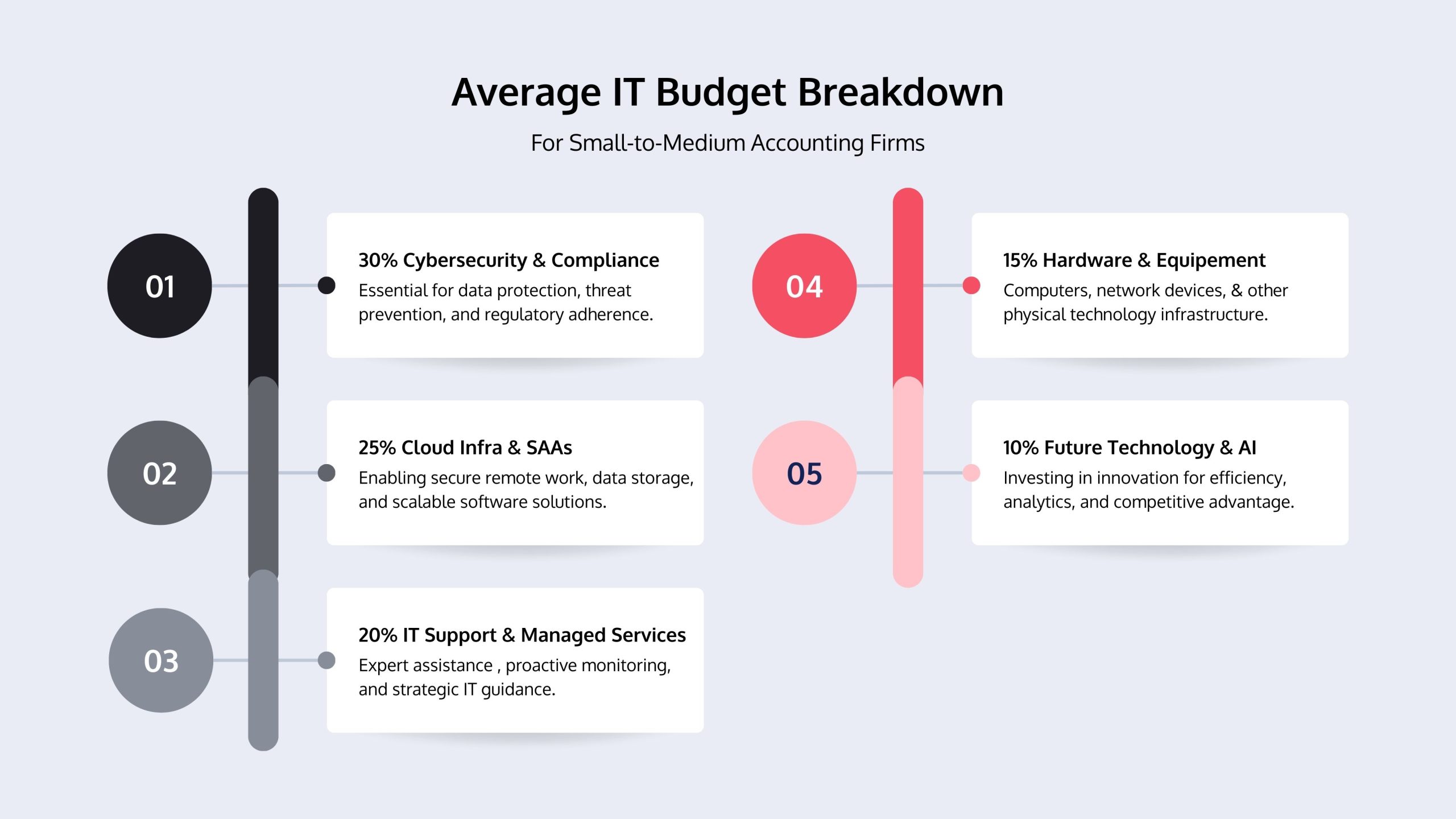
Why is our accounting practice spending so much on IT? Your accounting firm’s IT budget is likely higher than ever because of five unavoidable forces:
- Cybersecurity threats targeting financial data require constant, layered defenses
- Regulatory mandates demand frequent software updates, system changes, and staff training
- Cloud infrastructure and automation tools replace one-time capital expenses with recurring subscription costs
- Client expectations for real-time data, secure portals, and advisory services keep rising
- Emerging technologies like AI require upfront investment to stay competitive
These aren’t optional expenses—they’re the minimum cost of running a modern, secure, and competitive accounting practice in 2025.
The shift is clear: IT expenditure now accounts for 2% to 12% of revenue globally, and digital change spending is forecast to grow at 16.2% annually through 2027. For accounting firms handling sensitive financial data, these numbers track to the higher end of that range. The question isn’t whether to spend, but how to spend strategically so every dollar drives efficiency, protects your reputation, and supports growth.
I’m Orrin Klopper, CEO of Netsurit. Over the past 30 years, I’ve helped over 300 organizations, including dozens of Texas accounting practices, build technology strategies that pay for themselves. Thriving firms don’t see IT as a cost center; they treat it as the operational backbone of their business.
1. The Non-Negotiable Cost of Cybersecurity
Cybercriminals target accounting firms for one simple reason: you hold the keys to your clients’ financial kingdoms. Tax returns, bank account details, and payroll data are all extremely valuable on the dark web. A breach doesn’t just cost money; it destroys the trust you’ve spent years building with every client.
This reality explains a major part of your IT spending. You’re investing in survival. The spending covers endpoint protection, managed firewalls, continuous monitoring, and regular employee training, as technology alone can’t stop a malicious click. Add rising cyber insurance premiums, which require proof of proper defenses, and you have a substantial, growing recurring expense.
Understanding Why is Cybersecurity Important? is the first step toward building a resilient practice. For firms that lack in-house security expertise, a Fully Managed Cybersecurity solution provides comprehensive protection without hiring a full-time security team. Our Cybersecurity Services in Houston ensure local practices get enterprise-grade protection custom to the threats accounting firms actually face.
Why underinvesting in security is a critical mistake
The math on cybersecurity underinvestment is brutal: pay a reasonable amount now, or pay a catastrophic amount later.
A mid-sized CPA firm in Katy, TX, learned this the hard way. Relying on basic antivirus software, they fell victim to a sophisticated phishing email disguised as a client inquiry. One click later, ransomware spread across their network.
The final bill exceeded $150,000. That covered forensic investigation, mandatory client notification letters, two years of credit monitoring for affected clients, and IRS fines for failing to protect taxpayer information. The firm also lost three major clients who couldn’t stomach the risk of staying with a practice that had proven it couldn’t protect their data.
The worst part? A proper security setup would have cost them roughly $3,000 per month—about $36,000 per year. They gambled to save money and lost everything they were trying to protect.
How to approach cybersecurity investment
Smart cybersecurity spending isn’t about buying every tool on the market. It’s about building layered defenses that address your actual vulnerabilities.
The most effective approach combines endpoint protection on every device, a managed firewall monitoring all network traffic, continuous security monitoring to catch breaches within minutes (not months), and quarterly employee training on phishing and social engineering tactics. This layered strategy means that if one defense fails, three others are still standing.
This works best when you treat security as an ongoing process, not a one-time project. Threats evolve weekly; your defenses must keep pace.
Avoid the trap of relying on a single security tool or the “set it and forget it” mindset. No single product stops every threat, and unmonitored security tools become useless the moment they need updating.
The risks are straightforward: underinvest and you face a high probability of a breach with six-figure recovery costs. Overinvest in mismatched tools and you waste budget on redundant features that don’t actually improve your security posture.
The mitigation is simple: start with a professional Cyber Risk Assessment to identify your firm’s specific vulnerabilities. This assessment shows you exactly where attackers would target your practice and lets you prioritize spending on the highest-impact solutions first. You’ll know whether you need to focus on email security, network protection, or endpoint hardening—and you won’t waste money guessing.
2. The High Price of Regulatory and Compliance Mandates
The accounting profession operates under a relentless wave of regulatory change. Tax laws shift annually, data privacy regulations tighten, and financial reporting standards grow more complex. For your practice, this means your IT systems must adapt constantly—and that adaptation costs real money.
Compliance isn’t negotiable. Mandates from the IRS, PCAOB, and data privacy laws drive IT spending through required software updates, system improvements for audit trails and secure data handling, and staff training on new tools and rules. Understanding The Importance of Cybersecurity Compliance helps frame why these investments protect more than just your data—they protect your license to operate. Regular IT Audits and Assessments identify gaps before regulators or auditors do.
How compliance drives up software and training costs
Compliance costs hit your bottom line twice: once in software licenses, and again in lost billable hours.
A Conroe-based accounting practice learned this the hard way in 2024. New IRS and PCAOB requirements forced them to upgrade their entire tax and audit software suite. The licenses alone ran into five figures. But the real pain came from the 40 hours of non-billable time their staff spent in mandatory training sessions to learn the new systems. That’s a full week of work that generated zero revenue—multiplied across every staff member.
These aren’t one-time expenses. Regulations change every year, triggering another round of updates and training. This recurring cycle is a major reason why is our accounting practice spending so much on IT year after year. You can’t defer compliance spending without risking penalties, malpractice claims, or losing your professional credentials entirely.
Staying current with regulatory technology
The smart approach is to invest in platforms that update automatically. Specialized tax compliance resources and cloud-based software receive updates the moment new regulations take effect, protecting you and your clients from costly errors. These systems maintain the audit trails and documentation that regulators demand, without requiring manual intervention from your already-stretched staff.
This proactive investment prevents the far more expensive alternative: scrambling to fix compliance gaps after an audit, or worse, after a penalty. The firms that budget for ongoing regulatory technology as a fixed cost—rather than treating each update as a surprise—consistently spend less and stress less during tax season and audit periods.
3. The Necessary Shift to Cloud and Automation
The accounting industry has fundamentally changed how it operates. The old model of buying expensive servers and manually processing data is gone. In its place are cloud-based platforms and automation tools that replace large, one-time capital expenses with predictable monthly subscriptions.
This shift is a major reason why is our accounting practice spending so much on IT. Instead of a $30,000 server purchase every five years, you’re now paying monthly for cloud infrastructure and software-as-a-service (SaaS) subscriptions. The expense structure has changed, but the value is compelling: no more hardware failures, no maintenance headaches, and the ability to work securely from anywhere.
Cloud-based accounting solutions running on platforms like Microsoft Azure Services eliminate the need for physical servers altogether. Your team gains instant access to files and applications from home, client sites, or coffee shops—all with enterprise-grade security. Automation tools handle repetitive tasks like data entry and report generation, freeing your staff for advisory work that generates revenue. This isn’t just about keeping up; it’s about staying competitive. Embracing Digital Finance Transformation and leveraging robust Cloud Services are now essential for any practice that wants to attract quality clients and top talent.
Why the cloud is a recurring, but valuable, expense
A Sugar Land firm moved from an aging on-premise server to the cloud. While the monthly bill felt like a new expense, the benefits were immediate. Their team could work from anywhere, boosting tax season productivity by 15% as staff could finish returns from home instead of driving to the office.
The firm also downsized their office lease, saving $1,200 per month in rent. They eliminated the annual $3,500 maintenance contract for their old server. And when Hurricane Beryl knocked out power in their building for three days in July 2024, they didn’t miss a single deadline because everyone worked remotely.
The recurring cloud bill replaced capital expenses, maintenance costs, and inflexibility with scalability, resilience, and the ability to attract talent who expect modern work options. The trade-off is worth it when you measure total cost of ownership and business continuity.
How to manage your cloud and automation strategy
Most cloud cost overruns happen because firms migrate without a plan. They move everything to the cloud—“lift and shift”—without optimizing workloads, rightsizing resources, or monitoring usage. The result: bills that spiral out of control and performance that’s no better than before.
Works best when you follow a clear Cloud Migration Checklist and establish cost controls from day one. This means choosing the right tier of service for each application, setting up alerts when spending exceeds thresholds, and regularly reviewing which licenses and resources you actually use.
Avoid when you treat cloud migration as purely an IT project without involving your finance and operations teams. Without buy-in and oversight, costs will drift.
Risks include security gaps during migration, poor performance if workloads aren’t properly configured, and budget overruns that can exceed your old on-premise costs. Common Cloud Migration Challenges also include complex integrations with legacy systems and unexpected data transfer fees.
Mitigations start with partnering with a Cloud Consulting expert who understands accounting workflows. At Netsurit, we design cloud environments specifically for CPA firms, ensuring you get the security, performance, and cost efficiency you need without the trial-and-error that wastes money and time.
4. Why Is Our Accounting Practice Spending So Much on IT to Meet Client Expectations?
Your clients no longer want just accurate tax returns delivered once a year. They expect secure portals for document uploads, real-time dashboards showing cash flow and profit trends, and proactive advisory services backed by data analytics.
This shift in client expectations is a major reason why is our accounting practice spending so much on IT. The bar has moved, and it’s not moving back.
The accounting industry is fiercely competitive. Clients now comparison-shop based on the quality of your technology experience as much as your technical expertise. A firm that can’t offer a modern digital experience will lose ground to competitors who can. These investments aren’t about flashy features—they’re about client retention, competitive survival, and the ability to charge for higher-value advisory work. Strategic IT Strategy Services and expert IT Consulting Houston help firms align their technology investments with what clients actually demand and what competitors are already offering.
Investing in Technology for a Competitive Advantage
A Houston CPA firm with a 20-year track record recently lost a high-value manufacturing client—not because of service quality, but because a competitor offered a sophisticated client portal with real-time financial dashboards. The client didn’t leave angry; they left because the competitor made their life easier.
This was a wake-up call. The firm realized it needed to invest in similar client-facing technology, not just to win new business, but to keep the clients it already had. Today’s clients expect a higher level of digital service and proactive insight. They want to log in at any time and see where their business stands, without waiting for a quarterly meeting.
The firms that invest in these tools aren’t just keeping up—they’re building a competitive moat. They’re positioning themselves as modern advisory partners, not just compliance providers. That shift opens the door to higher fees, longer client relationships, and referrals from clients who appreciate the experience.
The ROI of IT Spending on Firm Profitability and Valuation
Modern IT doesn’t just cost money—it makes money. When staff automate routine tasks and use efficient digital workflows, they can handle more clients or spend time on higher-value advisory work. This efficiency directly improves your profit margins.
There’s also a longer-term payoff: firm valuation. While many accounting firms are valued based on a multiple of revenue, a tech-enabled practice with strong cash flow, operational efficiency, and a reputation for excellent client service often commands a premium. Buyers pay more for firms that don’t require a technology overhaul on day one. They pay more for recurring revenue streams built on advisory services, not just compliance. And they pay more for client retention rates that prove the firm’s value proposition works.
5. Preparing for the Future with AI and Emerging Tech
The accounting profession stands at a technological inflection point. Artificial Intelligence and automation are no longer distant possibilities—they’re here, and firms that invest now will reap significant competitive advantages and long-term savings, even if the initial IT spending feels steep.
AI-powered accounting solutions already streamline repetitive tasks like data entry, bank reconciliations, and invoice processing. They minimize human error and surface insights that would take hours to extract manually. Predictive analytics transforms how firms deliver advisory services, shifting from backward-looking compliance work to forward-looking strategic guidance. A client doesn’t just want to know what happened last quarter—they want to know what’s likely to happen next quarter and what they should do about it.
The numbers tell a sobering story: senior leaders estimate that roughly 50% of digital change spend is wasted on misaligned projects or poor implementation. But the firms that get it right achieve over 10% recurring savings while simultaneously improving service quality. The gap between winners and losers is growing wider. Resources on AI Productivity and how to Innovate AI can guide your firm’s investments toward the high-impact side of that equation.
How can accounting firms optimize their IT spending without compromising growth?
The answer isn’t slashing your budget—it’s spending smarter. Strategic planning beats arbitrary cuts every time.
Start by consolidating vendors. Many firms accumulate dozens of small software subscriptions and service providers over the years. This “vendor tail spend” creates billing complexity, security gaps, and missed volume discounts. Consolidating to fewer strategic partners often cuts costs by 15-25% while improving service quality.
Next, right-size your software licenses. A Houston firm recently finded they were paying for 40 licenses of their tax software when only 28 staff actually used it. They were also subscribed to premium features that no one had touched in two years. A quarterly license audit can recover thousands of dollars annually.
For most small and mid-sized practices, partnering with a Managed IT Services provider delivers enterprise-grade tools and expertise at a fraction of the cost of hiring an in-house team. An MSP spreads the cost of specialized talent—cybersecurity experts, cloud architects, compliance specialists—across dozens of clients. This guide on how to choose a managed services provider walks you through finding the right fit. Our Managed IT Services are designed specifically to support accounting practices that need reliability without the overhead.
If you’ve moved to the cloud, implement FinOps practices. Financial Operations brings the same rigor you apply to client finances to your own cloud spending. It means tracking which applications consume the most resources, shutting down idle environments, and choosing the right instance sizes. A Sugar Land firm reduced their Azure bill by 30% simply by scheduling their development servers to power down outside business hours.
These strategies reduce complexity, eliminate waste, and free up budget for genuine innovation—the kind that accelerates growth rather than just maintaining the status quo.
What are the risks associated with underinvesting in IT for an accounting firm?
Underinvestment isn’t conservative—it’s reckless. The risks are real, measurable, and growing.
Client attrition happens quietly at first, then all at once. A Katy firm lost a $50,000-per-year client in early 2025 because they couldn’t provide the real-time cash flow dashboard the client’s new CFO expected. The client didn’t complain or negotiate—they just left. In a competitive market where clients have options, outdated technology is a silent business killer.
Increased cyber risk is perhaps the most immediate threat. Cybercriminals specifically target accounting firms because of the valuable financial data you hold. A firm without modern endpoint protection, multi-factor authentication, and continuous monitoring is essentially leaving the vault door open. The average cost of a data breach for a small firm now exceeds $150,000, and that doesn’t include the clients you’ll lose when word gets out.
Operational inefficiency compounds over time. Staff spending hours on manual tasks that could be automated leads to burnout, erodes profit margins, and limits your capacity for new clients. A Conroe practice calculated that outdated systems cost them 20 billable hours per week—over $100,000 in lost revenue annually.
Talent drain accelerates when your technology lags. Top accounting graduates and experienced professionals expect modern tools. They’ve been trained on cloud-based systems, automation platforms, and collaborative software. If your firm is still running decade-old on-premise solutions, you’ll struggle to recruit and retain the people you need to grow. In the current tight labor market, this is a competitive disadvantage you can’t afford.
Compliance penalties are the final risk. Regulators and professional bodies increasingly require specific security controls and data handling procedures. If your IT systems can’t support these requirements, you face fines, sanctions, and potential loss of your license to practice. The question of why is our accounting practice spending so much on IT has a simple answer when viewed through this lens: because the alternative—underinvesting—threatens your firm’s very survival.
Frequently Asked Questions about Accounting Firm IT Costs
How much should an accounting firm spend on IT?
There’s no magic number, but industry benchmarks suggest IT spending accounts for 2% to 12% of revenue. For accounting firms handling sensitive financial data and facing intense regulatory pressure, you’ll likely track toward the higher end of that range.
Your budget should reflect your firm’s specific circumstances—size, growth trajectory, and risk appetite. A 5-person practice in Conroe needs a different IT investment than a 30-person Houston firm pursuing aggressive growth. High-growth firms consistently invest more in technology as a strategic growth engine. Firms that treat technology as a cost to minimize often find themselves struggling to compete within 18–24 months.
Can outsourcing IT reduce costs for my practice?
Yes, and for most small and mid-sized accounting firms, it’s significantly more cost-effective. Hiring a full-time IT professional in the Houston metro area costs $70,000–$90,000 annually, plus benefits and training, and they may lack expertise in critical areas like cybersecurity. When that person takes vacation or leaves, you’re on your own.
Partnering with a Managed Service Provider (MSP) gives you a team of specialists—cybersecurity experts, cloud architects, compliance advisors—for a predictable monthly fee that’s 30–50% less than a single full-time hire. You eliminate recruitment costs and training expenses while gaining access to enterprise-grade tools and expertise that are otherwise unaffordable. With the right partner, the question of why is our accounting practice spending so much on IT becomes more manageable.
What is the single biggest IT risk for accounting firms in 2025 and beyond?
Cybersecurity remains the overwhelming top risk, and the threat landscape is accelerating. We’re now seeing sophisticated, AI-driven phishing attacks that can convincingly impersonate your clients, partners, or even the IRS. Ransomware groups specifically target accounting firms during tax season, knowing you’re under pressure and more likely to pay.
Traditional antivirus and basic firewalls are no longer adequate. A Sugar Land firm we worked with in early 2025 had “good” security until a single compromised email led to a ransomware attack that encrypted their client database weeks before the April deadline. The recovery cost exceeded $200,000, and they lost 15% of their client base within six months. The firms that survive implement multi-layered security: endpoint protection, managed firewalls, continuous monitoring, regular employee training, and a tested incident response plan. This isn’t an area where you can afford to learn by making mistakes.
Conclusion
If you’ve been wondering why is our accounting practice spending so much on IT, the answer is clear: high IT spending is the new baseline for running a competitive, secure, and compliant accounting firm in 2025. The five forces driving your budget—cybersecurity threats, regulatory mandates, cloud infrastructure, client expectations, and emerging technologies like AI—are intensifying.
Firms that struggle treat technology as a cost to be minimized. Thriving firms see IT spending as a strategic investment that, when optimized, improves profitability, protects your reputation, attracts talent, and increases firm valuation. The question is not whether to spend, but how to spend strategically for measurable returns.
Strategic optimization doesn’t mean slashing your budget. It means consolidating vendors, right-sizing software licenses, implementing cloud cost management, and ensuring security investments align with your risk profile. Most importantly, it means partnering with experts who understand the technology landscape and the unique pressures facing accounting practices in markets like Houston, Sugar Land, Katy, and Conroe.
The cost of underinvestment—losing clients, suffering a devastating data breach, operating with crippling inefficiency, or failing to attract skilled professionals—far exceeds the cost of a well-planned IT strategy. Your technology infrastructure is the operational backbone of your practice. Treat it accordingly.