Payroll Is Broken for Most Businesses — AI Fixes the Core Problems
AI in payroll refers to using machine learning, natural language processing, and predictive analytics to automate wage calculations, flag errors, monitor compliance, and generate real-time workforce insights — replacing slow, error-prone manual processes.
How AI streamlines payroll — fast answer:
| Problem | What AI Does | Result |
|---|---|---|
| Manual data entry errors | Flags anomalies before processing | Up to 42% fewer payroll errors |
| Compliance across jurisdictions | Monitors tax law changes in real time | Reduced legal exposure |
| Slow processing cycles | Automates validation and scheduling | 25–50% faster payroll runs |
| Employee pay questions | AI chatbots answer instantly | Up to 40% fewer HR inquiries |
| Labor cost forecasting | Predictive models analyze trends | 15–20% better forecast accuracy |
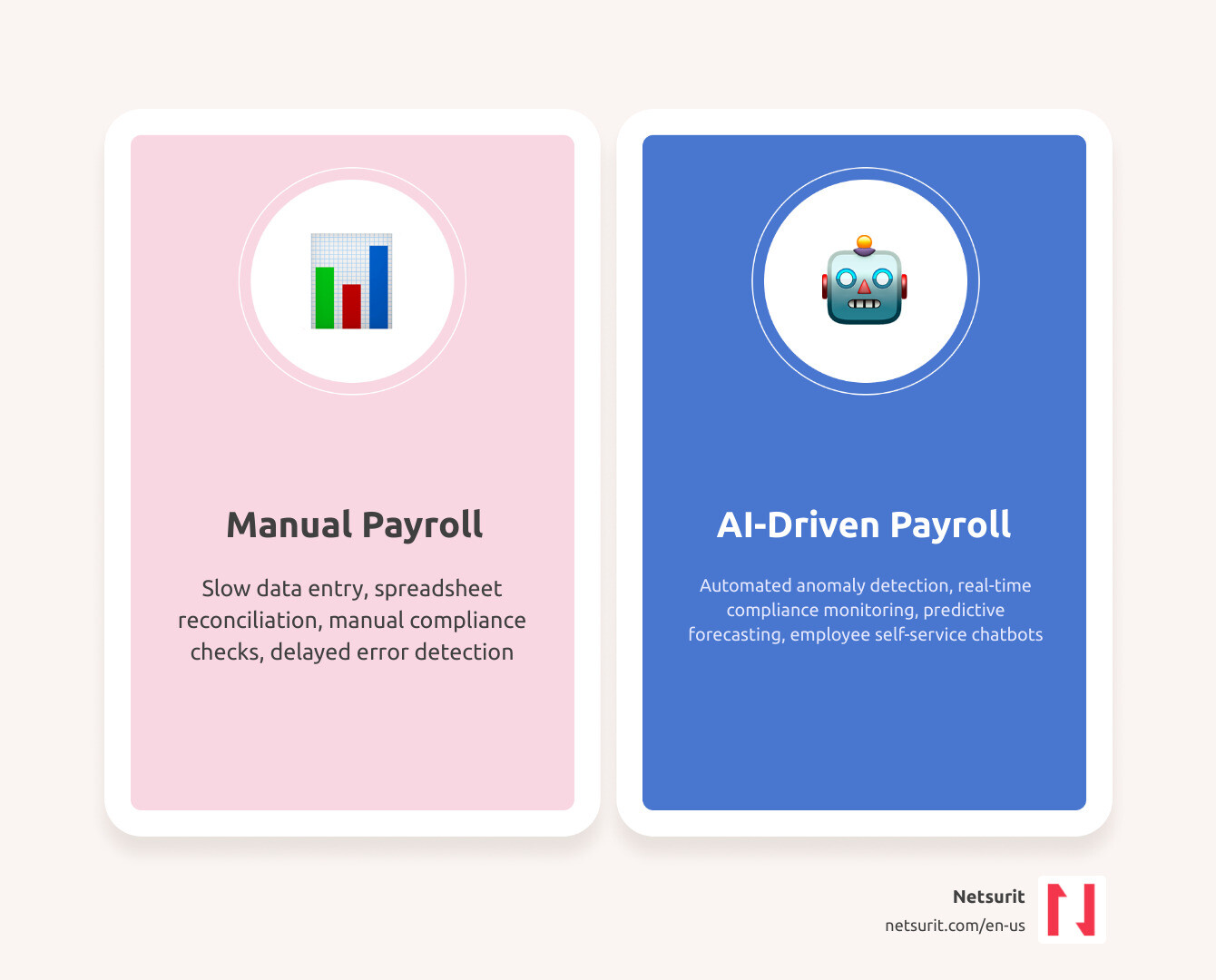
Payroll teams are under real pressure. Regulations change constantly, processing windows shrink, and 63% of teams still rely on spreadsheets — with half entering data by hand. That’s a fragile setup. One misclassified deduction or missed tax update can trigger compliance failures that cost far more to fix than to prevent.
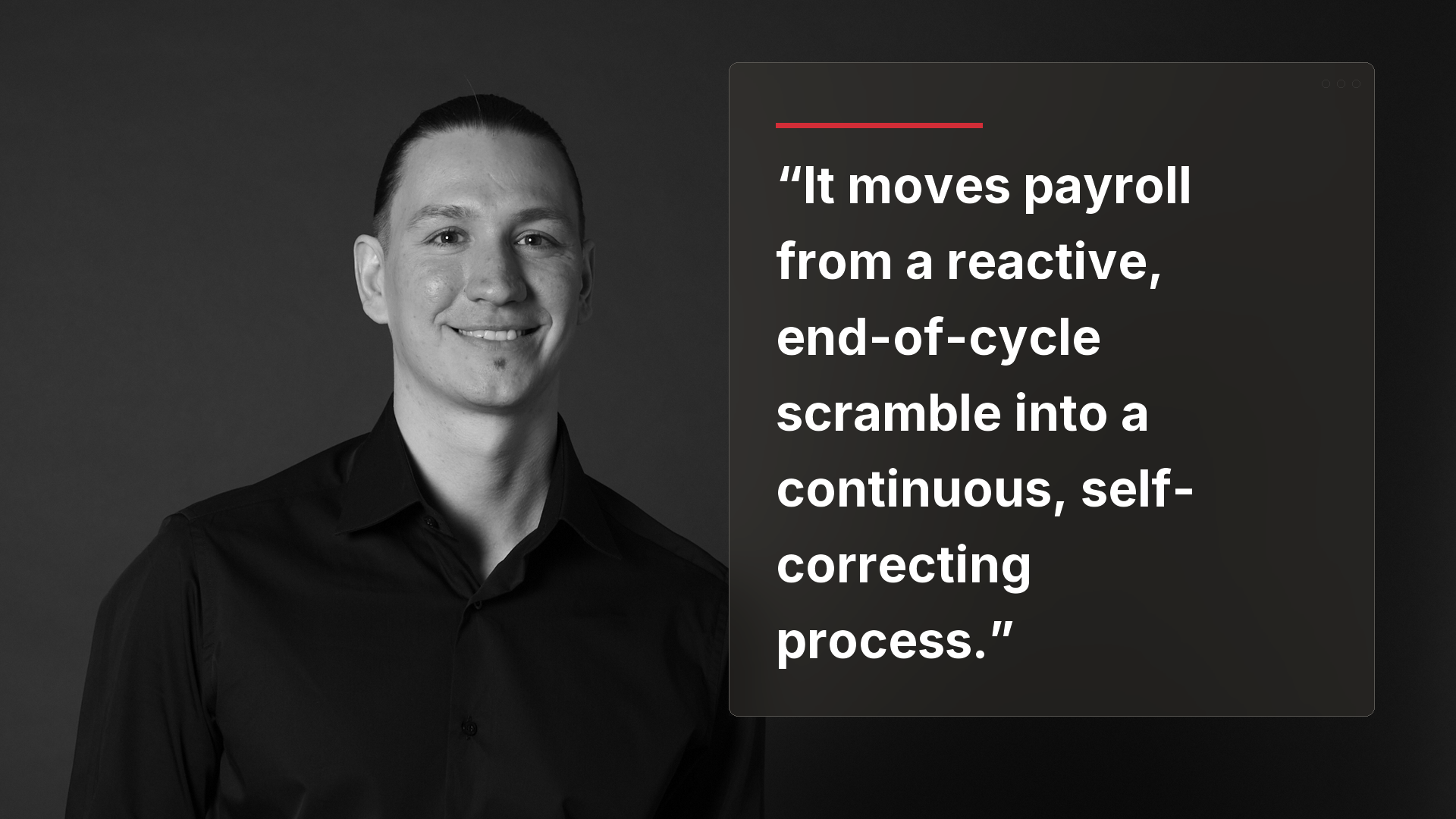
The shift to AI doesn’t just speed things up. It moves payroll from a reactive, end-of-cycle scramble into a continuous, self-correcting process. For accounting and professional services firms in Houston — managing payroll across Texas entities with varying local rules — that difference is material.
This guide walks through how to make that shift: the tools, the risks, and the steps that actually work.
I’m Orrin Klopper, CEO of Netsurit, and over nearly three decades of helping businesses modernize their IT and operations, I’ve seen how poor data infrastructure turns AI in payroll from a competitive advantage into a compliance liability. The sections ahead draw on that experience to help you implement AI payroll systems that are accurate, auditable, and built to scale.
AI in payroll word list:
- AI for accounting
- Automate accounts payable
- Machine learning accounting
Defining the Strategic Value of AI in Payroll
To understand why AI in payroll is gaining momentum, we must look past the hype of “automation” and focus on the specific technologies driving change. At its core, AI uses Machine Learning (ML) to identify patterns in vast datasets and Natural Language Processing (NLP) to interpret complex documents or employee queries.
Traditional payroll software follows a rigid “if-this-then-that” logic. If an employee works 40 hours at $20/hour, it cuts a check for $800. AI is different. It looks at the historical context. It might notice that a specific employee in your Katy office typically never works overtime, but suddenly has 20 hours of it. Instead of blindly processing the payment, the AI flags this as an anomaly for human review.
According to a McKinsey report, organizations using AI-driven payroll software have observed a 20% improvement in payroll accuracy. This isn’t just about saving a few dollars; it’s about reclaiming the hundreds of hours your team spends on manual reconciliations. By leaning into AI productivity, firms can pivot from being data entry clerks to strategic financial advisors.
The Shift from Reactive to Proactive Operations
Most payroll cycles are reactive. You wait for the period to end, collect timesheets, find the errors, and scramble to fix them before the direct deposit deadline. AI flips this script. It enables continuous payroll monitoring, identifying discrepancies the moment data enters the system.
A recent Gartner survey reveals that 58% of finance functions are already using or testing AI in 2024. This rapid adoption is fueled by the need to reduce manual data entry, especially for firms in data-rich environments like Houston’s energy and healthcare sectors.
Example: A logistics firm in Conroe previously spent three days every month manually verifying per diem rates and mileage for 200 drivers. By implementing AI-based validation, they reduced their processing time by 33%, allowing their small HR team to focus on talent retention rather than spreadsheet audits.
Core Applications of AI in Payroll for Houston Firms
For businesses in the Houston metro area, including Sugarland and Katy, the application of AI goes beyond simple math. It serves as a sophisticated gatekeeper for financial integrity.
| Feature | Traditional Automation | Agentic AI in Payroll |
|---|---|---|
| Logic | Rule-based (static) | Context-aware (learning) |
| Error Detection | Flags missing fields | Identifies “concerning patterns” |
| Workflow | Human must trigger each step | Autonomously validates and queues |
| Compliance | Manual updates required | Real-time legislative monitoring |
One of the most critical applications is anomaly detection. AI models leverage historical patterns to flag deviations using statistical thresholds. This is particularly effective at catching crooks with code. By reviewing data for unauthorized changes to timesheets or suspicious recurring expenses, AI acts as a 24/7 internal auditor.
According to a Stonebridge report on fraud patterns, unauthorized changes to benefits or investments are common pain points that AI can proactively block.
Enhancing Employee Experience with AI in payroll
Employee satisfaction often hinges on “payday perfection.” When an employee has a question about their tax withholding in Germany or their bonus in Texas, they want an answer immediately—not three days later when HR finally clears their ticket queue.
AI-powered chatbots, like those highlighted in the EY and Microsoft study, have reduced HR inquiries by up to 40%. These bots use NLP to provide instant feedback. If an employee submits an expense that exceeds a per diem limit set for a business trip to Houston, the AI can flag it instantly and explain the local tax rule, allowing the employee to fix it before submission.
When you’re ready to work smarter with AI, you move toward a personalized employee experience. This includes “self-explaining” payslips that break down gross-to-net changes, eliminating the confusion that often leads to internal disputes.
Navigating Global Compliance via AI in payroll
If your firm operates across multiple jurisdictions—perhaps with contractors in Mexico and employees in Texas—compliance is a nightmare. Tax rules, labor laws, and reporting formats change constantly.
Research from Eightfold AI shows that 77% of HR executives now use AI to manage these complexities. AI tools track legislative changes in real-time and update system rules without human intervention. This ensures that your withholding is always accurate, whether you’re dealing with regional pay differentials—which 71% of multi-location employers now offer—or complex 13th-month pay requirements abroad.
By keeping your compliance supercharged, you minimize legal exposure and avoid the “compliance tax” of expensive re-runs and penalties.
Overcoming Implementation Barriers and Ethical Risks

Despite the benefits, adoption isn’t always smooth. The Gartner poll on AI exploration found that while 70% of respondents are exploring AI, only 19% are in production. The main culprit? Data fragmentation.
Payroll data is often scattered across HRIS, finance systems, and clunky time-tracking apps. If the underlying data is messy, the AI’s output will be too. We often see this in Houston firms that have grown through acquisition; they end up with three different legacy payroll systems that don’t talk to each other.
Furthermore, there is the “trust gap.” Only 52% of employees are comfortable with AI tools in payroll. This is why we advocate for a “human-in-the-loop” model. As discussed in the BDO webinar on AI accountants, AI should handle the volume, but humans must manage the context and sensitive judgments.
Managing Data Privacy and Trust
Data privacy is non-negotiable. When you deploy AI in payroll, you are feeding it the most sensitive PII (Personally Identifiable Information) your company owns. Systems must be compliant with local and global standards, such as GDPR or the growing list of US state privacy laws.
ISG research suggests that by 2028, half of all enterprises will use AI to identify mistakes, but this requires a unified data model to be effective. Without a “single source of truth,” AI can actually accelerate data leakage.
Trade-offs: AI Implementation
- Works best when: You have a clean, centralized data foundation and a clear “human-in-the-loop” policy.
- Avoid when: Data is siloed across disconnected legacy platforms or when there is no internal capacity for oversight.
- Risks: Algorithmic bias (e.g., unfair flagging of specific groups) and data breaches.
- Mitigations: Regular bias audits, strict encryption, and “least-privilege” access controls.
Using AI to solve business problems requires intentionality. It is far easier to open a security door than to close it after a breach.
Predictive Analytics and the Future of Compensation
The “Golden Age of Payroll” isn’t just about processing checks; it’s about using payroll as a strategic data goldmine. The global data analytics market is expected to hit $68 billion by 2025, and payroll is a massive part of that.
Predictive analytics allow CFOs to move beyond looking at what happened last month to forecasting what will happen next quarter. Using time series models and regression analysis, AI can identify seasonality in overtime, predict turnover based on pay gaps, and optimize labor cost forecasting with 15–20% higher accuracy.
This makes financial statements smarter. Instead of guessing your Q4 labor costs, you can use AI to simulate different hiring scenarios and see their immediate impact on your bottom line.
Emerging Trends: Agentic AI and Blockchain
What’s next? We are moving from “Automated AI” to “Agentic AI.” These are autonomous agents that don’t just flag an error—they investigate it, contact the employee for clarification via chatbot, and queue the fix for approval.
As Thomson Reuters notes, AI will replace the manual work, not the professional. We are also seeing the integration of blockchain for “programmable wallets.” This allows for secure, instant, cross-border payments—a massive win for Houston firms with global supply chains.
The best way to automate workflows today is to build the foundation for these future technologies now.
Frequently Asked Questions about AI in Payroll
How does AI improve payroll accuracy?
AI improves accuracy by using machine learning to identify anomalies—like duplicate entries or incorrect hours—that traditional systems miss. It compares current data against historical patterns to flag discrepancies in real-time, reducing error rates by up to 42%.
Can AI handle complex global tax compliance?
Yes. AI tools monitor hundreds of jurisdiction-specific rules and filing deadlines simultaneously. They update tax tables and labor law constraints automatically, ensuring that withholding is accurate even as local regulations in different countries or states change.
What are the security risks of AI in payroll?
The primary risks include data leakage if the AI is used on unencrypted platforms and algorithmic bias if the training data is flawed. To mitigate these, firms must ensure AI is deployed within a secure, governed environment with strict human oversight and regular audits.
Conclusion
The transition to AI in payroll is no longer a luxury for the “Big Four” accounting firms; it is a necessity for any Houston business looking to scale without drowning in administrative debt. By automating the repetitive and securing the complex, you allow your team to focus on what matters: strategy and growth.
At Netsurit, we help firms across Texas navigate this digital transformation by building the secure data foundations AI requires. Don’t let your payroll be the weakest link in your business—make it your most strategic asset.
Next Action: Audit your current payroll data silos to determine if you are ready for AI integration.