Financial Fraud Is Outpacing Every Defense You Have — Except One
AI fraud detection is the use of machine learning and advanced algorithms to identify and block fraudulent activity in real time — faster and more accurately than any human or rule-based system can.
Here’s how it works at a glance:
| What AI Does | Why It Matters |
|---|---|
| Analyzes thousands of variables per transaction | Catches fraud patterns invisible to static rules |
| Scores risk in milliseconds | Blocks fraud before money moves |
| Learns from new data continuously | Adapts to tactics that traditional systems miss |
| Flags behavioral anomalies (device, typing, location) | Detects account takeover without waiting for a threshold breach |
| Generates explainable audit trails | Supports KYC and AML regulatory compliance |
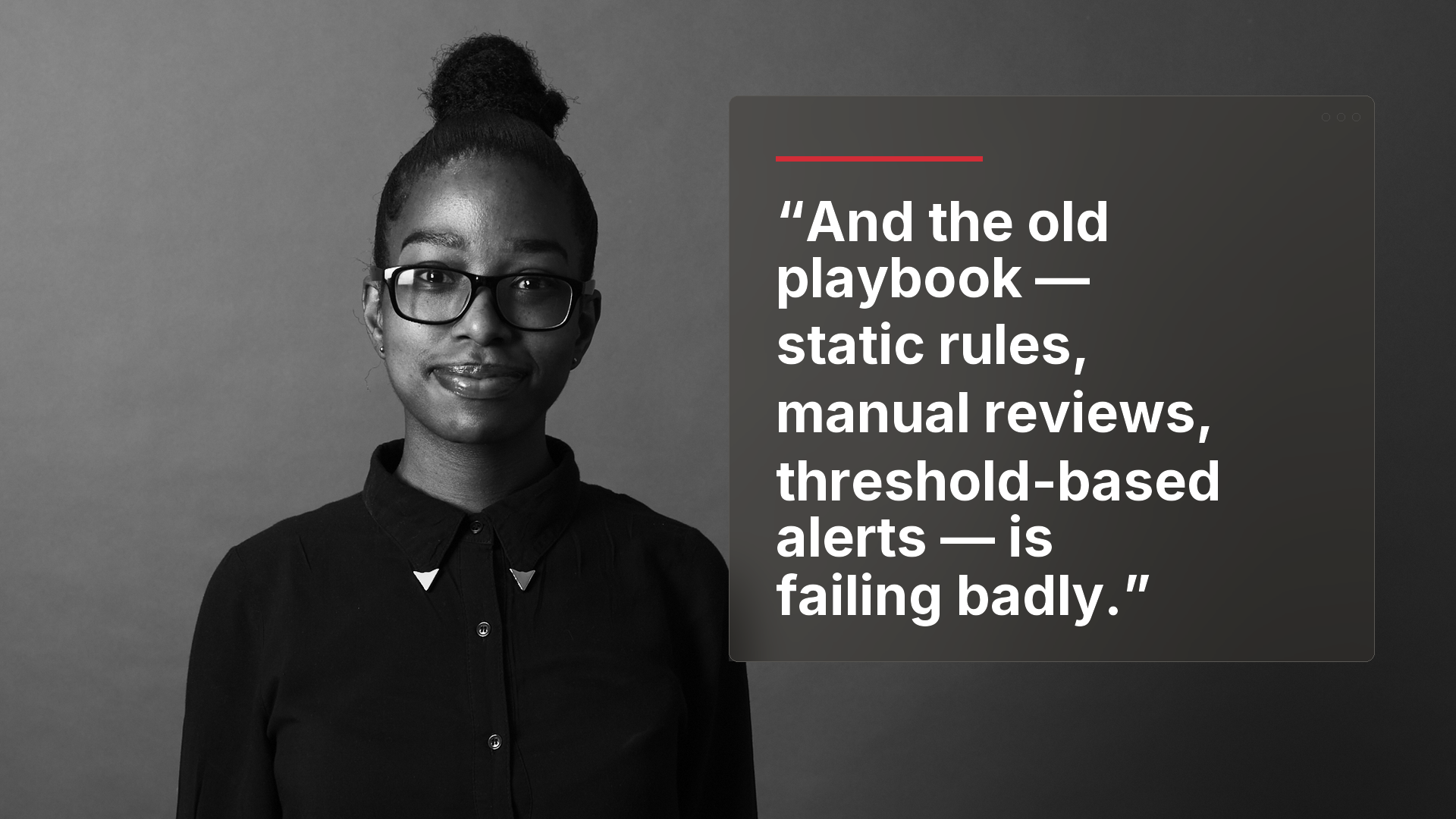
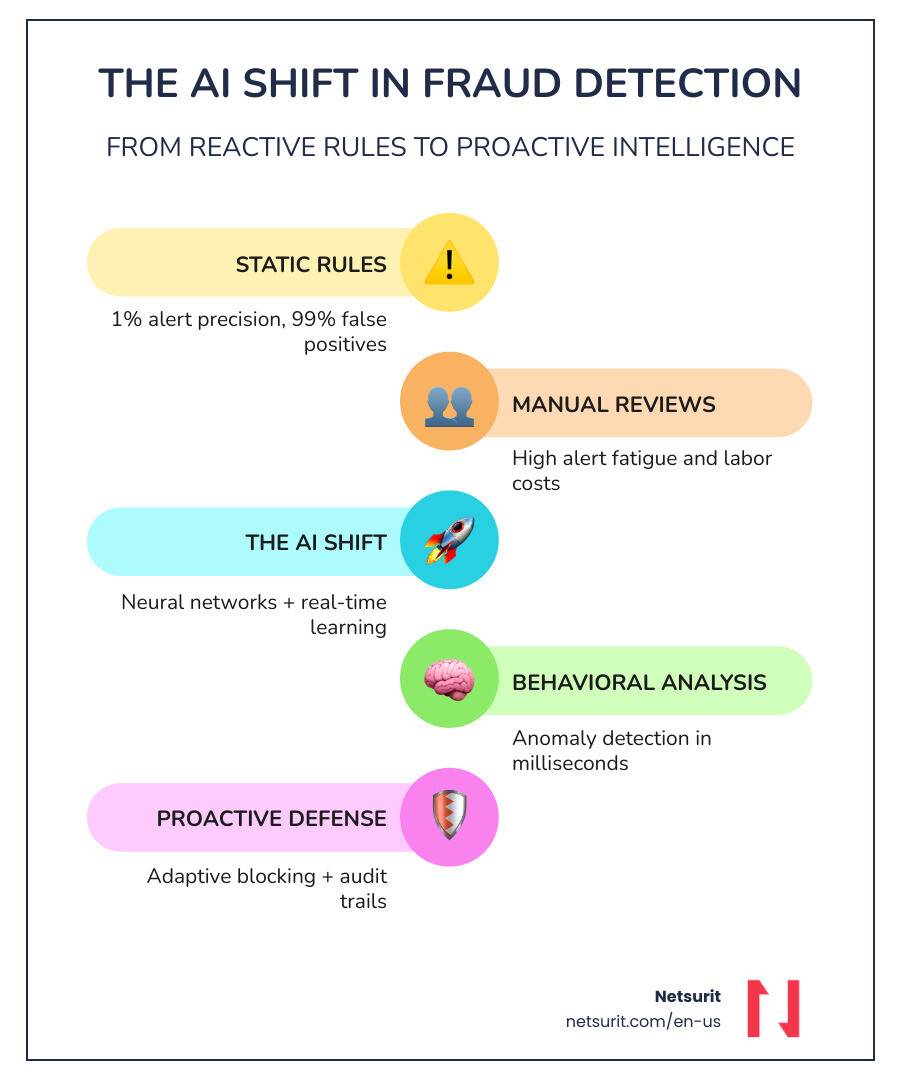
Fraud is no longer a fringe problem. In 2024, 90% of US companies reported being targeted by cyber fraud. Credit card losses alone are projected to hit $43 billion by 2026. And the old playbook — static rules, manual reviews, threshold-based alerts — is failing badly. Traditional systems produce alert precision rates as low as 1%, meaning 99 out of 100 flagged alerts are false alarms. That’s not a safety net. That’s noise.
Meanwhile, fraudsters have industrialized. They use AI tools, automated phishing kits, and synthetic identities to attack at scale. A single percentage point improvement in detection accuracy can save a financial institution millions of dollars annually — but only if the underlying system can keep up.
AI can. Rule-based systems cannot.
This guide breaks down exactly how AI fraud detection works, which techniques deliver the best results, where implementation gets hard, and what’s coming next.
I’m Orrin Klopper, CEO and co-founder of Netsurit — a global IT services company that has spent nearly three decades helping organizations secure and modernize their technology infrastructure, including deploying AI fraud detection solutions that protect sensitive financial data. As the threat landscape shifts from opportunistic attacks to industrialized cybercrime, I’ll walk you through what actually works — and where the real risks lie.
Simple AI fraud detection glossary:
- Machine learning for compliance
- Data analytics auditing
- Reduce audit risk
Beyond Static Rules: Why AI Fraud Detection Outperforms Legacy Systems
Traditional fraud prevention relies on “expert systems”—essentially a long list of “if-then” rules. If a transaction is over $10,000, flag it. If the IP address is from a different country, block it. The problem? Fraudsters know these rules and work just under the thresholds.
AI fraud detection moves past these rigid boundaries by using pattern recognition and predictive analytics. Instead of looking at a single transaction in a vacuum, AI analyzes the relationship between thousands of data points: the time of day, the device’s hardware signature, the typing rhythm, and how these compare to your historical behavior. Bank of England and PwC report on AI in financial services indicates that AI consistently outperforms manual controls because it doesn’t get tired and it doesn’t miss subtle correlations. For firms managing high-risk data, integrating machine learning into compliance is no longer optional; it is a prerequisite for safety.
The Failure of 1% Precision
Legacy systems are notorious for “alert fatigue.” When a system has a 1% precision rate, it means 99% of the alerts your team investigates are legitimate customers trying to buy groceries or pay a bill. This high false positive rate doesn’t just annoy customers; it carries a massive operational cost. A 5% false positive rate means one in 20 legitimate transactions is blocked, leading to abandoned carts and lost trust. AI reduces this friction by learning that a “high-risk” transaction might actually be normal for a specific user during a specific time of year.
Scaling Real-Time AI Fraud Detection for High-Volume Transactions
Speed is the ultimate arbiter in fraud prevention. If a system takes five seconds to decide if a swipe is fraudulent, the customer is already frustrated. Modern AI models achieve sub-second latency using edge computing, allowing them to block a transaction before it even reaches the processing stage. JP Morgan’s 3-year AI implementation results showed a significant reduction in fraud cases and false positives by monitoring live transactions in real time.
| Metric | Rule-Based Systems | AI-Powered Systems |
|---|---|---|
| Decision Speed | 1–2 Seconds (Lagged) | <100 Milliseconds (Real-time) |
| Detection Accuracy | Low (Threshold-based) | High (Pattern-based) |
| False Positive Rate | High (Up to 99% of alerts) | Low (Continuously optimized) |
| Adaptability | Manual updates required | Self-learning from new data |
Trade-offs: Accuracy vs. Explainability
While AI is powerful, it isn’t a magic wand. You must balance the “black box” nature of deep learning with the need for transparency.
- Works best when: You have high-volume, labeled historical data to train the model.
- Avoid when: You have a “cold start” problem (e.g., a brand-new product line with no transaction history).
- Risks: “Black box” models can make accurate decisions that are impossible to explain to a regulator.
- Mitigations: Use tools like SHAP (SHapley Additive exPlanations) to “unmask” the AI’s logic for audit trails.
Advanced Techniques Powering Modern Fraud Prevention
To stay ahead of industrialized crime, we use a multi-layered stack of technologies. This includes supervised machine learning (like Random Forest, which can hit 99.96% accuracy on credit card datasets) and unsupervised deep learning to find anomalies that haven’t been seen before. By utilizing NVIDIA RAPIDS for accelerated data science, we can process massive datasets in minutes rather than days. This speed is essential for working smarter with AI and maintaining a proactive defense.
Behavioral Biometrics and Anomaly Detection
Fraudsters can steal your password, but they can’t easily steal your “digital soul.” Behavioral biometrics analyze how you interact with a device:
- Typing Rhythm: The micro-intervals between keystrokes.
- Mouse Movements: The specific curves and speeds of your cursor.
- Touchscreen Pressure: How hard you press on your phone’s screen.
If an account is accessed with the correct password but the typing speed is 300% faster than usual, the AI flags a “bot” or an unauthorized user immediately.
How AI Fraud Detection Addresses Synthetic Identity and Payment Scams
Synthetic identity fraud is a growing nightmare where criminals combine real (often stolen) social security numbers with fake names to create “Frankenstein” identities. Traditional systems see a “new” customer with a clean record. However, Graph Neural Networks (GNNs) look at the connections. They might find that 50 different “new” customers all use the same obscure VOIP phone number or share a single digital fingerprint. Interac’s 300% increase in fraud detection in its first year proves that seeing the “bird’s-eye view” of a network is the only way to catch these rings.
Scenario: Tax Season in Sugarland
Imagine a Sugarland-based accounting firm that suddenly sees a spike in 200 new clients during April, all claiming high-value refunds. On the surface, they look legitimate. But their AI fraud detection system flags that 40% of these identities are linked to a single, obscured VOIP number based in a different region. By identifying this pattern, the firm blocks the synthetic identity payout before the filing deadline, saving millions in potential losses and protecting their professional reputation.
The Generative AI Paradox: Deepfakes vs. Fraud Copilots
Generative AI is a double-edged sword. While it helps us detect fraud, it also gives criminals “Fraud-as-a-Service” kits. The FTC has issued warnings on AI voice clones, where a fraudster mimics a CEO’s voice to authorize a wire transfer. For accounting and finance teams, understanding these AI tools for firms is the first step in building a defense.
The Rise of Industrialized Phishing
Large Language Models (LLMs) like ChatGPT have made it easy for hackers to generate “perfect” phishing emails. No more typos or weird grammar. Tools like “FraudGPT” allow criminals to launch sophisticated spear-phishing campaigns at scale. An Oxford study on LLM-driven phishing found that AI-generated emails are becoming indistinguishable from human ones, making user training alone an insufficient defense.
AI as the Fraud Analyst’s Copilot
On the defensive side, we use Generative AI as a “Fraud Copilot.” Using Retrieval-Augmented Generation (RAG), an AI assistant can scan thousands of pages of internal policy and transaction logs to summarize why a specific case is suspicious. This allows a human analyst to review a complex fraud attempt in seconds rather than hours. NVIDIA NeMo provides the guardrails needed to ensure these LLMs stay secure and don’t leak sensitive client data.
Trade-offs: Generative AI in Defense
- Works best when: Creating “synthetic” fraud data to train your models on rare attack types.
- Avoid when: You need a final “yes/no” on a high-value wire transfer; always keep a human in the loop.
- Risks: Adversarial AI, where fraudsters use LLMs to probe your detection model for “blind spots.”
- Mitigations: Implement multi-modal verification—checking voice, facial recognition, and behavioral signals simultaneously.
Overcoming Implementation Hurdles in Financial Workflows
The biggest barrier to AI fraud detection isn’t the math; it’s the plumbing. Many firms are stuck with legacy systems that don’t “talk” to modern AI. Data fragmentation—where transaction history is in one database and customer profiles are in another—prevents the AI from seeing the full picture.
Integrating with Legacy Infrastructure
You don’t have to rip and replace your entire IT stack. We recommend an API-driven architecture where AI acts as a “layer” on top of your existing systems. Using tools like the NVIDIA Triton Inference Server, you can deploy AI models that process real-time streams of data without disrupting your core accounting or banking software. This “middleware” approach allows for automated accounting workflows that are both fast and secure.
Navigating the “Failure to Prevent” Regulatory Landscape
Global regulations are shifting. Many jurisdictions now have “failure to prevent fraud” laws that hold companies liable if they don’t have “reasonable” digital defenses. This makes robust KYC (Know Your Customer) and AML (Anti-Money Laundering) audit trails mandatory. The PwC Global Economic Crime Survey highlights that 46% of businesses have been hit by fraud, yet many lack the explainable AI needed to satisfy a regulatory audit after an incident occurs.
Scenario: Business Email Compromise in Katy
A manufacturing controller in Katy receives an email from a long-time vendor asking to change their banking details for an upcoming $250,000 payment. The email looks perfect. But our AI-powered security layer flags it. Why? The “linguistic metadata”—the specific word choices and sentence structures—doesn’t match the vendor’s 3-year history of communication. The AI suspected a “conversation hijacking” attack, where a fraudster took over the vendor’s account. The controller called the vendor, confirmed the email was fake, and stopped a quarter-million-dollar loss.
Measuring Success and the Future of AI Fraud Detection
How do you know if your AI is actually working? You must track more than just “fraud caught.” You need to look at:
- True Positive Rate (TPR): The percentage of actual fraud caught.
- False Positive Rate (FPR): The percentage of good customers wrongly flagged.
- Value Detection Rate: The total dollar amount saved versus the cost of the system.
Improving your detection by just 1% can result in millions of dollars in savings for large organizations. To stay ahead, we are looking toward advanced graph techniques and AI productivity gains that allow smaller teams to punch above their weight class.
Federated Learning and Privacy-Preserving Detection
One of the most exciting trends is Federated Learning. This allows different banks or firms to “train” a shared fraud model without actually sharing their private customer data. You get the benefit of seeing fraud patterns from across the world without ever compromising your clients’ privacy. This is often run on high-performance NVIDIA DGX systems to handle the massive computational load.
Quantum Computing: The 2026 Horizon
By 2026, we expect Quantum Computing to begin impacting the fraud landscape. Quantum algorithms will be able to analyze encrypted transactions and complex variable interactions that are currently impossible for classical computers. This will shorten model training cycles from days to seconds, allowing for a truly “autonomous” fraud defense.
Frequently Asked Questions about AI Fraud Detection
How does AI reduce false positives compared to traditional rules?
AI analyzes thousands of variables simultaneously to understand “normal” behavior for a specific user. While a rule might flag all transactions over $5,000, AI knows that a $7,000 purchase is normal for you in December but suspicious in July, drastically reducing the number of legitimate customers who get blocked.
Can AI detect fraud types it hasn’t seen before?
Yes. Through “unsupervised learning,” AI looks for anomalies—anything that deviates from the established “normal” pattern. This allows it to flag “zero-day” fraud tactics that don’t have a known signature or previous example in the database.
Is AI fraud detection compliant with financial regulations?
Yes, provided you use “Explainable AI” (XAI). Regulators require you to show why a decision was made. Modern AI stacks generate audit trails that decompose a high-risk score into understandable factors (e.g., “unusual device,” “mismatched location,” “bot-like typing speed”), satisfying KYC and AML requirements.
Conclusion
At Netsurit, we believe that AI fraud detection represents a fundamental shift from reactive policing to autonomous defense. For any firm handling sensitive financial data in the Houston, Katy, or Sugarland areas, moving beyond static rules is no longer a luxury—it’s a survival requirement. By integrating an AI-driven security stack, you don’t just stop crooks; you protect your bottom line and ensure your clients’ trust remains unbroken. Unlock your business momentum with digital transformation today.