Reactive Security Is a Liability for Houston Accounting Firms
Analytics in cyber security is the practice of collecting, correlating, and analyzing security data to detect and stop threats before they cause damage — and for tax and accounting firms in the Houston metro, it is no longer optional.
Here is what it means in practice:
| What It Does | Why It Matters to Your Firm |
|---|---|
| Collects logs from endpoints, networks, and cloud systems | Gives you full visibility into who accesses client financial data |
| Establishes normal behavioral baselines for users and devices | Flags anomalies like a 2:00 AM login during tax season |
| Applies machine learning to reduce false alarms | Lets your team focus on real threats, not noise |
| Automates initial response actions | Cuts breach containment time from hours to minutes |
| Supports compliance reporting for HIPAA, PCI DSS, and similar frameworks | Reduces audit burden and regulatory risk |
The stakes are concrete. The average data breach now costs $4.88 million. In regulated industries like financial services, that number climbs higher. Accounting firms hold Social Security numbers, tax returns, and banking credentials — exactly the data attackers target. Yet most mid-market firms still run reactive security: they respond after something breaks.
That is the gap security analytics closes.
Cybercrime damages are projected to reach $10.5 trillion globally by 2025. Firms that treat security as a checkbox — rather than a continuous, data-driven process — are exposed during their highest-risk periods, including tax season.
I’m Orrin Klopper, CEO and co-founder of Netsurit, and over nearly three decades of building IT and security programs for more than 300 client organizations across North America, I’ve seen how analytics in cyber security separates firms that contain incidents quickly from those that don’t recover at all. In this guide, I’ll walk you through exactly how it works and what your firm needs to do next.
Discover more about analytics in cyber security:
- Airtel Cyber Security
- CSMS Cyber Security Management System
- Cyber Security Filtering
Cybersecurity vs. Data Analytics: Key Differences for Houston Firms
Many leadership teams confuse general business data analytics with security analytics. They assume that because they have a strong business intelligence (BI) team or robust tax-modeling software, their data infrastructure is naturally secure. This is a dangerous operational blind spot.
While both disciplines work with large datasets, they require entirely different mindsets, tools, and objectives. Traditional data analytics is opportunity-driven, focusing on business growth, client insights, and operational efficiency. Security analytics, on the other hand, is risk-driven and defensive. It assumes an active, intelligent adversary is already trying to exploit the system.
Understanding these differences is critical for proper budget allocation and risk management.
| Feature | Data Analytics (Business Intelligence) | Cybersecurity Analytics (Risk & Defense) |
|---|---|---|
| Primary Goal | Optimize operations, predict revenue, and find market opportunities. | Detect threats, mitigate risk, and protect sensitive digital assets. |
| Core Mindset | Exploratory, optimistic, and business-value oriented. | Skeptical, defensive, and focused on adversarial behavior. |
| Data Sources | CRM, ERP, billing systems, and client transaction records. | Firewalls, endpoint logs, identity providers, and network flows. |
| Key Tools | Power BI, Tableau, SQL databases, and Python libraries. | SIEM, SOAR, UEBA, and network traffic analyzers. |
| Success Metric | Increased revenue, higher efficiency, and better client retention. | Reduced Mean Time to Detect (MTTD) and Mean Time to Respond (MTTR). |
Consider a practical scenario: A CPA firm in Katy, Texas uses advanced predictive modeling tools to forecast client tax-filing volumes and staff requirements for the upcoming season. This is a classic data analytics application that helps the firm scale its operations.
However, those operational tools will not alert the firm if an attacker uses compromised credentials to download hundreds of client folders in the middle of the night. For that, the firm needs specialized network security monitoring systems running analytics in cyber security. Understanding Why Is Cyber Security Important means recognizing that growth analytics and protective analytics must run on separate tracks, even if they occasionally share data. For professionals looking to bridge this gap, programs like the Master of Science in Cybersecurity and Business Analytics highlight how academic institutions are training the next generation to handle both sides of the coin.
Defining Data Analytics in the Financial Sector
Within accounting and tax firms, data analytics is primarily used to extract value from client financial records. Firms analyze historical tax filings, cash flow statements, and market trends to provide proactive advisory services.
During the high-stress tax season, operational analytics helps partners monitor staff utilization rates, identify bottlenecks in document processing, and optimize client onboarding. The focus is entirely on business growth, client satisfaction, and operational efficiency. The data processed here is structured, predictable, and clean.
Defining Analytics in Cyber Security
In contrast, analytics in cyber security focuses on finding anomalies within massive, chaotic streams of machine-generated data. Security analytics platforms ingest raw log files, network packet captures, and API telemetry from every corner of your IT infrastructure.
Instead of looking for business trends, security analytics looks for indicators of compromise (IOCs) and subtle behavioral deviations. If an employee who normally logs in from Conroe suddenly authenticates from a foreign IP address, or if an endpoint begins scanning internal network ports, security analytics flags the event. It provides the forensic timeline needed for rapid incident response and risk mitigation before data exfiltration occurs.
Securing Financial Data: How Analytics in Cyber Security Prevents Accounting Breaches
For accounting firms holding high-value financial data, security analytics acts as an active, automated shield. Attackers no longer just launch loud, obvious attacks; they use stealthy, low-and-slow techniques that blend in with normal administrative traffic. Security analytics platforms solve this by correlating disparate events that seem harmless in isolation but point to a coordinated attack when viewed together.
Imagine an accounting firm based in Sugar Land, Texas during the peak of tax season in March 2026. At 2:00 AM, an administrative account attempts to access a legacy database containing historical client tax records. Under traditional security setups, this might not trigger an alarm because the credentials used are technically valid.
However, a modern security analytics platform analyzes the event in context. It notes that the administrator has never accessed this database before, the request originates from an unrecognized device, and the data transfer volume is abnormally high. The system immediately flags this as an unauthorized credential abuse attempt, locks the account, and alerts the security team, preventing a major breach before the firm opens the next morning. Implementing these protective measures is a core part of how modern platforms help you Protect Your Organization How AI Can Help You Manage Risks effectively.
Big Data Security Analytics and Threat Detection
The sheer volume of security logs generated by a mid-sized accounting firm can easily overwhelm a small, internal IT department. Every firewall, cloud application, and employee laptop generates thousands of log lines every hour. This is where big data security analytics becomes essential.
By using cloud-native log aggregation and machine learning, modern security analytics platforms ingest terabytes of data without slowing down operations. Advanced platforms can reduce false positives by up to 99% using over 3,000 specialized machine learning models. Instead of forcing human analysts to sift through thousands of daily alerts, the system isolates the single genuine threat that requires immediate human intervention.
Entity Analytics and Behavioral Anomaly Detection
One of the most difficult threats to detect is credential theft. When an attacker steals an accountant’s password, traditional firewalls and antivirus tools see a legitimate user logging in.
Security analytics addresses this through advanced Entity analytics, which continuously evaluates the risk posture of every user, host, and service. The platform establishes a behavioral baseline for each entity over time. If a user’s risk score spikes due to unusual file access patterns, atypical login times, or strange network requests, the platform flags the behavior. This behavioral anomaly detection is critical for stopping both external attackers using valid credentials and malicious insiders attempting to exfiltrate proprietary client data.
Building a Modern Security Analytics Workflow to Stop Threats
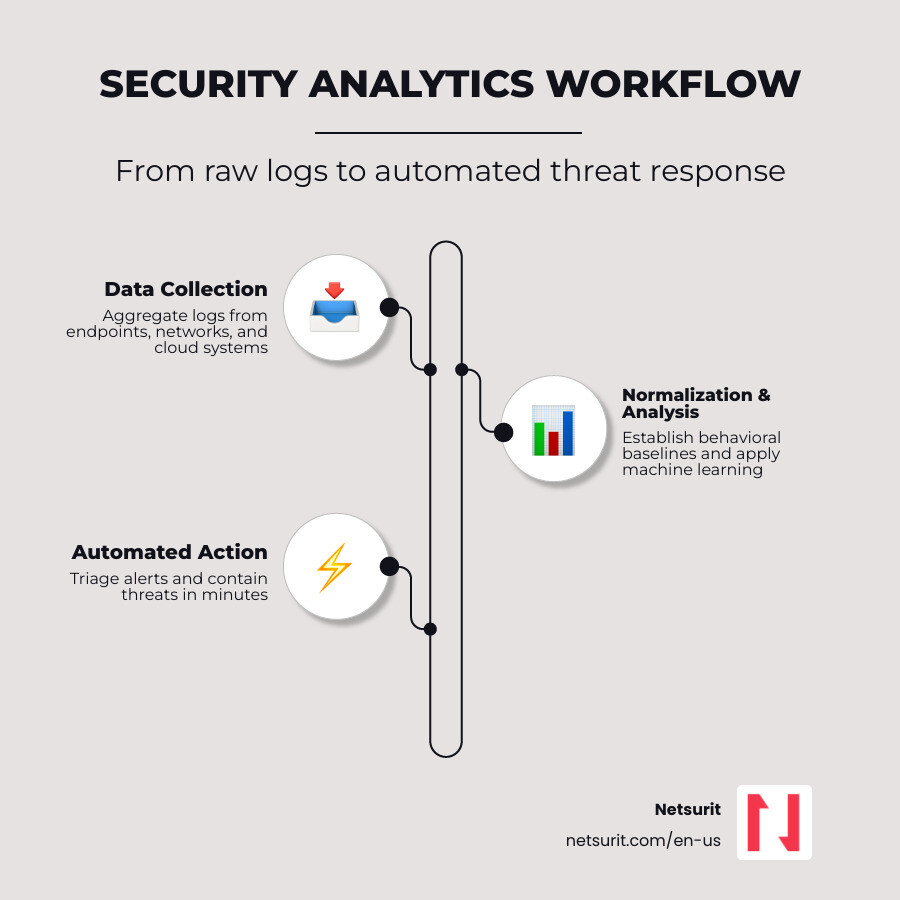
To build a security posture that actually stops modern threats, organizations must move away from isolated security tools. A modern security analytics workflow relies on a continuous pipeline: collecting data, normalizing it into a standard format, analyzing it for threats, and executing a rapid response.
For a multi-office accounting firm with locations in Conroe, Katy, and downtown Houston, establishing this workflow is the key to unified visibility. Instead of managing separate security tools at each location, the firm routes all firewall, endpoint, and identity logs into a centralized cloud-native data lake. This ensures that a threat detected on a laptop in Katy immediately informs the security defenses protecting the servers in Conroe. Implementing centralized SIEM Services allows the firm to maintain complete control and visibility over this entire pipeline from a single pane of glass.
Machine Learning and Automated Response
When a cyberattack occurs, response times are measured in seconds, not hours. If a ransomware strain begins encrypting files on an endpoint, waiting for an IT manager to read an email alert and manually isolate the machine is a recipe for disaster.
Modern security analytics platforms solve this by integrating machine learning with Security Orchestration, Automation, and Response (SOAR) playbooks. When the analytics engine detects a high-confidence threat—such as active data exfiltration or a known malware signature—it triggers an automated playbook. The system can instantly isolate the compromised endpoint, disable the affected user account, and block the malicious external IP address at the firewall. By automating these repetitive, high-speed tasks, human analysts are freed up to focus on complex investigation and forensic analysis.
Choosing the Right Tools for Analytics in Cyber Security
Selecting the right security analytics platform requires careful evaluation of your firm’s technical infrastructure, compliance needs, and available internal resources.
Tool Selection Trade-offs
- Works best when: Your organization has centralized cloud infrastructure, standardized log sources, and access to dedicated security analysts who can interpret and act on complex alerts.
- Avoid when: Your firm relies heavily on legacy, on-premises software that cannot export standardized log formats, or if you lack the operational budget to maintain and tune the platform.
- Risks: High implementation costs, vendor lock-in, and severe alert fatigue if the machine learning models and detection rules are misconfigured.
- Mitigations: Partner with a managed Security Operations Center (SOC) provider to handle the daily alert triage, tool configuration, and continuous model tuning.
Career Paths: Transitioning into Security Analytics Roles
The rapid rise of cyber threats has created a significant regional talent shortage in the security space. For information security analysts, the job market is projected to grow by 29% between 2024 and 2034, with a median annual pay of $124,910 in the United States. Similarly, data scientist roles are expected to grow by 34% over the same period. This demand makes security analytics one of the most lucrative and stable career paths in the technology sector.
For data professionals living in the Greater Houston area, this talent gap represents a massive career opportunity. Local energy vendors, financial institutions, and healthcare providers are constantly searching for analysts who can apply mathematical and analytical rigor to complex security datasets. You can explore the active regional market by researching the Top Houston, TX Cybersecurity Companies 2026 | Built In to see which firms are driving local hiring and technological innovation.
Transitioning from Data Analyst to Cybersecurity Data Analyst
If you are already working as a general data analyst, you already possess 80% of the foundational skills required to transition into security analytics. Core technical skills like SQL database querying, Python scripting, and statistical pattern recognition are highly transferable.
The primary gap is domain-specific security knowledge. To make the transition, you must learn how network protocols work, how to interpret firewall and active directory logs, and how common cyberattacks are structured. If you are looking for local opportunities to start your transition, checking listings for It Security Specialist jobs in Sugar Land – LinkedIn can give you a clear picture of the specific technical requirements and toolsets local employers are looking for.
Essential Certifications and Regional Training Programs
While formal degrees are valuable, the cybersecurity industry heavily prioritizes practical skills and recognized certifications.
To accelerate your career transition, consider pursuing industry-standard credentials such as:
- CompTIA Security+: Excellent for mastering foundational security concepts.
- Certified Information Systems Security Professional (CISSP): The gold standard for advanced security management.
- Certified Ethical Hacker (CEH): Focuses on understanding the offensive tactics used by threat actors.
For those living in Montgomery County, exploring specialized academic pathways like the Conroe, Texas Cybersecurity Degree Programs & Colleges can provide structured, local educational resources to help you gain hands-on lab experience and prepare for these professional exams.
Frequently Asked Questions About Security Analytics
How does security analytics differ from traditional SIEM?
Traditional Security Information and Event Management (SIEM) systems rely heavily on static, correlation-based rules (e.g., “if X happens five times in ten minutes, trigger an alert”). These systems generate massive amounts of noise and struggle to detect novel, complex attacks. Modern security analytics platforms use machine learning, historical behavioral baselines, and entity risk scoring to identify advanced threats and anomalies without relying on pre-defined, rigid signatures.
What are the main challenges of implementing cybersecurity analytics?
The primary hurdles are data quality, integration complexity, and the specialized skill gap. Security analytics platforms require clean, structured data from across your entire IT stack to work effectively. If your firewalls, identity systems, and cloud applications use incompatible formats, normalization becomes difficult. Additionally, configuring, tuning, and responding to the alerts generated by these tools requires highly specialized security engineering talent that many mid-market firms struggle to hire and retain internally.
How does machine learning reduce false positives in threat detection?
Machine learning reduces false positives by establishing dynamic behavioral baselines for every user and device on your network. Instead of triggering an alert every time an employee downloads a large file or logs in outside of normal business hours, the system evaluates the action in context. It considers the user’s historical patterns, peer group behavior, and asset criticality. This context allows the platform to ignore normal operational spikes and surface only high-confidence, genuine anomalies for human review.
Conclusion
Implementing advanced analytics in cyber security is the definitive line between a resilient financial firm and one vulnerable to devastating, reputation-ruining breaches. As cyber threats grow more sophisticated, relying on traditional, reactive defenses is no longer a viable business strategy.
We can help you evaluate your current security posture, consolidate your disparate log sources, and deploy a fully managed security analytics solution tailored to your compliance needs. To safeguard your client data and build a proactive defense, explore our comprehensive Cybersecurity services today.