Manual Risk Management Is Failing — Here’s What to Do Instead
AI for risk assessment is the use of machine learning, natural language processing, and real-time data analysis to identify, score, and respond to organizational risks faster and more accurately than manual methods allow.
How AI helps you conduct a risk assessment:
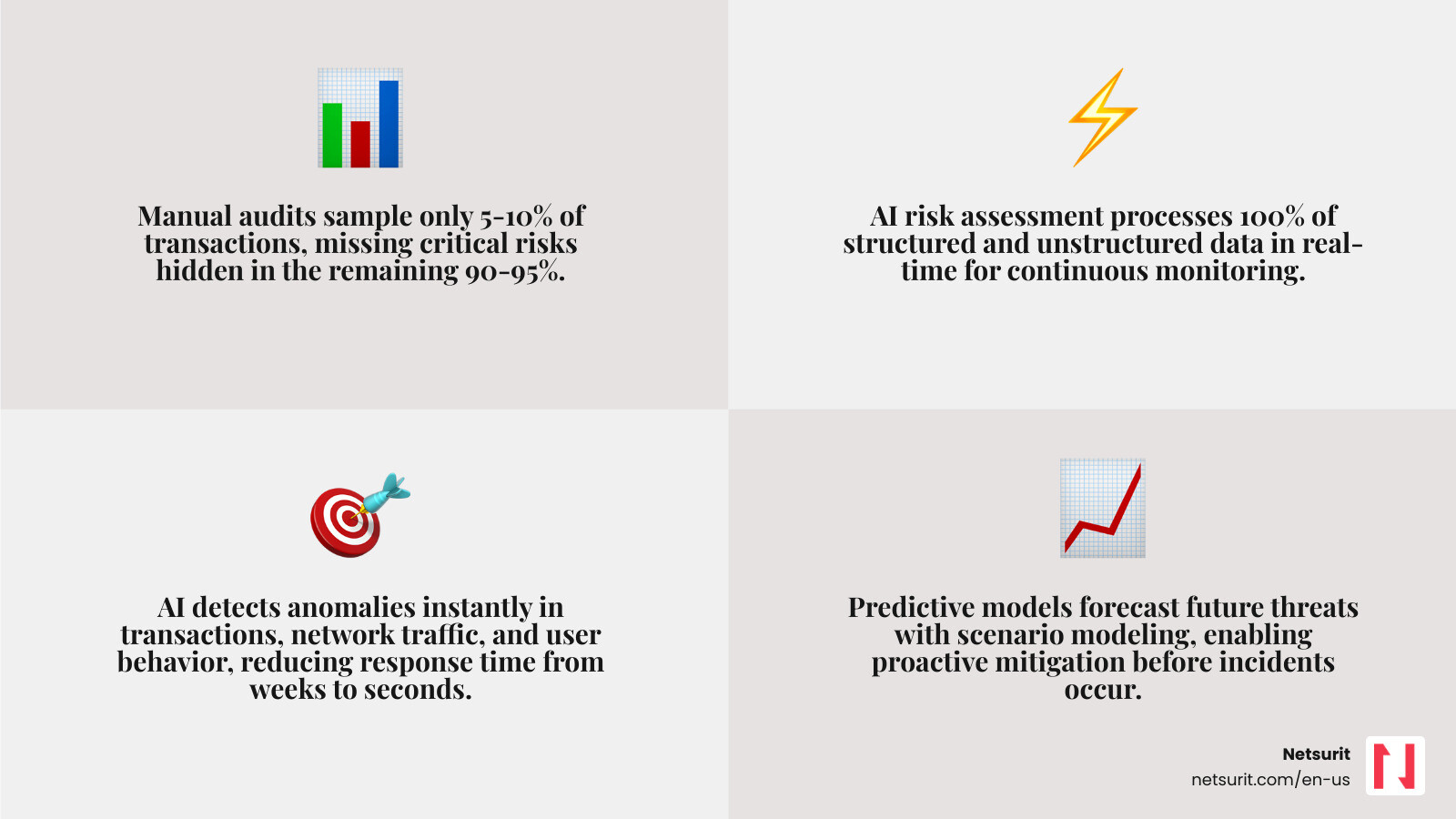
- Ingest all your data — AI processes 100% of structured and unstructured data, not just samples.
- Detect anomalies in real time — Systems flag unusual patterns in transactions, network traffic, or user behavior as they happen.
- Score and prioritize risks — AI assigns quantitative risk scores by measuring exposures and countermeasures independently.
- Generate audit trails — Every finding is logged, traceable, and reportable for compliance purposes.
- Predict future threats — Predictive models surface risks before they escalate into incidents.
Modern enterprises generate more data than any audit team can manually review. Sampling-based audits miss what they don’t see. Threat actors and compliance gaps don’t wait for quarterly reviews.
That mismatch is the core problem this guide solves. You’ll learn how to move from reactive, periodic risk reviews to a proactive, AI-driven system that monitors continuously, quantifies risk precisely, and keeps human judgment where it matters most.
This is not a pitch for blind AI adoption. Implementing AI for risk assessment comes with real trade-offs — metric selection, data quality, algorithmic bias, and the cost of integration. We cover those too.
I’m Orrin Klopper, CEO of Netsurit, where I’ve spent nearly three decades helping organizations modernize their IT infrastructure — including building governance frameworks and security postures that now incorporate AI for risk assessment across industries. That hands-on experience informs every recommendation in this guide.
Easy AI for risk assessment glossary:
Why AI for Risk Assessment is Non-Negotiable in 2025
Traditional risk management relies on human intuition and periodic checks. In 2025, that approach is a liability. The sheer volume of data moving through your organization—from cloud storage and email to financial transactions—exceeds human processing capacity. AI for risk assessment bridges this gap by aggregating data from disparate sources into a single, cohesive view.
Organizations that fail to adopt these tools face “invisible” risks. For instance, employees in a Houston-based energy firm might adopt browser-based AI tools to summarize sensitive contracts. Without an automated cyber risk assessment, these actions bypass traditional IT controls, leading to potential data leaks that remain undetected for months.
To manage this, the NIST AI Risk Management Framework (AI RMF 1.0) provides a voluntary benchmark. It emphasizes moving beyond “black box” models toward trustworthy systems that are governed, mapped, measured, and managed. By aligning with this framework, we help you transition from guessing where your vulnerabilities are to knowing exactly what they cost.
Identifying Fraud and Cyber Threats with AI for Risk Assessment
AI excels at pattern recognition. While a human auditor might spot a single suspicious invoice, AI identifies subtle correlations across millions of data points. A global financial institution like Citibank now reviews approximately 9 million annual trade transactions using AI. This shift improved their risk insights and reduced operational costs by automating the detection of compliance anomalies that manual reviews often missed.
In the realm of cybersecurity, AI-driven tools perform cloud security assessments by monitoring network traffic for indicators of compromise. Instead of waiting for a breach notification, AI flags lateral movement or unusual data egress as it happens.
Example: A mid-sized logistics company in Katy, TX, used AI to monitor its payment gateways. The system flagged a series of small, “low-risk” transactions that, when viewed together, revealed a sophisticated credential-stuffing attack. Manual sampling would never have connected these dots.
Automating Compliance and Regulatory Processes
Compliance is no longer a “once-a-year” event. Regulators increasingly demand continuous monitoring and real-time audit trails. AI automates the evidence-gathering process, linking business activities directly to risk controls.
Professional firms have seen massive gains here. For example, some accounting practices have reported skyrocketing efficiency after adopting AI-powered risk identification. These tools allow auditors to spend less time on manual data entry and more time on high-value analysis. By using IT audits and assessments powered by AI, you can ensure that your firm meets stringent regulatory requirements without bloating your headcount.
Core Capabilities: How AI Outperforms Manual Audits
The primary advantage of AI is its ability to interpret unstructured data. Most business risk lives in emails, PDF contracts, and chat logs—data that traditional databases struggle to parse. Using Natural Language Processing (NLP), AI “reads” these documents to identify conflicting clauses or unauthorized commitments.
Real-Time Risk Detection and Mitigation
User and Entity Behavior Analytics (UEBA) is a cornerstone of modern vulnerability tests. By establishing a baseline of “normal” behavior for every user in your Sugar Land office, AI can instantly detect when an account is hijacked.
Tools like Microsoft Security Copilot use Large Language Models (LLMs) to help security analysts respond to threats in minutes rather than hours. These systems reduce false positives by contextualizing alerts—knowing the difference between a developer running a legitimate script and a malicious actor executing a script to exfiltrate data.
Predictive Analytics for Proactive Decision-Making
AI doesn’t just tell you what happened; it models what could happen. Through scenario modeling, you can assess the impact of a supply chain disruption or a sudden shift in financial regulations.
| Feature | Traditional Risk Management | AI-Driven Predictive Risk |
|---|---|---|
| Data Scope | 5-10% (Sampling) | 100% (Full Population) |
| Frequency | Periodic (Quarterly/Annual) | Continuous (Real-Time) |
| Analysis Style | Descriptive (What happened?) | Predictive (What will happen?) |
| Human Effort | High (Manual Processing) | Low (Strategic Oversight) |
Houston Energy Sector Example: An oil and gas services provider in Houston uses predictive AI to monitor equipment sensors. By correlating vibration data with historical failure patterns, they predict maintenance needs 14 days before a breakdown occurs, mitigating the risk of costly environmental fines and downtime.
Quantitative Dimensions of a Trustworthy AI Risk Assessment
To trust an AI, you must be able to measure it. We focus on six quantitative dimensions to ensure your AI for risk assessment isn’t just fast, but accurate and ethical.
- Performance: Does the model accurately identify risks without excessive errors?
- Fairness: Is the model biased against specific groups or regions?
- Privacy: Does the model protect sensitive PII during analysis?
- Adversarial Robustness: Can the model resist “jailbreaking” or data poisoning?
- Explainability: Can a human understand why the AI flagged a specific risk?
- Value Alignment: Do the AI’s decisions align with your organizational ethics?
Desirable Properties for Quantitative Assessment Metrics
According to Scientific research on Quantitative AI Risk Assessments, a valid risk metric must be:
- Deterministic: The same input should yield the same risk score every time.
- Valid: The metric must actually measure the risk it claims to measure.
- Monotonic: An increase in threat level should always result in a higher risk score.
- Interval Scale: The difference between a score of 10 and 20 should be the same as the difference between 80 and 90.
Setting Thresholds for AI for Risk Assessment Metrics
Setting thresholds requires context. A “high-risk” flag for an accounting firm in Sugar Land might be different from one in a manufacturing plant in Conroe. You must define what constitutes an acceptable margin of error.
Example: A Sugar Land-based accounting firm sets a “Fairness” threshold for its AI-driven hiring tool. If the model’s bias ratio exceeds 0.8, the system automatically pauses and requires a manual review. This ensures compliance with emerging local laws regarding automated employment decision tools. Use a cyber security assessment checklist to define these thresholds before deployment.
Implementation Hurdles: Balancing Automation with Human Oversight
AI is not a “set it and forget it” solution. Poor data quality is the leading cause of AI failure. If your underlying data is messy, your risk assessments will be too. You must also account for the cost of uncovering hidden IT infrastructure risks and integrating AI with your existing ERP or CRM systems.
Addressing Challenges in Metric Interpretation
Information loss occurs when you try to boil complex risks down to a single number. This “aggregation” can hide specific vulnerabilities. Common AI Risk Pitfalls:
- Over-reliance on scores: Ignoring the qualitative “why” behind a number.
- Data Drift: Models becoming less accurate as business environments change.
- Lack of Transparency: Using “black box” vendor tools that don’t explain their logic.
Example: A Katy-based tax practice found their AI was flagging all foreign-sourced income as “High Risk.” Upon review, they realized the model lacked the context of their specific international client base, leading to hundreds of unnecessary manual reviews.
The Role of Human-in-the-Loop (HITL) Oversight
AI identifies the “what,” but humans decide the “so what.” Human oversight is essential for strategic judgment and ethical accountability. Our cyber risk and compliance services emphasize that AI should augment, not replace, the experienced auditor.
Trade-offs in AI Risk Implementation
| Category | Guidance |
|---|---|
| Works best when | Processing high-volume, structured financial data or real-time network logs. |
| Avoid when | Making high-stakes qualitative decisions with zero historical data or context. |
| Risks | Algorithmic bias and “black box” opacity leading to regulatory non-compliance. |
| Mitigations | Regular model auditing, diverse training sets, and mandatory human sign-off for critical risks. |
Future-Proofing Your Strategy: From Reactive to Agentic Risk Management
The next frontier is “Agentic” AI. Unlike standard AI that flags a risk for you to fix, an AI agent can interpret intent, decide on a path, and take action.
What to Watch Next: The Rise of Autonomous Risk Agents
By 2026, expect systems that not only identify a network intrusion but autonomously trigger containment protocols—like isolating a compromised server or revoking user credentials—without waiting for an admin to wake up at 3:00 AM. The challenge shifts from monitoring a dashboard to governing these autonomous decision-paths. You will need a robust cybersecurity checklist to manage these agents.
Scaling AI Risk Management Safely
To scale, you must anchor AI agents to standardized workflows. If an agent can’t be constrained by your policies, it shouldn’t have production authority.
Example: A Conroe-based CPA firm implements “guarded execution” for its AI agents. The AI can draft client risk reports and flag tax discrepancies, but it cannot send them to the client without a partner’s digital signature. This maintains speed while ensuring total accountability.
Frequently Asked Questions about AI for Risk Assessment
How does AI improve risk assessment over traditional methods?
AI processes 100% of data in real-time, identifying patterns and anomalies that human analysts miss during manual sampling. It moves the organization from a reactive posture to a proactive one.
What are the main challenges in implementing AI for risk assessment?
Key hurdles include ensuring high data quality, selecting the right quantitative metrics for your specific industry, and maintaining human-in-the-loop oversight to prevent algorithmic bias and “black box” errors.
Is the NIST AI Risk Management Framework mandatory?
No, the NIST AI RMF is a voluntary, consensus-driven framework. However, it has become the global benchmark for organizations that want to prove their AI systems are trustworthy, responsible, and compliant with emerging regulations.
Conclusion
At Netsurit, we believe AI for risk assessment is no longer a luxury—it is a requirement for survival in a data-heavy threat landscape. Whether you are managing a complex supply chain in Houston or a data-rich accounting firm in Sugar Land, the ability to quantify risk in real-time is your greatest competitive advantage. By integrating the NIST framework and focusing on transparent, quantitative metrics, you can transform your risk function from a cost center into a strategic asset.
Modernize your risk strategy with digital transformation for accounting