Financial Reporting Takes Too Long — Here’s What AI Does About It
Automated financial reporting AI uses machine learning and natural language processing to replace manual data entry, reconciliation, and statement preparation with systems that run faster, catch more errors, and close the books in days instead of weeks.
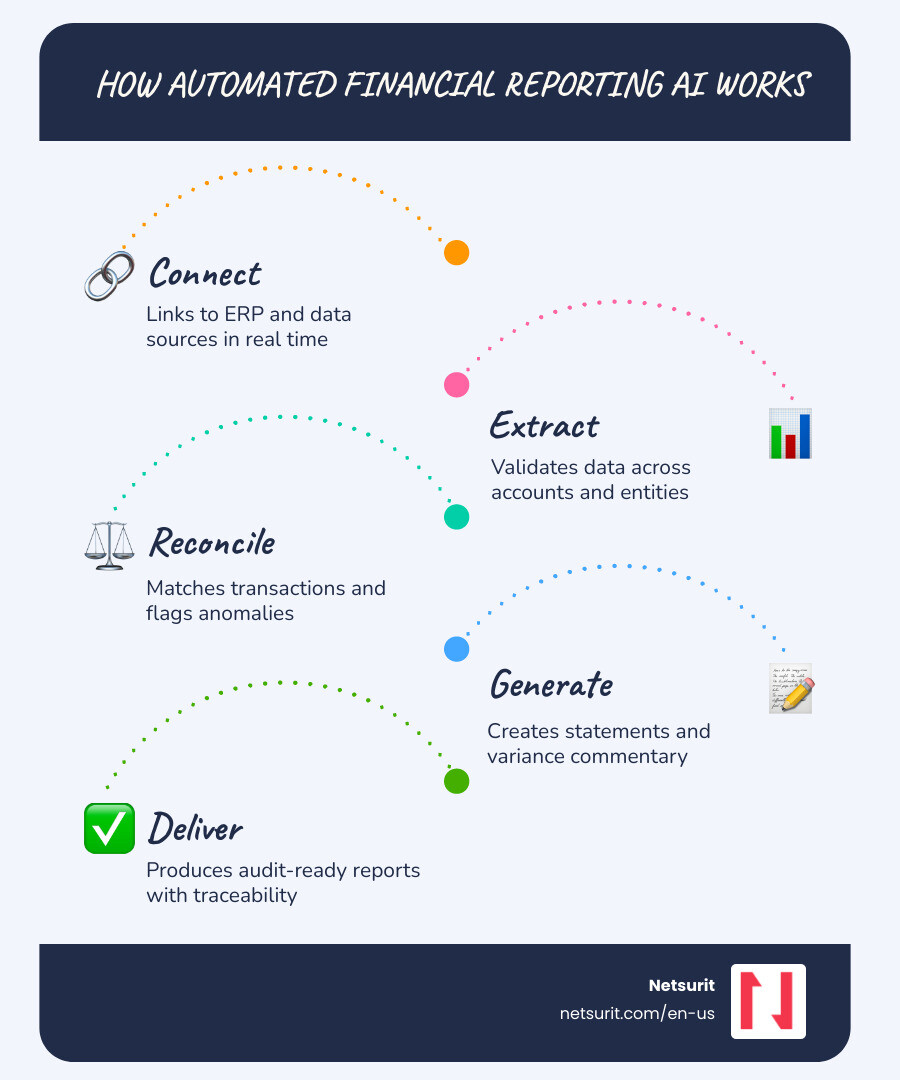
How automated financial reporting AI works — quick answer:
- Connects to your ERP, accounting system, or data sources in real time
- Extracts and validates financial data across accounts, entities, and currencies
- Reconciles transactions automatically, flagging anomalies for human review
- Generates financial statements, variance commentary, and disclosures
- Delivers audit-ready reports with full traceability and governance controls
This matters now. According to KPMG, nearly 72% of companies are already piloting or using AI in financial reporting — and that number is expected to hit 99% within a year. Yet most organizations are still stuck in experimentation mode, running manual closes that cost time and introduce errors.
The stakes are real. EY’s global corporate reporting survey found that 96% of finance leaders have concerns about data integrity. Meanwhile, McKinsey found that 70% of CFOs say already demanding workloads are the main reason automation efforts stall — not lack of interest, but lack of capacity to change.
This guide cuts through the noise. It covers what AI financial reporting tools actually do, which platforms are worth evaluating, how to implement them without derailing your team, and what governance controls you need to stay compliant.
There are trade-offs to understand and pitfalls to avoid — we cover those too.
I’m Orrin Klopper, CEO and co-founder of Netsurit, a global IT services and digital transformation company that has spent over two decades helping organizations modernize their operations — including deploying automated financial reporting AI solutions for accounting firms and finance teams across North America. In that time, I’ve seen which implementations deliver real efficiency gains and which ones stall due to poor data foundations or missing governance structures.
Basic Automated financial reporting AI vocab:
- AI automated financial forecasting
- AI for financial statements
- AI for regulatory reporting
What is Automated Financial Reporting AI and How It Redefines the Close
Historically, corporate financial reporting was a backward-looking exercise. Accounting teams spent the first two weeks of every month gathering data, correcting manual entry mistakes, and wrestling with Excel formulas. By the time leadership received the financial statements, the data was already stale.
Using financial statements made smarter with AI shifts this dynamic from reactive assembly to proactive oversight. Modern platforms operate directly on top of your ledger systems, continuously analyzing transactions as they occur. Instead of waiting for month-end to run reconciliations, the system matches transactions daily. This continuous close model reduces the end-of-period workload, allowing finance leaders to focus on strategic capital allocation rather than manual data verification.
Traditional Workflows vs. Automated Financial Reporting AI
The core difference between legacy close processes and AI-driven workflows lies in how they handle unstructured data. Traditional financial reporting relies on highly structured ledger inputs. When invoices, lease contracts, or purchase orders arrive in unstructured formats (like PDFs or scanned images), human operators must manually extract and key the data into the ERP.
By contrast, what is financial reporting automation? – IBM defines modern systems by their ability to ingest both structured and unstructured inputs simultaneously. AI tools parse contract terms, read invoices, and validate shipping documents using advanced Optical Character Recognition (OCR) and natural language processing.
A human-in-the-loop architecture ensures that if the model’s confidence score drops below a pre-set threshold (e.g., 95%), the transaction is routed to a human reviewer. This eliminates the bottleneck of manual data entry while maintaining rigorous accuracy standards. For a CPA firm in the Houston metro area managing multi-entity accounts, this shift alone can cut close times from 11 days to 3 days.
Core Capabilities of Modern Intelligent Accounting Tools
To move beyond basic automation, modern platforms utilize specialized machine learning models that understand accounting logic. This is not generic text generation; these systems are trained on accounting standards, chart of accounts relationships, and general ledger structures.
Key capabilities include:
- Automated GL Mapping: The system automatically maps transactional data from disparate operational systems to the correct general ledger dimensions, accelerating consolidation.
- Real-Time Data Extraction: Extracting key dates, payment terms, and dollar amounts from vendor agreements without manual tagging.
- Intelligent Insights: As explained in crunching numbers not napping: How AI transforms financial insights, AI-driven systems continuously monitor data feeds to identify historical patterns, unusual spend velocity, and budget variances.
Key Use Cases: From Anomaly Detection to Statement Creation
Deploying AI in corporate finance yields immediate returns when applied to highly repetitive, rules-based workflows that require high precision.
Automating Financial Statement Creation and Reconciliation
Manually drafting balance sheets, profit and loss (P&L) statements, and cash flow reports requires meticulous cross-checking. AI platforms automate these steps by pulling live ledger balances and compiling statements instantly.
For instance, platforms utilizing AI Features – Calculom Financial Reporting allow users to build complex reports from natural language prompts, eliminating manual formula errors. The system automatically handles multi-entity consolidations, intercompany eliminations, and foreign currency conversions at the correct closing or average rates.
Scenario: A multi-unit retail group based in Sugar Land, Texas, operates 15 distinct legal entities across different point-of-sale systems. Instead of an accounting clerk spending three days manually reconciling intercompany transfers and currency variances, an automated platform processes these eliminations in real time, presenting a consolidated balance sheet daily.
Predictive Forecasting and Real-Time Cash Flow Analysis
Traditional forecasting relies on historical averages and static spreadsheets. AI models leverage predictive analytics to combine internal ledger trends with external market signals (such as interest rates, regional economic data, or supply chain indicators).
With tools like cash flow crystal ball: AI-driven forecasting for treasury, treasury departments can run dynamic multi-scenario simulations. Platforms like Planir — FP&A Platform for Mid-Market Finance Teams | Plan, Report, Analyse provide automated financial health assessments, helping teams analyze margin expansion and profitability ratios across different business units.
Scenario: A manufacturing firm in Katy, Texas, uses machine learning models to forecast cash requirements. The system analyzes raw material price fluctuations, historical customer payment cycles, and seasonal demand. This allows the CFO to optimize working capital and make precise inventory purchasing decisions 90 days in advance.
Evaluating the Leading AI Financial Reporting Platforms
Selecting the right platform requires balancing feature depth, integration complexity, and your organization’s transaction volume.
| Platform | Primary Focus | Best For | Key Strengths | ERP Integration |
|---|---|---|---|---|
| Trullion | Lease accounting, revenue recognition, audit readiness | Mid-market to Enterprise | Exceptional contract extraction (ASC 606/842), clear audit trails | NetSuite, SAP, Sage Intacct |
| Numeric | Month-end close management, reconciliations | Growing mid-market teams | Real-time close checklists, automated flux analysis | Direct API to major cloud ERPs |
| Netgain | Specialized asset and lease accounting | NetSuite-centric businesses | Deep native integration, complex amortization schedules | Built natively on NetSuite |
| DataSnipper | Audit and reconciliation automation | CPA firms and internal audit teams | Excel-native automation, matches supporting docs to sheets | Integrates directly into MS Excel |
| MindBridge | Risk profiling, anomaly detection, audit analytics | Large CPA firms and enterprises | Ingests 100% of ledger transactions to flag risk | ERP agnostic via file ingestion |
To achieve true automation, platforms like Maximor Brings Autonomous Finance to the CFO Office utilize specialized agents that layer directly over your existing ERP. This allows teams to automate contract ingestion and revenue recognition without undergoing a costly IT overhaul.
Evaluating Platforms for Automated Financial Reporting AI
When choosing a solution, focus on platforms that offer deep vertical specialization rather than general-purpose automation.
- Trullion excels at translating raw contracts into structured journal entries, making it highly valuable for compliance-heavy environments.
- Numeric focuses on close collaboration, helping teams monitor outstanding tasks and automate variance explanations.
- DataSnipper is the industry standard for audit teams who want to remain inside Excel but automate the tedious process of “snapping” supporting invoices and bank statements to ledger entries.
Selection Criteria for Houston-Area CFOs
For mid-market enterprises in Conroe, Katy, or Sugar Land, evaluating software must go beyond a feature checklist. CFOs should prioritize three main criteria:
- Auditability: Can an external auditor trace an AI-generated journal entry back to the source document in a single click?
- ERP Integration: Does the platform integrate via native APIs, or does it require manual CSV exports?
- Data Security: Does the vendor meet SOC 2 Type II and ISO 27001 standards?
Platforms like AI Finance Software | Prophix provide highly governed, role-based access controls that ensure sensitive financial data remains protected while giving leadership on-demand visibility.
Governance, Risk Management, and Compliance (GRC) in the AI Era
As machine learning models take on more accounting tasks, the need for robust internal controls increases. Organizations cannot delegate compliance responsibility to an algorithm.
Establishing Entity-Level Controls and Audit Trails
According to the Guide: AI and automation in financial reporting – KPMG International, companies must design and implement specific entity-level controls for intelligent tools. This includes establishing clear IT governance policies, system controls, and ongoing model validation protocols.
For companies in the Houston energy sector, where regulatory scrutiny is intense, maintaining a complete audit trail is non-negotiable. Every automated adjustment must be stamped with:
- The specific AI model version that processed the transaction.
- The training data parameters utilized.
- The explicit approval of the human reviewer who authorized the posting.
By leveraging reporting made easy: simplifying regulatory reporting with AI copilots, finance teams can automate compliance tracking and ensure that all reporting outputs align with internal control frameworks.
Navigating ASC 606, ASC 842, and SEC Disclosures
Compliance with complex accounting standards like ASC 606 (Revenue from Contracts with Customers) and ASC 842 (Lease Accounting) requires analyzing hundreds of pages of legal agreements.
AI models are highly effective at scanning lease portfolios to extract commencement dates, renewal options, and payment escalations. For a real estate development firm in Sugar Land managing hundreds of commercial leases, AI automation ensures that all lease liabilities are accurately calculated and represented on the balance sheet, reducing the risk of material restatements.
Step-by-Step Implementation and Mitigating Common Pitfalls
Successful AI integration is an iterative process, not a one-time software installation.
A Phased Roadmap for Houston-Area Accounting Firms
To successfully adopt automated financial reporting AI, we recommend a structured, four-step rollout:
- Process Assessment: Document your existing close workflow. Identify the specific manual bottlenecks (e.g., bank reconciliations or intercompany matching) that consume the most hours.
- Data Preparation: Clean your ledger data. Standardize naming conventions, eliminate duplicate vendor profiles, and resolve outstanding ledger discrepancies before connecting any AI tool.
- Pilot Program: Select a single, low-risk process—such as accounts receivable matching—and run the AI tool in parallel with your traditional manual process for 30 to 60 days.
- Scale and Monitor: Once the pilot meets your accuracy KPIs, expand the platform to more complex areas like variance commentary and automated disclosure drafting.
Overcoming Data Integrity Issues and Employee Resistance
The transition to AI can trigger anxiety among accounting staff. Many fear displacement, while others struggle with the technical learning curve. This resistance is a primary driver behind the 70% automation stall rate cited by CFOs.
To mitigate this, frame AI adoption as a capacity-building initiative. As highlighted in AI in Accounting 2026: From Practical Automation to Strategic Advantage, the goal of these tools is to handle repetitive, low-value tasks, freeing up professionals to focus on interpretation, variance analysis, and strategic advisory work. Provide comprehensive upskilling programs to help your team transition from data entry operators to financial data analysts.
Emerging Trends: Agentic AI and the Future of Autonomous Finance
We are moving rapidly beyond basic copilot assistants into the era of Agentic AI in corporate finance. While traditional AI tools wait for a user prompt, agentic systems proactively monitor workflows, identify anomalies, and execute multi-step tasks autonomously.
As announced in the Prophix® Launches Next Wave of Prophix One™ Agents, Defining the Delegation Era for Finance, finance teams can now delegate entire operational cycles to specialized agents. For instance, an AI Reconciliation Agent can continuously match bank statements, resolve variances, and draft the corresponding journal entries, presenting only the exceptions to the controller.
Furthermore, generative AI is transforming how financial narratives are written. Rather than spending days drafting the Management’s Discussion and Analysis (MD&A) section of a financial report, tools covered in the Automated Financial Reporting with AI Online Class – LinkedIn can analyze ledger variances and instantly draft professional, compliance-aligned narratives for stakeholders.
What to watch next: Expect deeper integration of domain-specific AI agents directly into standard communication platforms like Microsoft Teams, allowing executives to query real-time financial metrics using simple voice commands.
Frequently Asked Questions about Automated Financial Reporting AI
How does AI handle data security and privacy in financial reporting?
Enterprise-grade financial AI tools do not use your proprietary financial data to train public models. They operate within secure, isolated cloud environments utilizing bank-level encryption, multi-factor authentication, and strict role-based access controls. Always choose vendors that are SOC 1, SOC 2 Type II, and ISO 27001 certified.
Can generative AI completely replace human CPAs and auditors?
No. AI lacks the capacity for professional skepticism, ethical reasoning, and complex qualitative judgment. The technology serves to augment human capabilities by automating data aggregation and anomaly detection, allowing CPAs to focus their expertise on high-risk areas, complex transactions, and strategic advisory.
What is the typical ROI and implementation timeline for AI reporting tools?
Most mid-market organizations achieve a full return on investment within 6 to 12 months of deployment, primarily driven by a 50% to 70% reduction in close times and the elimination of manual reconciliation errors. A standard implementation takes between 4 and 8 weeks, depending on the complexity of your existing ERP setup.
Conclusion
Adopting automated financial reporting AI is no longer a luxury for forward-thinking firms—it is a operational necessity to remain competitive, compliant, and agile. However, the success of these advanced tools depends entirely on the strength of your underlying IT infrastructure, data pipelines, and cybersecurity protocols.
We help mid-market enterprises and CPA firms navigate this digital transition safely. To ensure your systems, networks, and data structures are fully optimized for secure AI integration, partner with an elite managed service provider.
Explore our Managed IT Services for Accounting Firms to schedule an infrastructure assessment and unlock your team’s operational momentum.