Financial Auditing AI Tools Have Changed the Audit Forever
Financial auditing AI tools are no longer experimental — by April 2026, they are the standard for firms that want accurate, scalable, and defensible audits.
Here are the top tools available right now:
| Tool | Best For | Key Capability |
|---|---|---|
| MindBridge | Risk discovery & oversight | 100% transaction monitoring via unsupervised ML |
| Trullion | Accounting & audit teams | Traceable, agentic AI with full source documentation |
| Fieldguide | End-to-end audit workflow | AI agents automate up to 70% of testing hours |
| DataSnipper | Excel-native audit teams | Cuts audit prep time by up to 50% |
| Arvexi Cortex | Account reconciliation | Investigates 224 accounts in 32 minutes |
| Finspectors.ai | AI-native audit lifecycle | Saves 100+ hours per audit, 2-week timeline reduction |
| CoAuditor | Internal audit & SOX | Reduces testing and review time by 75% |
| Cortea | Regulatory IT audits | 50% effort reduction across 22+ audit frameworks |
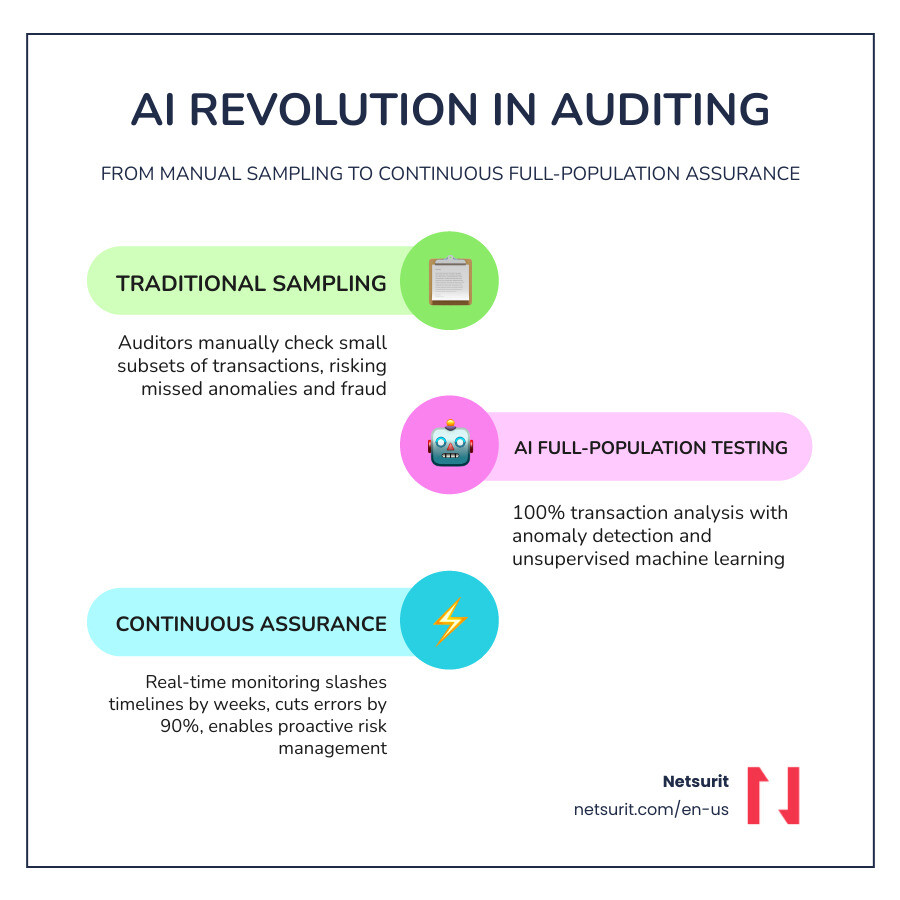
The shift from manual sampling to AI-driven, full-population testing is real and measurable. Teams are cutting manual data-entry errors by up to 90%, slashing audit timelines by weeks, and identifying fraud risks that traditional spot-checks would miss entirely. But these tools are not plug-and-play — choosing the wrong one, or deploying without proper training and human oversight, creates new problems rather than solving old ones.
This article breaks down the tools, trade-offs, and implementation realities so you can make a confident decision.
I’m Orrin Klopper, CEO and co-founder of Netsurit, a global IT services and digital transformation company — and over nearly three decades of working alongside finance and accounting leaders, I’ve seen how the right technology decisions (and the wrong ones) shape outcomes when it comes to financial auditing AI tools. That experience is what drives this guide: practical, honest, and built for leaders who need answers, not hype.
Financial auditing AI tools vocab to learn:
- AI for auditors
- AI in internal audit
- Machine learning audit
How AI Transforms Traditional Financial Auditing Processes
The core promise of financial auditing AI tools is the move from “looking for a needle in a haystack” to “analyzing the entire haystack in seconds.” Historically, auditors relied on statistical sampling—testing a small fraction of transactions and hoping it represented the whole. By April 2026, this method is increasingly viewed as a liability.
AI transforms the workflow through three primary mechanisms:
- Full-Population Testing: Instead of sampling 50 invoices, AI scans 100% of the General Ledger (GL). This eliminates the risk of missing material anomalies hidden in the “untested” 95% of data.
- Predictive Analytics: By analyzing historical trends, AI flags deviations before the books even close. This proactive stance moves auditing from a post-mortem exercise to a due diligence role that adds real business value.
- Anomaly Detection: Unsupervised machine learning identifies patterns that humans cannot see, such as unusual timing of entries or rounding patterns that suggest fraud.
Houston-Area Example: A mid-sized accounting firm in Sugarland, TX, recently deployed autonomous AI agents to handle high-volume transaction testing for a local retail chain. By automating the matching of purchase orders to bank statements, they reduced manual testing hours by 70%, allowing their senior auditors to focus on complex valuation issues instead of data entry.
Trade-offs: AI Audit Implementation
- Works best when: Dealing with high-volume, structured data across multiple ERP systems.
- Avoid when: Data is highly qualitative or requires deep subjective “professional judgment” without supporting documentation.
- Risks: Algorithmic bias where the AI ignores certain transaction types it wasn’t trained on, or “black box” logic that cannot be explained to a regulator.
- Mitigations: Use platforms that offer deterministic scoring and always maintain a “human-in-the-loop” to override or validate AI conclusions.
The future is now for those ready to embrace automated assurance.
Top Financial Auditing AI Tools for 2026
Selecting the right platform depends on your firm’s size, your clients’ complexity, and your existing tech stack. In 2026, the market has bifurcated into “Assistive AI” (chatbots) and “Agentic AI” (tools that actually execute tasks).
MindBridge: The Standard for Risk Discovery with Financial Auditing AI Tools
MindBridge remains a global leader in AI-powered financial intelligence. Its primary strength lies in risk discovery. Using unsupervised machine learning, it monitors 100% of financial transactions across all systems to surface errors and policy breaches early.
For finance leaders, MindBridge provides an “independent oversight layer.” As more companies use AI agents to automate their own bookkeeping, MindBridge acts as the watchdog, ensuring those agents haven’t introduced new forms of financial leakage or fraud. It provides contextual explainability, meaning it doesn’t just flag a transaction; it provides the auditable reasoning and chain of evidence for why it was flagged.
Trullion: Auditable AI for Accounting Teams using Financial Auditing AI Tools
Trullion focuses on what they call “Auditable AI.” Built by former Big Four CPAs, the platform is designed to be vertical-specific rather than generic. It excels at unifying structured data (like ERP entries) with unstructured data (like lease contracts or PDF invoices).
Their agentic assistant, “Trulli,” helps teams make financial statements smarter by automating data extraction and testing. One of Trullion’s most cited metrics is a 25% reduction in reporting time and a 30% saving on software costs by consolidating disparate tools into one traceable platform.
Fieldguide: End-to-End Workflow Automation
Fieldguide is designed for the modern audit firm that wants to reimagine its entire practice. It isn’t just a point solution; it’s an end-to-end platform. Their “Field Agents” can automate up to 70% of testing hours, handling everything from trial balance management to risk assessments.
A standout feature is the domain-specific AI chat, which is tuned to a firm’s specific methodologies. This ensures that the AI doesn’t just give generic advice but follows the exact standards and workflows your firm has established. It also includes a seamless tax export, bridging the gap between audit and tax teams.
DataSnipper: Intelligent Excel Integration for Auditors
For many auditors, Excel is home. DataSnipper understands this and builds its AI directly into the Excel interface. It specializes in “sniping” data—extracting and cross-referencing information from source documents like invoices or bank statements directly into your workpapers.
Firms using DataSnipper report cutting audit prep time by up to 50%. It is particularly effective for internal audits where teams need to perform rapid tests of details, payroll testing, or cash confirmations without leaving their spreadsheets.
Ensuring Compliance and Security in the AI Era
Adopting financial auditing AI tools is not just about speed; it is about staying compliant with evolving standards like SOX, PCAOB, and ISQM. Regulators in 2026 are increasingly skeptical of “black box” AI. If you cannot explain how your AI reached a conclusion, that conclusion is not auditable.
Conroe, TX Example: A local firm specializing in government contracting recently moved to an AI-native audit workspace to comply with strict regulatory frameworks. They utilized Cortea to manage IT audits because the platform natively understands over 22 audit frameworks, including ISO 27001 and GDPR. By using “framework-aware” AI, they ensured that every automated test was mapped directly to a regulatory requirement.
One of the most significant emerging risks is the rise of AI-generated fraudulent documents. As bad actors use GenAI to create perfect-looking fake invoices, auditors must use tools like AuditFlow or CoAuditor that feature synthetic document detection. These tools look for digital fingerprints and metadata patterns that indicate a file was manipulated, helping you audit your way out of a potential disaster.
Don’t mess with Texas algorithms—ensure your AI tools provide a full, immutable audit trail where every extraction is timestamped and linked back to the original source coordinate.
Implementation Strategy and Frequently Asked Questions
The biggest mistake firms make is treating AI as a “set it and forget it” solution. Successful implementation requires a “human-in-the-loop” strategy. This means AI handles the data-heavy lifting, but a certified auditor reviews all “amber” or “red” flags.
Katy, TX Example: A local accounting firm integrated AI agents with Microsoft Dynamics 365 Business Central to automate their monthly bank reconciliations. While the AI reduced the task from hours to minutes, they kept a senior accountant in the loop to review any exceptions. This allowed them to sleep soundly knowing their risk was drastically reduced without losing the human touch.
Common Adoption Mistakes to Avoid:
- Underestimating Training: AI tools are intuitive, but understanding how to interpret AI-risk scores requires a new skillset.
- Ignoring Integration: If your AI tool doesn’t talk to your ERP (like SAP, Oracle, or Business Central), you’re just creating another data silo.
- Price-Only Decisions: A “cheap” tool that lacks SOC 2 or ISO 27001 certification is a massive security liability.
What is the typical ROI for AI audit tools in 2026?
Most firms see an immediate ROI through time reduction. For example, Finspectors.ai claims a 50% reduction in administrative tasks and an average audit timeline reduction of two weeks. This translates to roughly 100+ hours saved per audit. In terms of hard numbers, some firms report a 30% increase in reporting efficiency and a significant boost to profit margins by increasing capacity without adding headcount.
Can AI tools integrate with existing Excel workflows?
Yes. Tools like DataSnipper and Audentum are built specifically for this. Audentum, for instance, uses AI for the extraction layer but keeps downstream processing in deterministic SQL. This means your data remains in a structured, queryable format that works seamlessly with Excel or Google Sheets, maintaining workflow continuity for your team.
How do these tools handle AI-generated fraudulent documents?
Modern tools like Arvexi Cortex use pattern matching and cross-cycle analysis to spot anomalies. Cortex, for example, investigates accounts autonomously and provides a confidence score. If it sees a pattern that matches a known synthetic document profile or a suspicious timing variance, it flags it for human investigation. Arvexi Cortex can investigate 224 accounts in just 32 minutes, identifying risks that would take a human weeks to find.
Conclusion
The era of manual, sample-based auditing is closing. By April 2026, financial auditing AI tools have become the essential engine for accuracy and growth in the accounting profession. Whether you are looking to automate your internal audits or scale your firm’s external audit capacity, the technology is ready.
At Netsurit, we act as an elite tech partner for firms across Houston, New York, and beyond. We provide the managed IT, cybersecurity, and AI solutions needed to crush downtime and unlock business momentum. If you’re ready to modernize your practice, explore our Netsurit Accounting Firm IT Services to see how we can help you scale.
What to watch next: Keep an eye on “Autonomous Agents” that don’t just flag issues but actually perform the reconciliation and draft the final report for review. The “Commentator” AI of 2024 has become the “Investigator” of 2026—and the “Controller” AI is just around the corner.