Rogue AI Agents: The Hidden Operational Risk for CPA Firms
By Dr. Alex Heublein, Chief AI & Innovation Officer, Netsurit
A rogue AI agent is any agent inside a CPA firm acting with more authority, or less oversight, than the firm approved for it, and the risk it creates has nothing to do with whether the model misbehaves.
For the last twenty years, the software inside a CPA firm has been, in the security sense, passive. Practice management systems store things. Tax engines calculate things. Document portals move files when a person tells them to. The entire discipline of protecting a firm’s data grew up around one quiet assumption: software holds information and people take actions. Get the access rights right and you have bounded the problem, because nothing in the stack does anything on its own.
AI agents break that assumption, and they break it without announcing themselves. An agent is not a faster version of the tools a firm already owns. It is the first thing in the professional workflow that can interpret a goal, choose its own intermediate steps and then act — pulling a client file, updating a workpaper, sending an email, posting an entry — without a person initiating each move. When a firm issues an agent a credential, it has not added a feature to its software. It has added a participant to its workflow.
That participant is genuinely valuable, which is why adoption is moving as quickly as it is. It is also why the risk profile changes in kind rather than in degree. When software only reads and displays, the worst realistic outcome is a bad answer that a professional catches on review. When software can act, an ordinary error — a misread figure, the wrong client record, a superseded source document — stops being a draft to correct and becomes a business event: an email that left the firm, an entry that hit the ledger, a filing that went out.
What Makes an Agent “Rogue”?
This is the failure that “rogue AI agent” describes, and it is considerably less exotic than the phrase suggests. A rogue agent is not a system that developed intentions of its own. It is an agent operating outside the purpose, permissions or oversight the firm approved. The tool may have been vetted. The vendor may be excellent. The model may be doing precisely what it was designed to do. None of that is protective, because nothing has malfunctioned — an unauthorized action was taken with credentials the firm handed over, usually because nobody ever wrote down what the agent was permitted to do with them.
That distinction determines where a firm should spend its effort. If the problem looks like model misbehavior, the money goes into accuracy. If the problem is understood as excessive agency — the more precise term, and the one the security community uses — the money goes into access control, approval gates and audit trails. Only the second bounds the downside.
At a Glance
- A rogue AI agent is any agent operating outside the authority the firm granted it. The tool being approved is not the same thing as the behavior being authorized.
- The underlying vulnerability is excessive agency: the agent can do more than the business process requires, or it can act without anyone approving the action.
- CPA firms are unusually exposed because agents touch regulated client data and can influence filings, audit evidence, payroll and client communications.
- The controls are unglamorous — an agent inventory, separate identities, least privilege, human approval on consequential actions, tamper-resistant logs and continuous testing.
- An AI risk assessment is only useful if it connects those technical controls to the firm’s Written Information Security Plan and its professional responsibilities.
How Is an Agent Different From a Chatbot or a Workflow?
This is worth being precise about, because firms are making budget and risk decisions with all three collapsed into a single category.
A chatbot returns text. An automated workflow follows rules somebody wrote in advance. An AI agent interprets a goal, decides its own intermediate steps, selects tools and acts across systems. It might retrieve a client file, summarize it, update a workpaper, draft an email and route the result for review — choosing the sequence as it goes.
The security question changes with that third case. With a chatbot, the leadership question is whether the answer is accurate. With an agent, accuracy is still necessary but it is no longer sufficient. You also have to ask what the system can reach, what it can change, who authorized the change, and whether it can be undone. Reversibility is the one that gets forgotten, and it is usually the factor that decides whether an incident is an inconvenience or a disclosure.

Why Are Rogue AI Agents a Particular Risk for CPA Firms?
A mid-sized CPA firm may hold Social Security numbers, bank account details, completed returns, payroll registers, acquisition documents and the complete financial records of hundreds of organizations. That concentration is precisely what makes over-permissioning so consequential. A single agent with broader access than its job requires does not create exposure for one client; it creates exposure across the book.
The regulatory framing is already in place, even though it was not drafted with autonomous systems in mind. The FTC Safeguards Rule requires covered financial institutions, tax preparation firms among them, to maintain safeguards for customer information. IRS guidance for tax professionals is explicit that protecting taxpayer data includes maintaining a Written Information Security Plan. Neither instrument exempts agents. If an agent can read client data, it belongs inside the risk program — and if it can act on client data, it belongs near the top of it.
How Can an Agent’s Output Become Part of Professional Work?
An agent’s output can influence an audit procedure, a tax position, a journal entry, a payroll calculation or advice given to a client. A plausible-looking answer is not the standard. The firm needs the source data, the steps taken and evidence of the human judgment applied at the end — and that trail has to survive a peer review or an examination, not just an internal conversation.
Put another way: efficiency and assurance are both legitimate goals, but the line between them has to stay visible. Netsurit’s guide to AI for auditors makes the same point from the audit side. AI genuinely expands the population you can analyze and cuts real manual effort. It does not substitute for professional judgment, and no amount of fluency in the output changes that.
Why Does Busy Season Reward Shortcuts?
This is the risk I would worry about most, and it is not really a technology problem. During peak periods, a tool that saves ten minutes per file spreads through a department in days. Staff connect browser extensions, assistants and workflow agents because the pressure is real and the friction of asking permission is not zero. What begins as an individual shortcut in February is a persistent integration with standing access to mailboxes, shared drives and client systems by June — often with nobody in IT aware that it exists.
A 2026 AICPA-CIMA survey put change management for technology and AI at the top of the long-term issues facing accounting firms, which matches what I see in the field. The capability is arriving faster than the governance around it, and the gap is widest exactly when the firm is busiest.
How Does an Agent Actually Go Rogue?
Five patterns account for most of it. None of them requires a sophisticated attacker, and several require no attacker at all.

- It has more authority than the task requires. An agent built to summarize client documents is given access that also lets it move, share or delete them. An agent meant to draft journal entries can also post them. Nobody intended either capability; both came bundled with whichever permission scope was easiest to grant.
- A document or message rewrites its instructions. Indirect prompt injection happens when an agent processes content — an email, a PDF, a web page, a client-supplied spreadsheet — that contains instructions aimed at the agent rather than the reader. If the system treats that content as trusted input, it may disclose data or abandon the firm’s workflow entirely. This is the failure mode most firms have not tested for, and the one where an ordinary client upload becomes an attack surface.
- Its memory or context becomes contaminated. Agents retain context across steps and sometimes across sessions. An incorrect client mapping, a stale instruction or injected content can persist and shape later work. Weak separation between engagements is how one client’s information ends up influencing another client’s output — which is a confidentiality problem before it is a security problem, and a harder one to explain afterward.
- It acts on unverified output. A model misreads a figure, invents a missing fact or selects the wrong client record. That is ordinary and manageable. It stops being manageable the moment a downstream component executes the output automatically — sending external email, changing master data, initiating a payment, posting an entry, submitting a filing. The model error is the same size either way. The consequence is not.
- Nobody owns it anymore. Agents outlive the project that justified them, the employee who built them and sometimes the vendor relationship that supplied them. Credentials stay valid, integrations keep running, and no one revisits whether the original purpose still exists. This is privileged access debt, and like most debt it accrues quietly until something forces a reckoning.
What Could Rogue Agent Risk Look Like in a CPA Firm?
The pattern is consistent across workflows: the intended use is narrow and defensible, and the control failure comes from authority the agent was never meant to exercise.
| Workflow | Intended Use | Control Failure |
|---|---|---|
| Client intake | The agent reads portal uploads and routes documents into the correct engagement folder. | A manipulated upload causes it to copy those documents to an external location. |
| Tax preparation | The agent extracts tax data and drafts workpapers or client queries. | It pulls from a superseded source document, or exposes taxpayer data in a draft that leaves the engagement. |
| Audit and assurance | The agent analyzes transaction populations and flags exceptions for follow-up. | Its selection logic changes silently and the evidence trail is incomplete by the time it reaches review. |
| Client accounting and payroll | The agent drafts entries, updates records or prepares a payroll run. | A mistaken or manipulated output reaches the ledger or the payroll process with no approval gate in front of it. |
| Firm administration | The agent handles mailbox, calendar and access requests. | It discloses confidential information or alters permissions without review. |
Which Controls Keep AI Agents Accountable?
Almost nothing in this list is novel, and that is rather the point. Most of it is identity and access management applied to a non-human actor. The controls that work are the ones a firm already understands, extended to a class of user that does not appear in the HR system.
- Inventory every agent and integration. Owner, business purpose, model, tools, data sources, credentials, vendor, deployment environment, review date. If you cannot produce this list on request, you do not know your exposure.
- Give each agent its own identity. Shared or human-borrowed credentials destroy permissioning, logging, revocation and accountability in a single stroke.
- Apply least privilege, and separate read from draft from execute. Scope access by client, engagement, folder and time period rather than by system.
- Require human approval for consequential actions — external communications, filings, payments, ledger postings, payroll changes, permission changes, document deletion and any professional conclusion. The approval has to be substantive rather than a click.
- Treat all external content as untrusted. Isolate ingestion from tool execution, test explicitly for indirect prompt injection, and validate structured outputs before another system consumes them.
- Log the full action chain: agent identity, request, source data references, tools called, approvals, output, changes made, exceptions. The log has to be tamper-resistant, or it is not evidence.
- Test behavior, not only accuracy. Does the agent refuse prohibited tasks, stay inside the client boundary, handle malicious input, escalate when uncertain and stop when a control fails? Re-test after every model, prompt, tool or permission change — which is more often than most firms expect.
- Build a kill switch and a lifecycle process. You need to be able to suspend an agent and revoke its tokens in minutes, and you need a defined path for decommissioning one.
- Fold agents and their vendors into the Written Information Security Plan and the incident response plan. If they are not in those documents, they are not governed.
What Should Firm Leaders Ask Before an Agent Goes Live?
- What specific business outcome is this agent responsible for?
- Which client and firm data can it read, retain, change or disclose?
- What is the most damaging single action its current permissions allow?
- Which actions always require human approval, and who is professionally qualified to give it?
- How have prompt injection, cross-client leakage and malicious documents been tested?
- Who can stop it, and how quickly can its credentials and tokens be revoked?
If the firm cannot answer these, the agent is not ready for production authority. That is not the same as saying it is not ready at all. A contained deployment where the agent retrieves, compares and drafts but cannot execute is often the correct first step, and it captures a surprising share of the available value at a fraction of the risk.
Where Should a CPA Firm Start?
Start where agents already exist or are most likely to appear: document intake, tax workpaper preparation, audit analytics, client accounting, payroll, knowledge search and email. The output of the first pass should not be a policy. It should be a verified map of which agents can reach which client data and what each one is able to do with it.
A useful AI risk assessment produces three artifacts: an inventory of current agents including shadow use, a risk map connecting permissions to business consequences, and a prioritized 90-day control plan. Netsurit’s article on using AI to manage risk argues that trust has to be tested across performance, privacy, robustness, explainability and alignment rather than inferred from a demonstration. That is worth underlining, because a demonstration is where most agent decisions are currently being made.
The most important design decision sits above all of the individual controls: separate assistance from authority. Let agents retrieve, compare, draft and recommend wherever that helps, and it helps in more places than skeptics expect. Grant execution only when the firm can demonstrate that permissions are narrow, approvals are meaningful, activity is visible and mistakes are containable.
Frequently Asked Questions About Rogue AI Agents
What is a rogue AI agent?
A rogue AI agent is an AI system acting outside its approved purpose, permissions or oversight. It may be unapproved, over-permissioned, compromised or simply unowned.
Is a rogue AI agent the same as Shadow AI?
No. Shadow AI is technology used without organizational approval or visibility. A rogue agent can begin as Shadow AI, but a fully approved agent becomes rogue the moment it exceeds its authority, follows manipulated instructions or operates without controls.
Can an AI agent expose client tax data?
Yes. If an agent can reach tax documents, email or shared storage, weak permissions or malicious inputs can produce unauthorized disclosure — without anyone attacking the model itself.
Should CPA firms allow agents to post entries or submit filings?
Only under strict controls. Drafting and recommending can be separated from execution, and posting entries should require approval from an authorized professional.
How often should AI agent access be reviewed?
At deployment, after any material model or integration change, when the owner changes role or leaves, and on a recurring risk-based schedule. High-impact agents warrant continuous monitoring.
Conclusion: Autonomy Must Come With Accountability
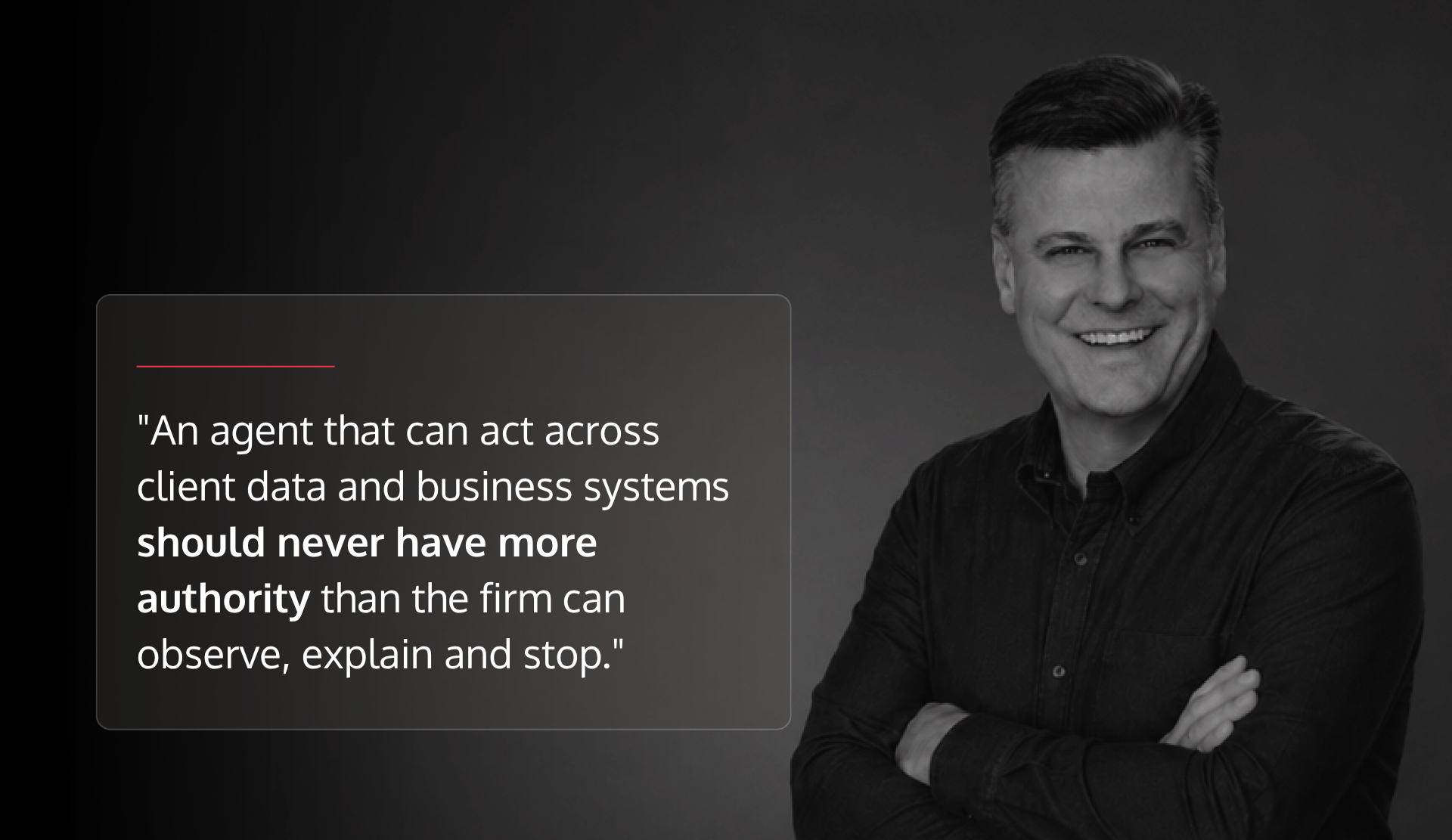
AI agents can take genuine drudgery out of professional work and give CPAs more time on analysis and advice. I am not neutral on this — the upside is real, and firms that sit out the next two years will feel it commercially. But the upside is contingent on control, and the contingency is not a formality. An agent operating across client data and business systems should never hold more authority than the firm can observe, explain and stop.
The framing that innovation and security are in tension is largely a false one. What is actually required is that autonomy be conditional: a defined job, a separate identity, minimum permissions, human approval on consequential actions, a complete audit trail and a tested response plan. That list is not a brake on adoption. It is what makes adoption defensible when someone eventually asks how the number got there.
Netsurit can help your CPA firm identify the AI agents already operating inside it, map their access to client data, and prioritize the controls that make secure adoption possible. To schedule an AI risk assessment, speak with Netsurit’s tax and accounting team.