The Case for AI in Accounts Receivable: Stop Chasing Payments, Start Predicting Them
AI for accounts receivable transforms how businesses collect cash – by replacing manual follow-ups, slow reconciliation, and reactive collections with predictive, automated workflows.
Here’s what AI does in AR, fast:
| AR Task | What AI Does |
|---|---|
| Invoice follow-up | Sends personalized, timed reminders automatically |
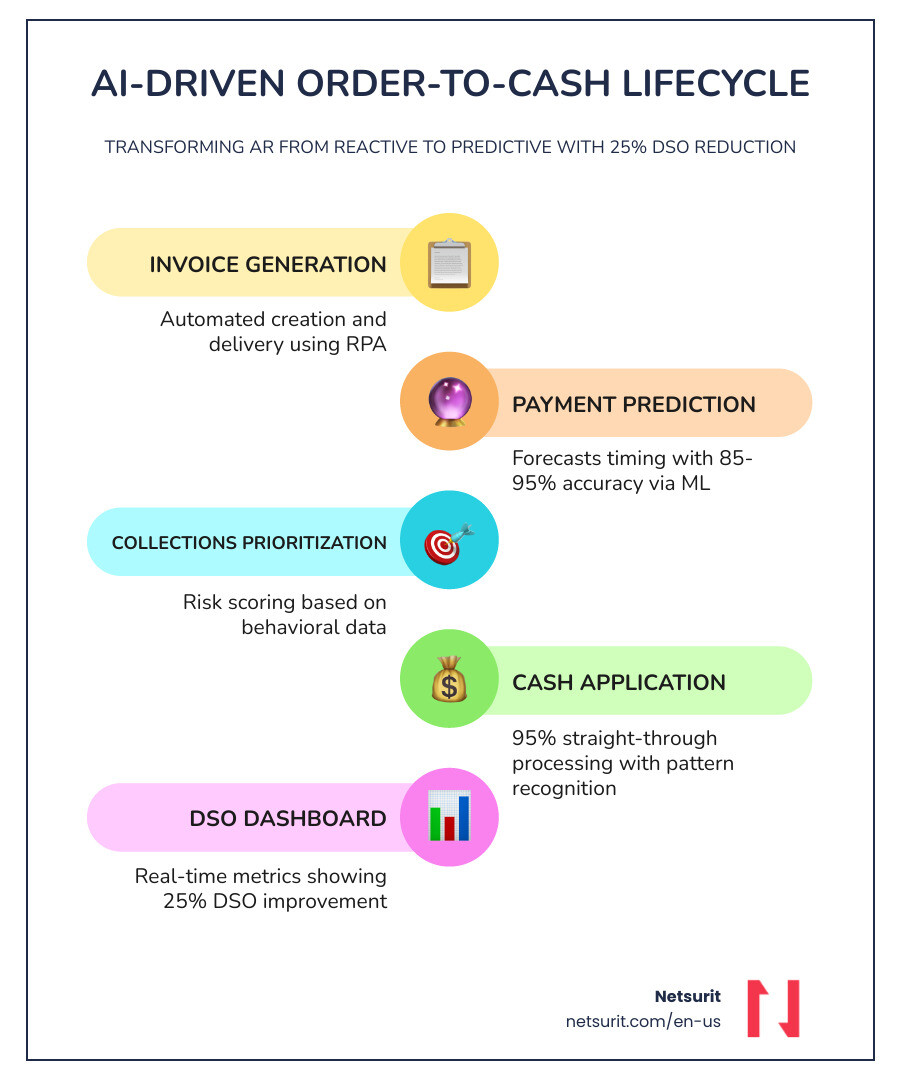
| Cash application | Matches payments to invoices with up to 95% straight-through processing |
| Collections prioritization | Ranks accounts by payment risk using behavioral data |
| Cash flow forecasting | Predicts payment timing with 85-95% accuracy |
| Dispute handling | Flags anomalies and routes exceptions to the right person |
The problem most finance teams face isn’t effort – it’s signal. Your AR team works hard, but they’re working from aging reports that tell you what already went wrong, not what’s about to.
Late payments compound. DSO (Days Sales Outstanding) creeps up. Cash sits locked in open invoices while your business makes decisions based on P&L, not actual liquidity. For a company with $100 million in revenue and a 55-day DSO, cutting just 10 days unlocks $2.74 million in working capital. That’s not a rounding error.
AI doesn’t just speed up the old process. It changes the process entirely – from reactive to predictive.
I’m Orrin Klopper, CEO of Netsurit, and over nearly 30 years of helping businesses modernize their operations through managed IT and AI services, I’ve seen how applying AI for accounts receivable shifts finance teams from firefighting to strategic decision-making. The roadmap below reflects what actually works when implementing these systems at scale.
AI for accounts receivable terms to know:
- Automate accounts payable
- AI-powered financial analysis
- Streamline accounting processes
Modernizing Cash Flow: What is AI for Accounts Receivable?
In simple terms, AI for accounts receivable is the application of advanced algorithms to manage the “order-to-cash” cycle. While traditional automation follows rigid “if-this-then-that” rules, AI learns from your data. It doesn’t just send an email because an invoice is 30 days late; it predicts which customers will be late based on their historical behavior, current economic signals, and even the sentiment in their last email.
We see this most effectively through three core technologies:
- Machine Learning (ML): Identifies patterns in payment history to forecast future cash inflows.
- Natural Language Processing (NLP): Reads and categorizes inbound customer emails or extracts data from unstructured PDF remittances.
- Robotic Process Automation (RPA): Handles the “heavy lifting” of data entry and moving information between your ERP and banking portals.
By combining these, firms can fix business problems with smart tech rather than just throwing more headcount at a manual process. What is AI in accounts receivable? It is the shift from looking in the rearview mirror (aging reports) to looking through the windshield (predictive insights).
Predictive Analytics: The Brain of AI for accounts receivable
The most significant drain on a CFO’s time is forecast volatility. Traditional forecasting is often a “best guess” based on the previous year. Predictive analytics changes this by analyzing thousands of data points—invoice size, seasonal trends, and historical payment “friction”—to assign a probability score to every open invoice.
Microsoft Research has demonstrated that these prototypes can predict invoice payments with 81% accuracy. This level of precision allows your team to focus on the “saveable” revenue—the accounts that are at risk but haven’t defaulted yet. This massive leap in AI productivity ensures your collectors aren’t wasting time calling customers who always pay on day 32, but instead focusing on the one whose behavior just shifted.
Cognitive Automation in Collections
Standard batch dunning emails are often ignored because they lack context. Cognitive automation uses NLP and sentiment analysis to personalize outreach. If a customer sends an email mentioning a “discrepancy in the shipping manifest,” the AI recognizes this as a dispute signal, pauses the automated collection sequence, and alerts a human specialist.
Research shows that AI-triggered reminder emails, sent at optimal times with personalized content, achieve 70% higher open rates and 152% higher click-through rates than standard batch messages. In the Houston metro area, where many logistics and oilfield service firms manage high-volume, complex invoicing, this nuance prevents “collection fatigue” and maintains better customer relationships.
Automating the Order-to-Cash Lifecycle
The order-to-cash (O2C) cycle is often broken by manual handoffs. AI for accounts receivable acts as the connective tissue. From the moment an invoice is generated to the final bank reconciliation, AI ensures data flows without human intervention. This is similar to how we help firms transform their accounts payable department, but focused on the revenue-in side of the ledger.
Streamlining Cash Application and Reconciliation
Cash application is historically the most labor-intensive part of AR. When a payment arrives without a remittance advice, or a single check covers fifteen different invoices with three partial deductions, a human usually spends hours “hunting and pecking” through the ERP.
AI changes this by using pattern recognition to achieve up to 95% straight-through processing. It “learns” that Customer X always deducts a 2% quick-pay discount even when they don’t state it, and it automatically suggests the match. This is one of the most effective AI tools to reduce manual data entry in accounting firms, freeing up staff for higher-value analysis.
Intelligent Collections Prioritization
Not all past-due invoices are created equal. Gartner identifies “Cash Collections” as a top AI use case because ML can forecast exactly when a customer will pay, allowing teams to trigger proactive efforts.
Instead of a collector starting at “A” in the alphabet, they start with the “Value-at-Risk” queue. This queue ranks accounts based on the likelihood of non-payment and the dollar amount. For example, a $50,000 invoice from a historically reliable customer who has suddenly stopped responding to emails will be flagged as a high-priority behavioral anomaly, even if it’s only two days past due.
Quantifying the ROI: Why CFOs are Investing
For most CFOs in 2025, AI is no longer a “nice to have”—it is a competitive necessity. 78% of CFOs plan to increase AI investments in AR processes because the math is undeniable. By using budgeting brilliance for smarter financial decisions, leaders can move from reactive cost-cutting to proactive capital allocation.
| Metric | Manual AR Process | AI-Driven AR Process |
|---|---|---|
| DSO (Days Sales Outstanding) | 45 – 60 Days | 34 – 45 Days (25% Reduction) |
| Cash Application Rate | 20-40% Straight-Through | 85-95% Straight-Through |
| Collection Efficiency | Reactive / High Effort | 40% Increase in Efficiency |
| Annual Savings (Mid-Market) | $0 (High Labor Cost) | Up to $440,000 + 4,500 Hours |
| Forecasting Accuracy | 60 – 70% | 85 – 95% |
Measuring the Success of AI for accounts receivable
To prove the value of AI for accounts receivable, we track three primary KPIs:
- DSO Reduction: 99% of organizations using AI in AR saw reductions in DSO, with 75% achieving a drop of six days or more.
- Collection Effectiveness Index (CEI): This measures how much of the available AR was actually collected. AI-powered dunning has helped some companies increase collections by 60% in six months without adding staff.
- Staff Productivity: One healthcare organization we analyzed doubled their AR productivity while saving 6,700 labor hours per month.
Unlocking Working Capital
The ultimate goal of AI is liquidity. When you reduce DSO by just 10 days, a company with $100 million in revenue can unlock $2.74 million in working capital. This is cash that can be used for acquisitions, R&D, or paying down debt rather than sitting as a line item on an aging report. To dive deeper into these metrics, we recommend viewing our on-demand webinar on AI in finance.
A 30-Day Roadmap to Implementing AI for accounts receivable
Implementing AI for accounts receivable doesn’t require a multi-year “rip and replace” of your ERP. In fact, the best way to automate accounting firm workflows with AI is through a phased, “wrap-and-extend” approach.
Phase 1: Assessment and Data Readiness (Days 1-14)
The first step is mapping your current process. Where are the bottlenecks? Usually, it’s in dispute resolution or manual cash application. You must also ensure your data is “AI-ready.” This means cleaning up customer master data and ensuring your ERP (like NetSuite, SAP, or Microsoft Dynamics) can export historical payment data via API. As discussed in our webinar on AI and the “death of the quick fix”, success depends on the quality of the foundation, not just the “shiny” AI tool.
Phase 2: Piloting and Scaling (Days 15-30)
We recommend starting in “Shadow Mode.” The AI generates predictions and drafts emails, but they aren’t sent. Your team compares the AI’s “Value-at-Risk” scores against actual outcomes. Once accuracy hits your target (typically 80%+), you flip the switch to automated workflows. If you’re ready to work smarter, this 30-day window is where the most significant mindset shifts occur.
Navigating Implementation Challenges and Trade-offs
No technology is a silver bullet. While the benefits of AI for accounts receivable are vast, firms in Houston and beyond must navigate real hurdles.
Managing the Human-AI Transition
The biggest barrier isn’t technical; it’s cultural. 89% of finance leaders say a mindset shift is needed for full AI benefits. Your team may fear that AI is coming for their jobs. In reality, AI augments their work. It handles the 80% of repetitive, boring tasks so your specialists can focus on the 20% of complex, high-stakes customer negotiations.
Trade-offs and Risks
| Feature | Details |
|---|---|
| Works best when | Data is structured, historical volume is high, and ERP has API connectivity. |
| Avoid when | Customer relationships require high-touch, non-standard “handshake” negotiations. |
| Risks | Non-deterministic outputs (AI may give slightly different answers to the same prompt); Model drift; Data exposure. |
| Mitigations | Human-in-the-loop approvals for large transactions; AES-256 and TLS 1.2+ encryption; Regular audits of AI decision logic. |
Future Trends: From Generative to Agentic AI
The next frontier of AI for accounts receivable is the shift from “Generative AI” (which creates content) to “Agentic AI” (which takes action).
While today’s AI might draft a payment reminder for you to approve, an Agentic AI workflow can:
- Identify a payment anomaly.
- Research the shipping documents.
- Contact the warehouse to confirm delivery.
- Email the customer with the proof of delivery.
- Negotiate a payment plan within pre-approved parameters.
These autonomous workflows will eventually handle the entire order-to-cash cycle with minimal human oversight, allowing finance departments to function as strategic “internal banks” rather than administrative centers.
Frequently Asked Questions about AI in AR
Will AI replace my accounts receivable team?
Unlikely. AI is designed to augment, not replace. It removes the “drudge work” of data entry and basic follow-ups. Humans are still essential for handling complex disputes, managing sensitive customer relationships, and making final strategic decisions.
How accurate is AI-based cash flow forecasting?
Current tools demonstrate 85% to 95% accuracy. By evaluating real-time payment data alongside historical trends, AI significantly outperforms traditional manual methods, enabling more confident treasury planning.
What is the typical payback period for AI in AR?
Most companies realize an ROI within the first quarter post-implementation. This is driven by rapid productivity gains (equivalent to several full-time employees) and the immediate reduction in interest costs as DSO falls.
Conclusion
At Netsurit, we believe that liquidity is the lifeblood of business momentum. By implementing AI for accounts receivable, you aren’t just automating a department; you are securing your cash flow and empowering your team to focus on growth. Whether you are operating in Houston, Sugarland, Conroe, or Katy, the transition to AI-driven finance is the most direct path to strategic liquidity.
Start your digital transformation journey today and unlock the capital hidden in your aging reports.
Last updated: May 2025