Agentic AI Deployment How to Move Beyond the Demo
A polished demonstration does not prove that an AI agent is ready for production. Successful deployment requires a defined outcome, scoped authority, governance, monitoring and reliable human escalation.
Successful agentic AI deployment requires more than a capable model. An organisation needs a narrowly defined business outcome, clear limits on what the agent may access and change, production-grade monitoring, tested error paths and a named human owner. A demonstration proves that an agent can complete a prepared task. Production proves that it can operate safely when the data, people and circumstances are less cooperative.
I once watched a flawless demonstration in which an agent triaged a support ticket, checked the account, drafted a response and closed the loop in 40 seconds. The executives in the room were impressed. They should have been. It was a good demonstration.
Nine months later, I asked how it was going in production. There was a pause you could park a truck in.
That pause is the distance between agentic AI as demonstrated and agentic AI as deployed. Closing it is less glamorous than the demonstration. It requires process design, permissioning, security, measurement and operational accountability. Those disciplines determine whether an agent becomes useful infrastructure or another pilot that never earns the right to scale.
Main Takeaways
- A successful demo proves capability in controlled conditions; production requires reliability across exceptions, changing data and real users.
- Start with one measurable outcome and give the agent only the authority required to achieve it.
- Register every agent with a named owner, permission scope, performance measure and review date.
- Design escalation, rollback and shutdown paths before launch, then test them under realistic failure conditions.
- Scale only after the agent demonstrates business value, acceptable risk and stable operating costs.
Why do agentic AI demonstrations fail to become deployments
The technology is often blamed when an agent stalls after the pilot. In many cases, the model is not the main problem. The organisation has demonstrated a technical possibility without building the operating system around it.
The base rates should make boards cautious. Gartner expects more than 40% of agentic AI projects to be cancelled by the end of 2027, citing escalating costs, unclear business value and inadequate risk controls. S&P Global Market Intelligence reported that the proportion of organisations abandoning most AI initiatives before production rose from 17% to 42%.
Those findings point to an execution problem. Organisations are capable of proving that AI can perform a task. They struggle to integrate the task into a live process with dependable data, clear ownership and controls that remain effective after the launch team has moved on.
A demo removes the difficult parts
A demonstration usually has a known input, a cooperative user and a clean route to the expected output. Production introduces incomplete data, conflicting instructions, unavailable systems, unusual customers, policy exceptions and people who use the tool in ways its designers did not anticipate.
A demo asks whether the agent can do the task. Production asks harder questions. What happens when the agent is uncertain? Which system is authoritative? Who approves an exception? How quickly can a decision be reversed? What evidence remains for audit? Who carries the business risk when the agent is confidently wrong?
If those questions are unanswered, the deployment is not delayed by AI capability. It is delayed by unfinished operating design.
What changes when an AI agent enters production
An AI assistant produces an answer for a person to assess. An agent can use tools, move information between systems and take actions toward a goal. That added agency changes the risk profile.
The important unit is no longer only the quality of a generated response. It is the quality of the whole chain: the data the agent receives, the systems it may reach, the decisions it may make, the records it creates and the people who supervise it.
Permissions become a business decision
The first production question is simple: what may this agent touch?
Access should be limited to the minimum needed for the approved outcome. A service agent may need to read an account record but not alter payment details. A finance agent may prepare a reconciliation but require a person to approve a journal entry. A security agent may isolate a device under defined conditions but should not make an unrestricted change across the environment.
Least privilege is established security practice. Agents make its absence more expensive because they can act quickly, repeatedly and across connected systems. Permissioning therefore needs business, process and security input. It cannot be left as a technical setting chosen at the end of the project.
Coordination matters more than intelligence
My doctorate focused on multi-agent systems, and one lesson from that work has not retired: the agent is rarely the hardest part. Coordination is. Handoffs are. Knowing which participant has authority, what state the process is in and who answers when something goes wrong.
That remains true when several agents are involved. If one gathers information, another makes a recommendation and a third performs an action, the organisation needs a dependable way to manage context, identity and approval across the chain.
Standards are improving the connection layer. The Linux Foundation's Agentic AI Foundation now houses the Model Context Protocol, which helps AI applications connect to tools and data. Better plumbing is useful, but connectivity does not answer the governance question. The ability to connect an agent to a system is not the same as the authority to let it act there.
Exceptions become the real workload
The prepared path shown in a demonstration is usually the cheapest part of production. Exceptions consume the effort.
An agent needs rules for low-confidence outputs, missing data, contradictory records, policy conflicts and unavailable downstream services. Each exception needs an owner and a service expectation. If everything falls into a general queue marked "human review", the agent may simply move the bottleneck instead of removing it.
This is why organisations should adopt AI without disrupting operations by mapping the existing workflow before automating it. Where work drops between teams today is where it will drop between agents tomorrow, only faster and without the experienced colleague who notices the silence.
What controls are required for agentic AI deployment
The controls do not need to begin as a large governance programme. They need to be specific enough to shape the deployment from day one.
Define the outcome and baseline
Name the operational result the agent exists to improve. It might reduce ticket resolution time, improve the quality of case summaries, lower rework or accelerate a research step. Measure the current process before the agent changes it.
Without a baseline, the organisation can report activity but cannot prove value. The number of agent actions, conversations or users is not a business result. The useful comparison is what happened to time, cost, quality, risk or capacity after deployment.
Scope the agent's authority
Write down what the agent may read, recommend, create, change and approve. Specify what it may never do. Link higher-risk actions to explicit human approval and separate permissions for testing from those used in production.
The US Cybersecurity and Infrastructure Security Agency advises careful adoption of agentic AI services, particularly where systems can act through privileged accounts or access sensitive resources. The practical implication is that autonomy should grow only as evidence and controls mature.
Create an agent register from the first deployment
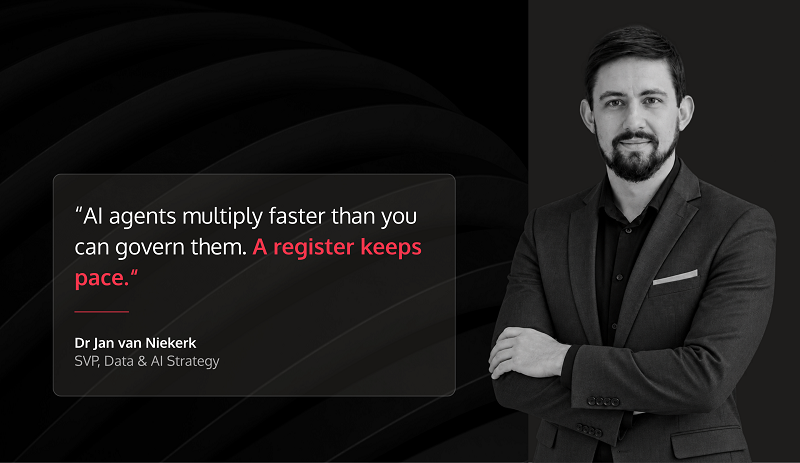
Every agent should have a named owner, a business outcome, a permission scope and a review or sunset date. Record the model or platform, connected systems, data classification, monitoring route and current operating status as the estate grows.
Starting this register with the first few agents is straightforward. Reconstructing it after business units have deployed hundreds is not. A register also creates a shared view across technology, security, risk, procurement and the business owner.
Design the failure path before launch
For each material failure, decide how it will be detected, who will be notified, what can be reversed and how the agent will be stopped. Test the path rather than assuming it works.
Useful tests include incorrect source data, unavailable tools, prompt injection, excessive permissions, duplicate actions, unexpected costs and an operator overriding the agent. A vendor who can show you a real error log, audit trail and rollback process is showing you production. Perfection belongs to staging.
Monitor behaviour and cost
Traditional application monitoring asks whether the service is running. Agent monitoring must also ask what the agent is doing, why it selected an action, which tools it used, what the action cost and whether the result remained within policy.
Set thresholds for failure rates, escalation volume, response time, token or model consumption and business outcomes. Monitoring should make deterioration visible before a user complaint or control failure does.
How should organisations move from pilot to production
A staged approach gives an agent the chance to earn authority.
Stage one runs in observation mode
Let the agent analyse real work without taking action. Compare its recommendations with the decisions made by experienced people. This exposes data gaps, ambiguous policies and categories the demonstration did not encounter.
Stage two allows reversible low-risk actions
Give the agent authority over actions that are limited, observable and easy to reverse. Keep approval gates around financial, customer, identity and security decisions. Measure exception rates as closely as successful completions.
Stage three expands only against evidence
Increase volume or autonomy when the agent meets agreed thresholds for accuracy, cost, security and business value. Scale one dimension at a time. Expanding volume, permissions and workflow complexity simultaneously makes it difficult to identify the cause of a problem.
This is also where measuring AI value beyond personal productivity becomes important. A tool can feel useful to individual employees while producing little process-level value. Production funding should follow measured operational improvement.
Should organisations buy or build AI agents
Most organisations should buy the base and build the edge. Use established platforms for identity, security, orchestration, audit and common capabilities. Build the parts that encode a distinctive process, proprietary knowledge or competitive advantage.
The decision should still be made at the workflow level. Buying a platform does not transfer accountability to the vendor. The organisation remains responsible for configuring permissions, validating outputs, monitoring use and determining whether the agent is appropriate for the decision it influences.
Before appointing a provider, ask for evidence beyond the demonstration: production references, incident processes, logging depth, data-handling terms, model-change controls, recovery options and a credible way to exit. The best vendor conversation is often about what the system should not be allowed to do.
Frequently asked questions about agentic AI deployment
What is agentic AI deployment
Agentic AI deployment is the process of placing an AI system that can use tools and take actions into a live business workflow. It includes integration, permissions, governance, monitoring, security, human oversight and ongoing performance management.
Why do AI agent demos fail in production
Demos usually use controlled data and a prepared path. Production introduces exceptions, changing information, real permissions, connected systems and users who behave unpredictably. Projects fail when these operating conditions have not been designed and tested.
What should be included in an AI agent register
At minimum, record the agent's owner, intended outcome, permission scope and review or sunset date. Mature registers also capture connected systems, data classification, platform, risk rating, monitoring route, cost and current status.
How much autonomy should an AI agent have
An agent should receive the minimum autonomy needed for its approved outcome. Low-risk and reversible actions may be automated first. High-impact actions should retain human approval until evidence shows that broader authority is justified.
How should an organisation measure an AI agent
Measure business outcomes such as cycle time, error rates, rework, unit cost and capacity. Add operational measures including escalation rates, failed actions, latency, security events and total running cost.
Who owns an AI agent in production
A named business owner should be accountable for the outcome and continued use of the agent. Technology and security teams manage technical controls, but they should not inherit ownership of a business process simply because AI is involved.
Agentic AI succeeds when the operating model is ready
The pause in that meeting room was not proof that the agent had failed. It was the sound of an organisation learning the difference between a demonstration and a deployment.
The practical response is to narrow the outcome, define authority, register the agent, build the error path and measure the live process. Agentic AI can produce real gains in well-bounded workflows, but the boundary is part of the product. Build it before increasing autonomy.
For organisations that need help identifying, designing and governing production-ready use cases, Netsurit's AI and business-process automation support can turn promising demonstrations into controlled, measurable deployments.
Book a free automation assessment with Netsurit.