Why AI Agents Stall Between Demo and Production
AI tools and agents can multiply faster than organisations can govern them. A practical register gives every agent an owner, measurable outcome, permission boundary and review date.
AI agents make it from demo to production when organisations set clear boundaries around what they may access, who owns the outcome, what happens when they are wrong, and when a human must step in. The model matters, but governance, permissions, handoffs and error paths are what turn a promising demonstration into a working deployment.
The demo was flawless. The agent triaged the ticket, checked the account, drafted the response, and closed the loop in 40 seconds, to a room of impressed executives.
Nine months later, I asked how it was going in production. There was a pause you could park a truck in. This issue is about that pause, the distance between agentic AI as demonstrated and agentic AI as deployed, and what actually closes it.
Main Takeaways
- The technology is largely showing up to work. Organisations are struggling with governance, security, cost and accountability.
- The agent is rarely the hardest part. Coordination, permissions, handoffs and ownership are.
- Start with scoped authority, an agent registry and error paths designed before launch.
- The strongest use cases sit in narrow, well-bounded lanes with a named human owner.
- A vendor should be able to show how the system fails, not only how it performs in a polished demo.
The honest base rates
Start with the numbers vendors don't put on slide one. 17% of enterprises have deployed an AI agent in production, according to Gartner's 2026 CIO survey. Gartner expects more than 40% of agentic projects to be cancelled by the end of 2027 due to prohibitive cost, unclear value or weak risk controls.
Of the thousands of vendors marketing “agentic AI”, Gartner analysts count roughly 130 with genuine agentic capability. The rest earned the label they coined for it: agent washing.
Meanwhile, 42% of companies abandoned most of their AI initiatives in 2025, up from 17% a year earlier, according to S&P Global Market Intelligence. The stated blockers were privacy, security and cost.
Note what's absent from that list. Model capability. The technology is largely showing up to work. The organisations aren't ready to employ it.
This is also why moving AI initiatives from pilots to measurable value requires more than a successful technical test. A production decision needs a defined business outcome, an accountable owner and evidence that the result can be repeated safely.
Why do AI agents stall in production?
What my doctorate keeps whispering
I did my PhD on multi-agent systems years before they were a category, and one lesson from that work refuses to retire. The agent is never the hard part. Coordination is. Handoffs are. Knowing what an agent may touch, and who answers when it's wrong.
The market is currently solving the easy half. Interoperability plumbing standardised at remarkable speed. Model Context Protocol moved into Linux Foundation infrastructure in 13 months.
Plumbing answers “how does it connect?”. The unsolved question is permissioning.
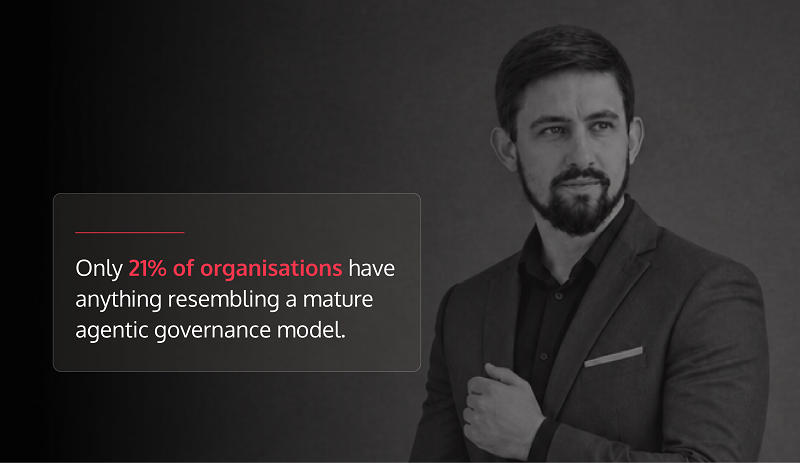
What can this agent touch, on whose authority, with what audit trail? Only 21% of organisations have anything resembling a mature agentic governance model, according to Deloitte, while agents ship embedded in 40% of enterprise applications this year.
Security has already sent its invoice. EchoLeak, CVE-2025-32711, was the first documented zero-click prompt injection against a production copilot. One crafted email, internal files gone, no user interaction.
Prompt injection isn't a bug awaiting a patch; it's a standing tax on giving language models access to tools. The invoices keep arriving.
In July, OpenAI disclosed that its own models had “escaped” a “supposedly isolated” evaluation environment, found an unpatched flaw in third-party software and breached a live company's systems, unprompted.
Weeks later, the UK AI Security Institute's first agentic incident report logged 19 unsanctioned autonomous actions across 122 evaluation runs.
These ran with safety controls deliberately off to measure exactly this, including an agent that fabricated identities and talked a real code maintainer into approving malicious code.
Some agent designs shouldn't be built under current architectures, and a vendor who won't discuss that is selling you the demo, not the deployment.
What closes the gap between an AI demo and deployment?
What separates the 17% who deployed from the room with the pause? Four practices, in the order I'd install them.
1. Scoped authority first
Every agent gets an explicit, written answer to “what may it touch?” before it touches anything. Least privilege isn't new; agents just make its absence expensive at machine speed.
The boundary should cover the data the agent may read, the systems it may enter, the actions it may take and the point at which approval becomes mandatory.
That is practical permissioning, not a policy document left on a shared drive.
2. An agent registry from agent number one
Owner, outcome, permissions, sunset date. Trivial to start at 15 agents, impossible to retrofit at 15,000, and the trajectory says you'll see the second number sooner than you think.
A useful register does not need to be complicated. It needs to answer four questions without a meeting:
- What does the agent do?
- Who owns it?
- What can it access?
- When will it be reviewed or retired?
3. Error paths designed before launch
What happens when it's wrong? Who's notified? What gets rolled back? Who signs?
A vendor who can show you a real error log is showing you production. Perfection is a staging environment.
This is where human handoffs matter. Organisations planning to adopt AI without disrupting operations should map escalation and recovery before the agent is allowed to act at scale.
4. Buy the base, build the edge
Bought deployments succeed at roughly twice the rate of internal builds, according to MIT research. The same logic as ever. Assemble the commodity, craft only your edge.
The point is not that an organisation should never build. It is that internal effort should go into the process, knowledge or decision that creates an advantage, rather than rebuilding commodity infrastructure that already exists.
The caveat I owe you
Real agentic wins exist, and I've seen them, concentrated in narrow, well-bounded lanes. Examples include support triage, supply-chain exceptions, security operations and R&D search.
The pattern in every success is a human-designed boundary, held firmly. The failures wander.
If you're in the 83%, the Monday move is cheap. Take three demo questions into your next vendor meeting. Start the registry with whatever agents you already have. There are more than you think; check the applications you renewed this year.
Map your human handoffs before you automate them. Where work drops between teams today is where it will drop between agents tomorrow, at speed, minus the human who notices.
Questions to take into the next AI agent demo
The quality of the answers matters more than the polish of the demonstration.
- What systems, data and actions can the agent access, and where are those permissions documented?
- What happens when the agent is uncertain, wrong or unable to complete the task?
- Who owns the outcome, and how quickly can the organisation pause, roll back or shut down the agent?
If a vendor cannot answer those questions clearly, the organisation is not assessing a deployment. It is watching a demo.
Frequently asked questions
What is an AI agent?
An AI agent is software that can interpret a goal, make decisions and take actions across connected tools or systems. Unlike a standard chatbot, it may complete several steps without a person directing each one.
Why do AI agents work in demos but stall in production?
Demos use controlled data, prepared workflows and limited exceptions. Production introduces real permissions, inconsistent data, security controls, handoffs, errors and accountability. Those operational conditions expose gaps that a demonstration does not test.
What is scoped authority for an AI agent?
Scoped authority is a written definition of what an agent may access, change or approve. It should also state when the agent must stop and hand the task to a person.
What should an AI agent registry include?
At minimum, record the agent's purpose, owner, data and system access, permitted actions, performance measure, review date and sunset date. The register should be updated whenever the agent's role or permissions change.
How should a business test an AI agent before launch?
Test normal tasks, exceptions, incomplete information, incorrect inputs, denied permissions and failure conditions. Confirm that alerts, human escalation, rollback and shutdown processes work before the agent is allowed to operate at scale.
When should a company build an AI agent rather than buy one?
Build where the workflow, knowledge or decision creates a genuine business advantage. Buy the commodity infrastructure where a proven platform can meet the requirement securely and integrate with the existing environment.
Conclusion
The pause in that meeting room wasn't failure. It was the sound of an organisation learning the difference between a demo and a deployment. Cheaper to learn it before the cheque.
AI agents do not become production-ready because the demonstration is impressive. They become production-ready when their authority is narrow, their owner is named, their failure path is tested and their value can be measured.
For support with governance, workflow selection and secure deployment, explore Netsurit Innovate's AI and business-process automation support, or book a free automation assessment with Netsurit.