AI ROI Measurement What CFOs Need to Track
CFOs are asking where AI value appears in the P & L. A credible answer requires a baseline, operational measures, full cost visibility and conservative financial attribution.
AI ROI measurement should connect a defined business baseline to changes in time, cost, quality, capacity, risk and financial performance. CFOs need the total cost of the initiative, a credible method for attributing improvement to AI and a timetable that reflects the maturity of the use case. Adoption figures and employee impressions may explain usage, but they do not prove return on investment.
"I believe in the technology. Show me where it lands in the P and L, and when."
A CFO said a version of that to me recently, and it is one of the most reasonable sentences in enterprise AI. It is also routinely misfiled as resistance.
The finance leader is not asking AI to justify its existence in advance. The request is for investment discipline: fund the opportunity, measure the result and do not confuse enthusiasm with evidence. That is the right position for an organisation that wants AI to move beyond experimentation.
Main Takeaways
- Establish the cost, time, quality and risk baseline before AI changes the workflow.
- Measure operational outcomes such as cycle time, error rates and rework before attempting to claim financial value.
- Include integration, data, change, governance, security and usage costs rather than reporting the licence price alone.
- Attribute gains conservatively when several changes affect the same process.
- Use stage-gate funding so initiatives earn larger investment through evidence rather than optimism.
Why are CFOs asking harder questions about AI ROI
CFOs are not generally rejecting AI. They are distinguishing expected value from realised value.
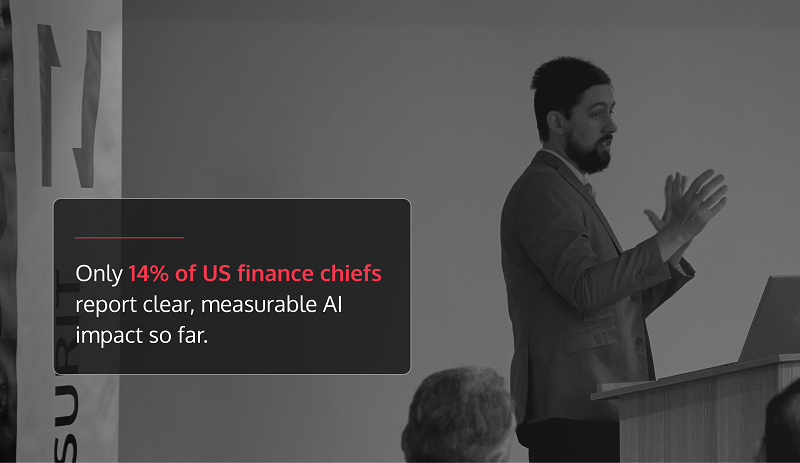
RGP's research on AI readiness found that 66% of CFOs expect measurable AI impact within two years, while only 14% report meaningful return today. That is a gap between ambition and operating readiness, not a collapse in belief.
Deloitte's Finance Trends 2026 research reached a similar conclusion. Although 63% of surveyed finance leaders said AI was fully deployed and actively used, only 21% reported clear, measurable ROI. Deployment, use and return are three different measures. Treating them as interchangeable makes the dashboard look stronger while making the investment case weaker.
The CFO's position is therefore: show the value pathway, show the full cost and show when the evidence should become visible. A credible AI programme should welcome that scrutiny because it forces the organisation to identify what the technology is expected to change.
Adoption is a leading indicator, not the result
Usage matters. People cannot create value from a tool they do not use. Yet a high adoption rate can coexist with no measurable improvement in the process.
An employee may use an AI assistant every day to draft messages, prepare meeting notes or summarise documents. That may improve the working experience, but it does not automatically reduce costs, increase revenue or release capacity. The organisation still needs to establish whether the time saved was real, whether quality held, and what happened to the recovered time.
This distinction is central to measuring AI value beyond personal productivity. Personal usefulness is worth understanding. Process performance is what finance can connect to an operating result.
Why do common AI ROI measures mislead leaders
The standard AI dashboard often leads with licence activation, prompt volumes, user surveys and estimated hours saved. These measures can help explain adoption, but each has limits.
Activation does not show sustained use. Prompt volume can reward inefficient behaviour. A survey captures perception. Estimated hours are frequently multiplied by salary costs even when no cost was removed, no additional output was produced and the time simply moved to another task.
People are poor stopwatches
A 2025 randomised controlled trial by METR offers a useful warning. Experienced open-source developers using early-2025 AI tools took 19% longer to complete the measured tasks, even though they believed AI had made them faster.
The study was narrow: 16 experienced developers worked on mature repositories they knew well. It should not be used to claim that AI slows all software work. Its value is methodological. It shows that perceived productivity and measured productivity can move in opposite directions, even among experts working on observable tasks.
Ask employees how the tool affects their experience, but file that answer under adoption and user value. Use timestamps, throughput, quality and cost records for the ROI calculation.
A weak baseline makes every improvement debatable
Many AI business cases begin after the pilot has already started. Teams then try to reconstruct the previous process from memory. The comparison becomes vulnerable to optimism, selective examples and changing conditions.
If the organisation does not know how long the workflow took, how often it failed, how much rework it created and what it cost before AI, the post-implementation number has no stable reference point. The first discipline of AI ROI measurement is therefore simple: measure the before before celebrating the after.
What should CFOs measure before AI is introduced
The baseline should describe the workflow in business terms. It does not need to be perfect, but it must be consistent enough to support a fair comparison.
Time and throughput
Measure end-to-end cycle time, waiting time between steps, work completed per period and backlog. Separating active work from waiting is important because an AI tool may accelerate one task without improving the full process.
Quality and rework
Track error rates, returns, corrections, duplicate effort, customer complaints and control exceptions. Faster work that creates additional checking or remediation is not a clean productivity gain.
Cost and capacity
Record the people time, technology cost and external spend required for the current process. Also identify the constraint. If demand already exceeds capacity, saved time may create additional output. If demand is fixed, the value may appear as avoided overtime, reduced outsourcing or capacity redeployed to higher-value work.
Risk and service outcomes
Some AI initiatives exist to improve consistency, response times, compliance or decision support rather than to reduce headcount. Define those outcomes explicitly. Avoid forcing every benefit into a labour-saving calculation when risk reduction or service quality is the real objective.
Which AI ROI metrics create an honest measurement chain
The strongest business cases connect four layers rather than jumping from usage to profit.
Layer one measures adoption
Useful indicators include active users, repeat use, training completion and the proportion of eligible work where the tool is used. These show whether the change has reached the workforce.
Layer two measures workflow performance
Track cycle time, throughput, first-time-right rates, rework, escalations and exception volumes. This layer demonstrates whether the process changed.
Layer three measures operating value
Translate workflow change into capacity released, additional work completed, outsourced cost avoided, service-level improvement, loss prevention or faster cash conversion. State the conversion logic clearly.
Layer four measures financial impact
Connect the operating value to revenue, margin, operating expenditure, working capital or risk-adjusted loss. This is where finance should test the assumptions and approve the attribution method.
The chain matters because a small improvement at one stage does not automatically survive every stage. Ten minutes saved per task creates no financial return if the work is repeated, the time is not redeployed or the initiative costs more to operate than the capacity it releases.
What costs belong in an AI business case
The licence is the visible part of AI cost. A complete business case should also include:
- Integration with existing applications, identity systems and data sources.
- Data preparation, classification, access controls and ongoing quality work.
- Process redesign, testing, documentation and employee training.
- Security reviews, governance, legal input, monitoring and audit activity.
- Model, token, compute, storage and transaction consumption as usage scales.
- Human review, exception handling and remediation when outputs are wrong.
- Vendor management, support and the cost of changing or exiting the solution.
Consumption deserves particular attention. A low unit price does not guarantee a low total bill. As more employees and automated workflows use AI, volume can grow faster than unit costs fall. CFOs should request cost per completed business outcome, not only cost per licence or model call.
That full-cost view should form part of any plan to adopt AI without disrupting operations. A solution that appears efficient in isolation can create hidden work for technology, security, finance and operations.
How should AI gains be attributed
Attribution should be conservative enough to survive challenge. If an improved process also received new staff, revised policies, cleaner data and a system upgrade, AI should not receive all the credit.
Use a comparison group where practical. Introduce the change in phases. Compare similar teams, customers or time periods. Document other changes that could have affected the result. Where a clean experiment is impossible, use a range and label the confidence level.
The purpose is not to minimise the reported return. It is to make the number useful for future capital allocation.
McKinsey's 2026 State of AI survey shows why this discipline matters. Only about 6% of respondents qualified as AI high performers, meaning they attributed at least 5% of EBIT to AI and described the value as significant. Broad adoption is rising, but enterprise-level financial impact remains concentrated.
How long should an organisation allow for AI returns
Different use cases reveal value on different clocks. A personal assistant may affect drafting time within weeks. A workflow tool may need a quarter to show stable throughput and quality. A process redesign that changes roles, systems and customer journeys may take several quarters before its impact reaches the P and L.
The answer is not to give every project an open-ended runway. Use stage gates.
Learning stage
Fund discovery and capability building with an explicit learning budget. Define what the organisation needs to learn and by when. Do not disguise learning as proven ROI.
Proof stage
Test the use case against the operational baseline. Require evidence that the workflow improves without unacceptable quality, security or control costs.
Scale stage
Release larger funding when the operating result is repeatable and the total cost remains credible at higher volume. Continue measuring because model behaviour, pricing, data and user practices can change.
Two years of runway can buy eight quarters of disconnected pilots, or two quarters of disciplined measurement followed by six quarters of scaling what proved itself. The first spends the clock. The second uses it.
How should finance and technology divide responsibility
Finance should own the financial logic, capital gates and standards for attribution. Technology should own architecture, integration, reliability and operating cost visibility. Security, legal and risk teams should define controls proportionate to the use case. The business owner remains accountable for the workflow and benefit.
No single function can produce a credible AI ROI number alone. Finance without operational context may reject benefits that are real but early. Technology without finance may report technical performance as business value. The shared model should be agreed before the pilot begins.
Frequently asked questions about AI ROI measurement
How should a CFO measure AI ROI
Start with a pre-AI baseline, measure changes in workflow performance, calculate the full implementation and operating cost, and translate verified improvements into financial outcomes using a documented attribution method.
Which AI ROI metrics matter most
The most useful metrics depend on the workflow. Common measures include cycle time, throughput, error rates, rework, unit cost, capacity released, revenue influenced, working-capital improvement and risk events avoided.
Are employee productivity surveys useful
They are useful for understanding adoption, confidence and employee experience. They should not be the primary proof of financial return because people may misjudge the amount of time saved or the effect on end-to-end performance.
What costs should an AI business case include
Include licences or consumption, integration, data work, process redesign, training, change management, security, governance, monitoring, human review, support and exit costs.
How long does it take to see AI ROI
Task-level improvements may appear within weeks. Workflow and process-level returns generally require longer because the organisation must change behaviour, integrate systems and stabilise controls. Set a timetable for each stage rather than one deadline for every use case.
What is the difference between AI adoption and AI ROI
Adoption shows that people are using the technology. ROI shows that the use produced measurable value greater than its total cost. Adoption can contribute to ROI, but it does not prove it.
Credible AI ROI begins before the pilot
The Monday move is simple. Pick the AI success story most often repeated in the business and ask what its baseline was. Then ask which operational measure changed, what the full cost was and how the gain was attributed.
If the room goes quiet, finance has found the next piece of work. The answer is not to stop investing. It is to build the measurement discipline that allows the organisation to invest with greater confidence.
Netsurit's AI and business-process automation support helps organisations identify high-value workflows, establish measurable baselines and implement AI with practical governance.
Book a free automation assessment with Netsurit.