


Strategy: 05:45
Innovation Discussion: 23:41
How to Win by Escaping the Multiple Destination Trap
Wondering what you can do to avoid a strategy execution failure and turn the current economic uncertainty into opportunity? Studies have concluded that the vast majority of strategic planning fails. Up to 67%, actually.
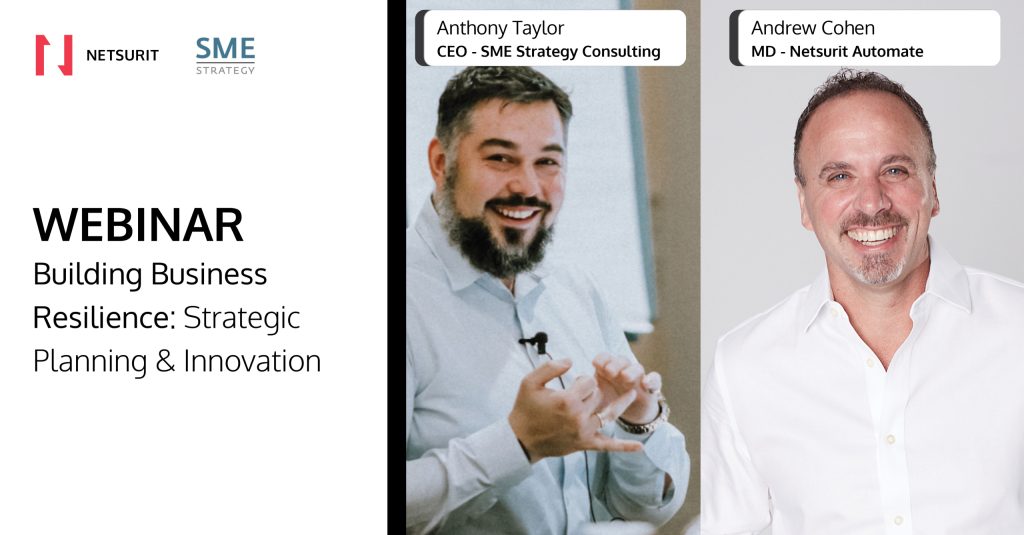
Netsurit hosted a webinar where industry experts Anthony Taylor from SME Strategy Consulting and Andrew Cohen from Netsurit discussed how to develop a winning business strategy that leverages innovation and digital transformation and avoids the ‘multiple destination trap.’
The discussion covered:
- An easy-to-follow process that your teams can use to encourage innovation and strategic thinking
- How to align your team around one strategic destination
- Learn how to implement changes quickly, adapt to market changes, and increase profits
- Introducing concepts on how to innovate no matter your company size
- Getting the most out of your tech investment
Watch Webinar Now
hbspt.forms.create({ region: “eu1”, portalId: “25723760”, formId: “0dac69de-c871-4525-ab5f-5b136de3de6a” });
Andrew Cohen has been an award-winning leader in the Digital Transformation space since 1997. Andrew helps companies build modern workplace solutions for nearly every common organizational and technological challenge imaginable and provides organizations with guidance and solutions on using technology to maximize ROI.
Anthony Taylor is the CEO and senior strategic planning facilitator at SME Strategy Consulting with an entrepreneurial background and more than 10 years of experience running his own businesses in various industries. Anthony works closely alongside senior leaders of organizations to facilitate their strategic planning sessions and help them get clarity, focus, and alignment on the direction of their entire organization.
Ready to Future-Proof Your Business Strategy?
Let Netsurit help you align innovation with resilient planning and tech investments. Talk to our experts
Frequently Asked Questions
1. What is business resilience in strategic planning?
Business resilience is an organisation’s ability to prepare for disruption, respond effectively to change and continue working towards its strategic objectives. Strong strategic planning can help businesses establish clear priorities while retaining enough flexibility to adapt to changing markets, technologies and customer needs.
2. How can strategic planning improve business resilience?
Strategic planning can improve business resilience by giving teams a clear destination, defined priorities and a framework for making decisions. When employees understand the organisation’s objectives, it can become easier to evaluate opportunities, respond to disruption and focus resources on initiatives that support the wider business strategy.
3. Why is innovation important for business resilience?
Innovation helps businesses adapt their products, services, processes and operating models as conditions change. It does not always require major transformation. Businesses can use incremental improvements, new technologies and different ways of working to solve problems, improve efficiency and respond to emerging opportunities.
4. What is the multiple destination trap in strategic planning?
The multiple destination trap occurs when an organisation tries to pursue too many competing strategic priorities at the same time. This can divide resources and make it difficult for teams to understand what matters most. Aligning the organisation around a clear strategic destination can support more focused execution.
5. How can businesses align teams around one strategic destination?
Businesses can begin by defining a clear strategic objective and communicating how individual teams contribute to it. Leadership should establish priorities, clarify responsibilities, set measurable outcomes and regularly review progress so that teams remain aligned as business and market conditions evolve.
6. How does digital transformation support business resilience?
Digital transformation can support business resilience by helping organisations modernise processes, improve collaboration, access information more effectively and adapt operations as requirements change. Technology investments are most effective when they are connected to clearly defined business objectives rather than implemented in isolation.
7. How can businesses get more value from technology investments?
Businesses can get more value from technology investments by identifying the business problem first, defining the desired outcome and selecting technology that supports that objective. Adoption, employee training, integration, security and ongoing performance reviews should also form part of the investment strategy.
8. How can a business adapt its strategy to changing market conditions?
Businesses can regularly review market developments, customer needs, operational performance and strategic progress. When conditions change, leaders can reassess priorities and adjust execution while maintaining focus on the organisation’s core strategic destination.
