Where Enterprise AI Is Going: Four Forces That Matter
Forecasts age quickly. Forces reveal the direction of travel. This article identifies four forces shaping enterprise AI and explains how organisations can position for each.
The future of enterprise AI will be shaped by four forces: greater competition and convergence at the model layer, the growing importance of agent permissions, falling unit costs accompanied by rising total expenditure, and a regulatory runway that rewards early preparation. Businesses can position for all four without predicting which model or vendor will lead in a particular year.
I don’t make dated predictions. I’ve watched too many confident ones age badly with someone’s name attached. Forces are different from forecasts. A forecast says when. A force says which way the river runs.
This article covers four forces and how to position for each without betting on a date.
Summary
- Model performance is becoming more competitive, making model portability more valuable than loyalty to a particular provider.
- Agent interoperability has advanced quickly, but permissioning, identity and accountability remain unresolved.
- AI unit costs are falling while total expenditure rises as usage expands faster than prices decline.
- Regulatory delays provide additional preparation time, not an exemption from existing data-protection and accountability requirements.
- Organisations can position for all four forces through swappable architecture, scoped permissions, realistic budgets and stronger governance.
Why Forces Are More Useful Than AI Forecasts
Enterprise AI forecasts often depend on precise dates, specific vendors or assumptions about the next technical breakthrough. The problem is that all three can change quickly. A model may lead one quarter and lose ground the next. A capability expected in two years may arrive sooner, while another remains unreliable long after the market predicted it would be ready.
A force is more useful because it does not require that level of certainty. If model performance is converging across providers, businesses can design for portability without knowing which provider will lead in 2028.
If agents are gaining access to more tools and information, businesses can establish permission controls without predicting when fully autonomous agents will become common. If usage is rising faster than unit prices are falling, finance teams can improve their budgets without knowing the future cost of every token.
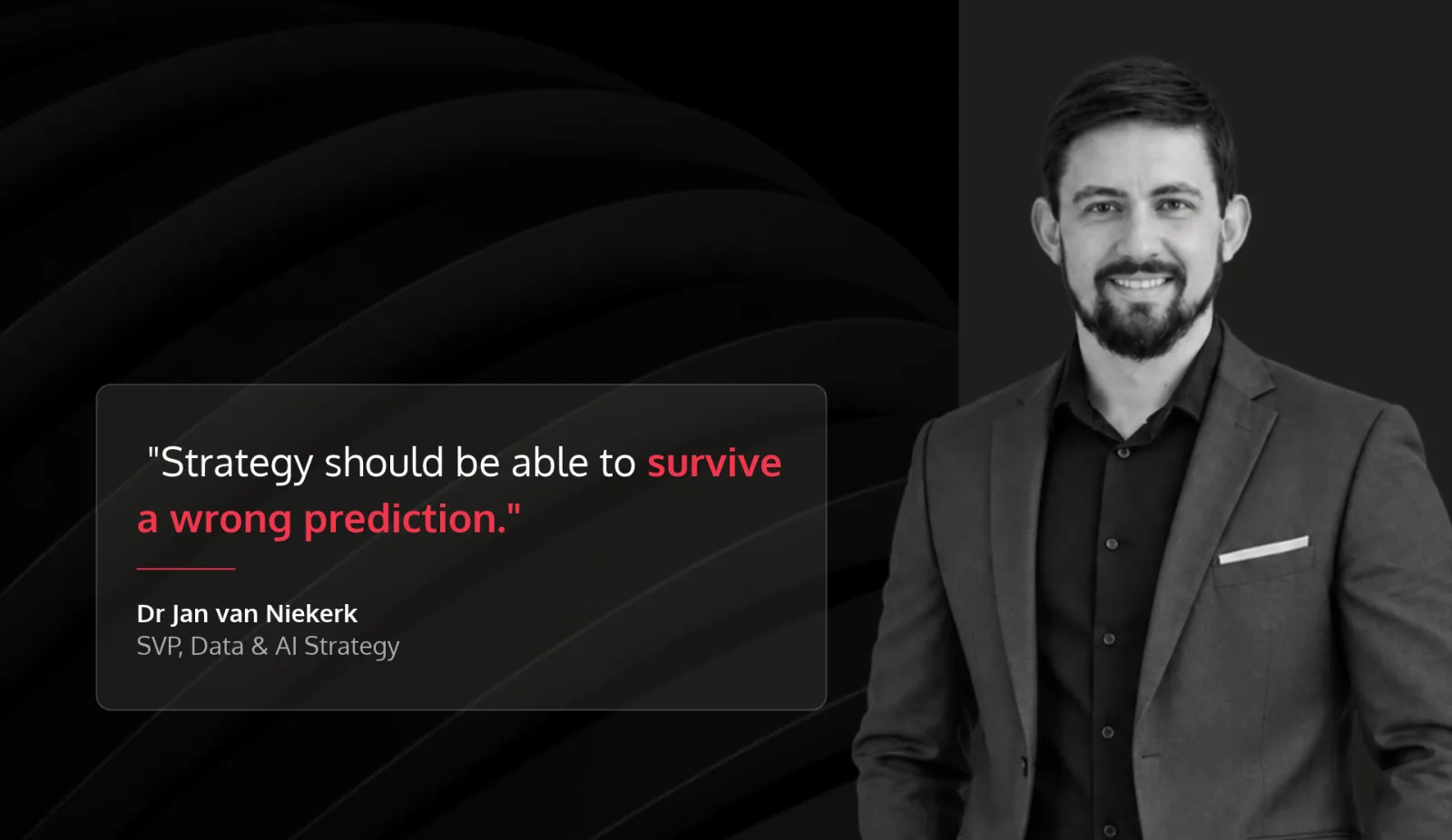
Strategy should be able to survive a wrong prediction.
These four forces provide a direction organisations can prepare for now.
Force One: The Model Layer Is Becoming a Commodity
Capability is converging across the frontier, and open-weight models are increasingly competitive with proprietary alternatives for many enterprise tasks. The direction is clear even if the pace isn’t. Intelligence is becoming something you rent at a falling price, not something you own as an advantage.
The Stanford 2026 AI Index found that performance among leading model providers is converging. Four companies were clustered within 25 points on the Arena Leaderboard as of March 2026. The gap between the leading closed- and open-weight models stood at approximately 3.3%.
Closed models still lead on that measure, and the gap differs across tasks. Open-weight models are nevertheless far more competitive than they were a few years ago. This changes the strategic value of model selection. The model still matters. Performance, security, cost, context limits, latency and specialist capability can differ materially. Some models will remain better suited to a particular task.
What is changing is the assumption that choosing one model gives an organisation a lasting advantage. A model available to one company is usually available to its competitors as well. Even where access differs temporarily, the performance gap may close before the organisation has finished implementing the system. The model provides capability. The organisation’s data, application engineering, workflows and ability to use that capability determine whether it creates an advantage.
How to Position Your Enterprise
Stop treating model selection as strategy. Build so the model is a swappable component, and move your real investment to the layers a vendor can’t sell you: your data and your application engineering. The leaders I see aren’t loyal to a lab. They’re loyal to their own optionality.
A swappable model architecture does not require changing providers constantly. It gives the organisation the ability to test alternatives and move when the economics, risk or performance justify it.
This requires a clear separation between business logic and the model. Prompts, evaluation sets and workflows should be documented. Inputs and outputs should use defined formats where practical.
The organisation should also know what would need to change if a different model were introduced. The goal is not perfect portability. Every model behaves differently, and any change will require testing. The goal is to avoid welding the organisation’s logic to a model simply because it was the first one selected.
Before committing to a platform or provider, businesses should assess the cost of changing their AI platform later. Entry price is only one part of the decision.
Force Two: Permissioning Becomes the Real Battleground
Interoperability got solved fast. Model Context Protocol moved from one lab’s project into shared infrastructure in about 13 months. The Linux Foundation announced the Agentic AI Foundation in December 2025, with Anthropic’s Model Context Protocol among its founding projects.
By October 2026, the foundation had grown from three hosted projects to 10 and attracted more than 300 member organisations. What remains conspicuously unsolved is authority. What may an agent touch, on whose say-so, and with what audit trail?
Only 21% of organisations surveyed for Deloitte’s 2026 State of AI in the Enterprise research reported having a mature model for agent governance. At the same time, in August 2025, Gartner predicted that 40% of enterprise applications would include task-specific AI agents by the end of 2026.
Capability has raced ahead. Control is the lagging variable, so it’s the next contested one.
Why Interoperability Does Not Solve Authority
A common protocol can help an agent connect to tools, applications and information.
It does not decide whether the agent should have that access. Interoperability answers: “Can these systems connect?”
Permissioning answers:
- What information may the agent read?
- Which records may it change?
- Which actions may it complete?
- When must it ask a human for approval?
- Whose authority is it using?
- How is the action recorded?
- Who remains accountable for the result?
The easier it becomes to connect an agent, the more important those questions become. An agent that cannot reach any business systems has limited operational value. An agent with broad access may be useful, but it also creates exposure if its authority is not controlled.
Traditional access management was designed largely around human users and software services with predictable functions. Agents complicate the model. They may interpret an objective, select tools and complete several steps before returning a result. The organisation must control both access and action.
How to Position Your Enterprise
Build the permissioning layer now, while your agent count is countable. Scoped authority. Agent identity separate from human identity. Immutable logs. The organisations that treat this as core architecture rather than a bolt-on will be the ones still standing after the first public agentic failure resets everyone’s assumptions.
Every agent should have its own identity rather than operating permanently through a shared employee account. Its permissions should match its current task, not every action it may need one day. High-risk actions should require human approval. The organisation should be able to reconstruct what the agent accessed, what it did and which person or policy authorised the action.
The permission model also needs a lifecycle. Access should change when the agent’s role changes and end when the agent is retired. An unused agent should not retain indefinite access because no one remembered to remove it. These controls should form part of the organisation’s broader approach to secure and practical AI adoption.
Force Three: The Spend Paradox Holds
Per-unit costs keep falling, and total AI spend keeps rising. Usage grows faster than price drops.
This isn’t a contradiction to resolve. It’s a condition to budget for. The “AI is getting cheap” story is true per token and often false per invoice. Epoch AI estimates that the cost of achieving a given level of AI performance fell by approximately 47% per quarter from 2023. The rate differs significantly by task and capability level. The broad trend is nevertheless clear: comparable AI capability is becoming cheaper at an extraordinary pace.
That does not guarantee that an organisation’s total AI bill will decline. More employees begin using the tools. More workflows enter production. Applications send larger amounts of context to models. Agents may call several tools and models to complete one task.
A chatbot may process one prompt and return one answer. An agentic workflow may plan the task, retrieve information, call several systems, evaluate the result and retry failed steps.
The cost of each unit can fall while the number of units grows much faster. This pattern is familiar in technology. Cheaper computing did not reduce global demand for computing. It made many more uses economically viable. AI is likely to follow the same path.
How to Position Your Enterprise
Budget both curves explicitly. Expect unit economics to keep improving in your favour and total spend to keep climbing, and stop being surprised by the second every quarter. Rerun the business cases that died on cost 18 months ago. Some are viable now, and nobody reran them.
Businesses should separate at least three numbers:
- The cost per model call, token or completed action
- The number of users, workflows and agents consuming the service
- The business outcome produced by that consumption
A falling unit price is helpful. It is not evidence of return. Higher total expenditure may also be justified if the system increases revenue, reduces process cost or improves capacity by more than the additional spend. The relevant question is not whether the AI invoice increased. It is whether the value increased faster.
This is why AI return on investment should be measured through operational and financial outcomes, rather than tool usage or self-reported time savings alone. Finance teams should also model different usage levels before scaling. A pilot with 30 users does not reveal what will happen when an agent is available across an enterprise and can initiate multiple model calls for every task.
Force Four: Regulatory Sequencing Buys Runway, Not Relief
The European Union adjusted the implementation timetable for some of the AI Act’s most demanding requirements. Following the Digital Omnibus amendments, rules for stand-alone high-risk systems listed under Annex III are scheduled to apply from 2 December 2027. Requirements for high-risk AI embedded in regulated products are scheduled to apply from 2 August 2028. This provides additional preparation time for some organisations. It does not remove the existing legal and governance environment.
Data-protection regimes such as POPIA in South Africa and GDPR in Europe already govern much of the immediate exposure around personal information. Contractual obligations, employment rules, consumer-protection requirements, sector regulations and existing corporate accountability also continue to apply. Across the board, the near term offers more runway than many boards realise and less relief than they hope.
Why the Runway Matters
Organisations often wait for a regulation to become enforceable before establishing the controls required to meet it. AI governance does not appear instantly. An organisation needs to understand where AI is being used, which data it accesses, what decisions it influences and who owns the outcome. It may need to improve data quality, establish documentation, test high-risk systems and revise procurement or incident processes.
These changes cross legal, risk, technology, security and operational teams. Leaving all of that until the final compliance date creates a predictable scramble. The organisation may also discover that important information was never recorded. Reconstructing why an AI system was selected, how it was tested and which controls applied can be difficult months after deployment.
How to Position Your Enterprise
Treat the runway as a build period, not a holiday. The organisations that use the coming months to get their data governance, agent permissioning and accountability design right will meet tighter rules already prepared. The ones that exhale will meet them in a panic. Same runway, opposite outcomes, and the only variable is whether you flew.
Start with an inventory of AI systems and use cases. Identify those involving personal information, customers, employees, regulated decisions or material operational risk. Assign an owner to each system. Record its purpose, data access, decision role and review date. Establish the evidence the organisation would need to show that the system was selected, tested and monitored responsibly.
These steps remain useful even if a particular regulatory deadline changes again. Good governance should not depend entirely on the date printed in one regulation.
What I Won’t, and You Shouldn’t, Predict
I won’t tell you when artificial general intelligence arrives, whether the next model is a leap or a plateau, or which lab leads in 2028. I don’t know, and neither does anyone selling you certainty.
What we do know is that models are becoming more competitive, permissioning is contested, total spend is rising and the runway rewards discipline.
You can position for all four without knowing a single date, which is precisely why they’re worth more than a forecast. The organisation does not need to predict the winner to avoid unnecessary vendor dependence.
It does not need to predict fully autonomous agents to control permissions.
It does not need to know future token prices to model rising usage.
It does not need to know every future rule to improve governance.
Each action remains useful across several possible futures.
That is what makes it strategy rather than a bet.
Four Questions for Your Next AI Strategy Session
Take these four forces to your next strategy session and ask one question of each current AI bet.
1. Does This Assume the Model Stays an Advantage?
If the initiative depends on exclusive model capability, test how long that advantage is likely to last. Identify which parts of the system remain valuable if competitors gain access to a comparable model.
2. Does It Depend on a Permissioning Layer We Haven’t Built?
List the systems, information and actions the AI can access. Confirm how its identity, permissions, approvals and activity logs will be managed.
3. Does It Budget for Rising Total Spend?
Model both falling unit costs and increasing usage. Connect the resulting expenditure to an operational or financial outcome.
4. Does It Use the Regulatory Runway or Waste It?
Identify the governance, data and accountability work that can be completed before the next major deadline.
The uncomfortable answers are your roadmap.
Frequently Asked Questions
What is enterprise AI?
Enterprise AI is the use of artificial intelligence across business systems, processes and decisions. It includes models, applications, agents, data, integrations, governance and the operating practices required to use AI at organisational scale.
Is the AI model still important to enterprise strategy?
Yes, but it should not carry the whole strategy. Models differ in capability, cost and risk, but performance is becoming more competitive. Sustainable advantage is more likely to come from proprietary data, applications, workflows and execution.
What is AI agent permissioning?
Agent permissioning defines which information, systems and actions an AI agent may access. It also establishes when human approval is required, how the agent is identified and how its activity is recorded.
Why can AI spending increase while prices fall?
Unit costs may decline while the organisation uses more AI across more employees, applications and agents. Total expenditure rises when consumption grows faster than the cost of each unit falls.
How should businesses prepare for AI regulation?
Businesses should inventory their AI systems, assign ownership, document data and decision exposure, test high-risk uses and establish monitoring and accountability. Existing privacy and sector rules may already apply.
Should businesses wait for AI technology to stabilise?
No. They can make useful investments without predicting the eventual market leader. Portable architecture, strong data, controlled permissions and measurable use cases remain valuable as models and regulations change.
Conclusion
Forecasts ask you to bet on a date. Forces tell you how to prepare. Model capability is becoming more competitive. Permissioning is moving to the centre of agentic AI. Unit costs are falling while total expenditure rises. Regulation is giving organisations preparation time, not permission to wait. Build for model optionality. Establish authority before agent numbers multiply. Budget the unit cost and the total bill. Use the regulatory runway to put governance in place.
You do not need to know who leads in 2028 to make those decisions now.
Netsurit helps organisations develop AI strategies, governance and implementation roadmaps designed around measurable business outcomes.